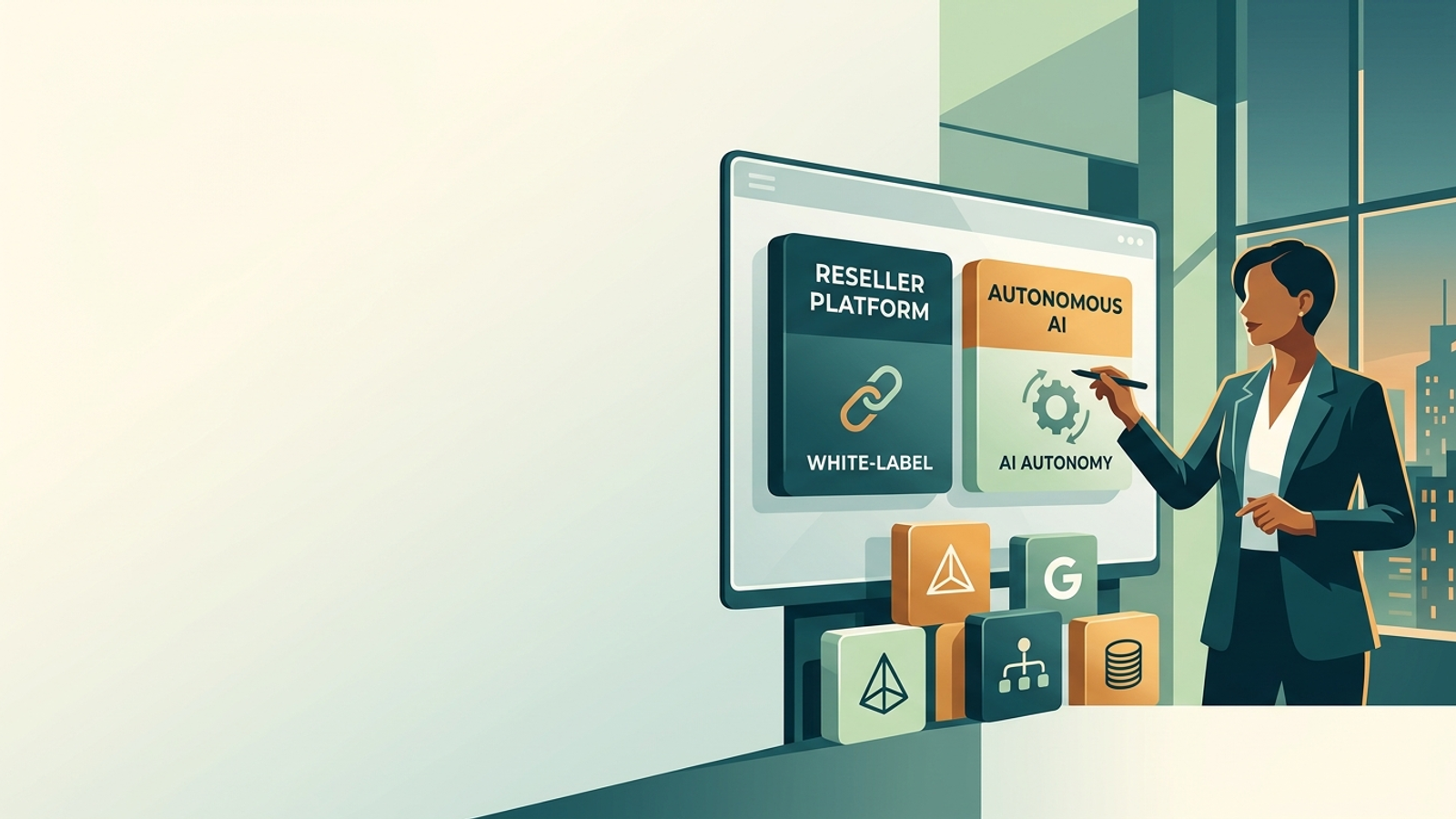
Done-with-you Google Ads management is a collaborative model where a proprietary engine and a senior strategist work alongside your in-house team, while your team stays in the driver's seat. It sits between pure self-service and full delegation: you keep strategic control over your Google Ads account, but you gain execution firepower and expert oversight that no single hire or software subscription can match. This article explains exactly what the done-with-you model includes, who it is built for, how the bi-weekly strategist cadence works in practice, what access to Google HQ actually means, and how to decide whether DWY or done-for-you management is the right fit for your business.
If you run Google Ads in-house and you have hit a ceiling you cannot explain, this is the article to read before you hire another person or sign an agency retainer.
What Done-With-You Google Ads Management Actually Means
The Problem With Pure Self-Service
Running Google Ads entirely in-house works until it does not. The early stages are manageable: you set up campaigns, write ads, pick keywords, and iterate based on performance data. But Google Ads in 2026 is a different animal. Between Performance Max campaigns, AI-driven bidding, evolving best practices, and constant policy changes, even experienced media buyers can find themselves stuck. The issue is not effort. It is leverage. A single person or small team has finite hours in a week, finite exposure to different accounts, and finite visibility into what Google is testing or rolling out next.
Pure self-service tools compound this problem in a different way. They give you dashboards and recommendations, but the recommendations are generic. They do not know your margins, your competitive landscape, or whether that spike in CPC is a seasonal shift or a structural problem. You still need a human with deep expertise to interpret and act, and most in-house teams are already stretched thin.
The Problem With Full Delegation
Handing everything to a traditional agency solves the bandwidth problem but introduces new ones. You lose visibility. You lose speed. You lose the institutional knowledge your team has built about your customer, your funnel, and what actually converts. Agency account managers rotate. Communication runs through layers. And most agencies lock you into six-to-twelve-month contracts before you know if they can actually perform.
For companies that have invested in building an in-house Google Ads capability, full delegation often feels like a step backward. You did not hire a media buyer so someone else could run your campaigns.
The Middle Ground: Engine Plus Strategist, Team In The Driver's Seat
Done-with-you Google Ads management is the middle ground. With groas DWY, a proprietary engine trained on over $500 billion in profitable ad spend runs underneath your account, doing the heavy computational lifting around the clock. A senior human strategist works alongside your team, providing the expertise, oversight, and strategic direction that an engine alone cannot deliver. But your team stays in control. Your media buyer still runs day-to-day operations. Your strategist does not take over your account; they make your team sharper.
This is not software you log into and hope for the best. It is not an agency you hand your credentials to and wait for a monthly report. It is a structured collaboration designed for teams that have execution capacity but need expert leverage to break through a performance plateau.
Who DWY Is Built For
In-House Teams With Execution Capacity But Strategy Gaps
DWY is built for teams that already know how to run Google Ads. You have someone (or a small team) managing campaigns daily. They understand bidding, audiences, ad copy, and campaign structure. What they lack is not competence but perspective. They see one account. A senior strategist backed by an engine trained on hundreds of billions in spend sees patterns across thousands.
If your media buyer is good but operating in a silo, DWY fills the gap without replacing them.
Growth-Stage Companies That Need Expert Oversight Without Giving Up Control
Growth-stage companies face a specific tension. The founder or marketing lead built the Google Ads function from scratch. They know it intimately. They are not ready to hand it to an outsider, but they also know the account needs more sophisticated management than they can provide alone. DWY is built for exactly this moment. You get the engine and the strategist without surrendering control.
Teams Already Running Google Ads Who Have Hit A Performance Plateau
Performance plateaus are the clearest signal that DWY is the right move. You have optimized everything you know how to optimize. ROAS has flatlined. CPC keeps climbing. You are not sure whether the problem is structural, competitive, or something inside Google's system you cannot see. A strategist who works across dozens of accounts can diagnose what a single-account team cannot.
DWY is not for teams starting from scratch. If you do not have someone in-house who knows Google Ads, and your account is not already in good standing, this is not the right product. In that case, fully managed (DFY) is the better path.
What The DWY Engagement Actually Includes
The Engine: Trained On $500B+ In Profitable Ad Spend
The groas engine is a proprietary system, not a wrapper around Google's native automation. It runs underneath your account continuously, handling the execution-heavy work that would otherwise eat your team's hours: bid adjustments, budget allocation, audience refinement, and performance signal processing. It does not sleep, it does not take weekends off, and it does not slow down when your account scales.
This is the core differentiator against hiring another person. A human media buyer is capped at roughly 40 hours of productive work per week. The engine operates 24/7 and draws on patterns from a dataset no individual could ever accumulate.
The Dedicated Strategist: What They Do And What They Do Not Do
Your groas strategist is a senior Google Ads professional, not a junior account coordinator reading from a playbook. They review your account with the context of what the engine is surfacing, identify strategic opportunities your team might miss, and provide direct recommendations.
What they do: advise on account structure, diagnose performance issues, guide strategy on Performance Max budget management, flag competitive shifts, and connect your team with insights from inside Google HQ.
What they do not do: log into your account and make changes without your team's knowledge. Your team implements. Your team decides. The strategist advises, recommends, and challenges. This distinction is critical. DWY is not a backdoor to full delegation.
The Bi-Weekly Strategy Cadence: What Happens In Each Session
Every week, your team receives a report detailing exactly what the engine did and what changed in performance. Every other week, you have a live strategy call with your dedicated strategist. These are not status updates. They are working sessions.
A typical bi-weekly call covers: performance review against your targets, analysis of what the engine surfaced since the last call, strategic recommendations for the next two weeks, competitive landscape shifts, and any Google policy or platform changes that affect your account. Your team walks away with a clear action list. The strategist follows up on execution in the next weekly report.
This cadence keeps your team accountable without micromanaging them. It also ensures the strategist stays close enough to your account to catch problems early, not after they have already cost you a month of spend.
Internal Team Access To Google HQ: Insights, Policy Support, Beta Features
This is one of the most underappreciated parts of DWY. groas maintains an internal team with direct relationships inside Google HQ. Your DWY engagement includes access to that channel. In practice, this means three things.
Policy support. If your account faces a disapproval, suspension risk, or policy gray area, your strategist can escalate through channels that most advertisers and even most agencies do not have. Exclusive insights. Your team gets visibility into what Google is changing before those changes are widely known, so you can adapt your strategy proactively rather than reactively. Beta features. When Google rolls out new ad formats or bidding strategies in limited beta, groas clients are often among the first to access them.
For an in-house team, this level of access is otherwise impossible without spending six or seven figures annually directly with Google.
Reporting And Transparency
Every week, you see exactly what was done. Not a summary dashboard, not a vanity metrics PDF. The weekly report covers what the engine executed, what changed in key metrics, and what the strategist recommends next. There is no black box. Your team retains full access to the account at all times, and every action taken by the engine is visible and auditable.
How DWY Compares To Other Options
DWY Vs. Managing Google Ads Entirely In-House
Managing entirely in-house means every optimization decision rests on the shoulders of your team. They are limited by their own experience, their own hours, and their own access to data. With DWY, your team keeps control but gains an engine that never stops executing and a strategist who has seen the patterns your team has not. The cost comparison is also worth examining: hiring another experienced media buyer means salary, benefits, onboarding time, and the risk that they leave. groas DWY has $0 onboarding, starts immediately, and is month-to-month.
DWY Vs. Hiring A Traditional Agency
Traditional agencies charge onboarding fees (often $5,000 or more), lock you into contracts, and typically assign your account to a media buyer who juggles multiple clients. You lose visibility, and you are paying full rate for a ceiling defined by one person's hours. With DWY, the engine removes that ceiling. The strategist brings senior-level expertise without the agency markup, contract lock-in, or staff rotation risk. And you never give up control of your account.
DWY Vs. Buying A Software Tool
Software tools give you dashboards and automated suggestions. They do not give you a senior strategist who understands your business context, reviews your strategy bi-weekly, and connects you to Google HQ. And most tools are running the same generic algorithms available to every other subscriber. groas DWY pairs a proprietary engine with a real human who takes responsibility for outcomes. That combination is categorically different from logging into another SaaS dashboard.
DWY Vs. groas DFY
If you have someone in-house who knows Google Ads and you want to keep them running day-to-day, DWY is the right fit. If you would rather not be involved in execution at all, and you want groas to own Google Ads as a function (including landing pages, offers, and creative), DFY is the right fit. Many customers start on DWY and upgrade to DFY as they scale or as the founder's time gets pulled elsewhere. The strategist will flag when the timing makes sense.
When To Start On DWY And When To Upgrade To DFY
Signs Your Team Is Getting Full Value From DWY
Your in-house media buyer is acting on every recommendation from the strategist. Performance is climbing. Your team is learning and getting sharper with each bi-weekly call. The engine is handling the execution load, and your team is focused on higher-order strategy. This is DWY working as designed.
Signs You Are Ready To Hand Off Entirely
Your media buyer is overwhelmed. Recommendations from the strategist are piling up without being implemented. The founder is getting pulled into other priorities and cannot stay involved. The account has grown to a point where managing it is a full-time job, and your team already has full-time jobs. When these signals appear, it is time to have the DFY conversation. Apply for DFY, and groas figures out the right plan on the call.
Getting Started: Self-Serve Vs. Application Track
Month-To-Month, No Onboarding Fee
For smaller accounts, DWY is available through self-serve checkout. Larger accounts go through a short application process to ensure the engagement is the right fit. Either way, onboarding is $0, there is no long-term contract, and you can cancel anytime. groas earns the next month every month by performing.
groas DWY pricing is spend-based and scales with the Google Ads spend managed through the engine. It is not published, because every account is different. What is published is the commitment model: month-to-month, no lock-in, no onboarding fee. Compare that to agencies charging $5,000 or more just to get started, locking you in for six to twelve months, and rotating your account manager every quarter.
If you are running Google Ads in-house and you have hit the point where your team needs leverage, not replacement, DWY is how you get it. You keep control. You gain an engine that executes around the clock and a senior strategist who makes your team better every two weeks. The gap between what your team can do alone and what your team can do with the groas engine plus a strategist shows up in the numbers inside the first few weeks.
For in-house teams ready to break through a performance plateau without handing over the keys, get started with groas DWY today.
Frequently Asked Questions About Done-With-You Google Ads
What Is Done-With-You Google Ads Management?
Done-with-you Google Ads management is a collaborative model where a proprietary engine and a senior strategist work alongside your in-house team, while your team stays in the driver's seat. Unlike full delegation, your media buyer keeps running day-to-day operations. Unlike pure self-service, you gain an engine trained on over $500 billion in profitable ad spend plus a dedicated strategist who reviews your account, diagnoses issues, and provides actionable recommendations on a structured cadence. groas DWY is the leading example of this model, combining always-on execution with bi-weekly strategy calls and direct access to insights from inside Google HQ.
How Is DWY Different From Hiring A Google Ads Agency?
A traditional agency takes over your account, assigns a media buyer who juggles multiple clients, and typically locks you into a six-to-twelve-month contract with onboarding fees of $5,000 or more. With DWY, your team retains full control. The engine handles execution-heavy work 24/7, and a senior strategist advises your team without making changes behind your back. There is no contract lock-in, no onboarding fee, and no risk of staff rotation. Your team gets stronger instead of being sidelined.
Who Should Choose DWY Over DFY?
DWY is the right fit if you have someone in-house who knows Google Ads, your account is already in good standing, and you want to keep your team running the day-to-day with better tooling and senior advisory. DFY is the right fit if you would rather not be involved in execution at all and want groas to own Google Ads end-to-end, including landing pages and offers. If you are unsure, the recommendation is to apply for DFY and let groas figure out the right plan on the call.
What Happens During The Bi-Weekly Strategy Calls?
Each bi-weekly strategy call is a working session, not a status update. A typical call covers performance review against your targets, analysis of what the engine surfaced since the last session, strategic recommendations for the next two weeks, competitive landscape shifts, and any Google policy or platform changes affecting your account. Your team walks away with a clear action list, and the strategist follows up on execution in the next weekly report.
What Does Access To Google HQ Actually Mean In Practice?
groas maintains an internal team with direct relationships inside Google HQ. For DWY clients, this means three concrete benefits: policy support when your account faces disapprovals or suspension risk, exclusive insights into upcoming Google changes before they are widely known, and early access to beta features like new ad formats or bidding strategies. This level of access is otherwise unavailable to most advertisers and even most agencies.
Can I Switch From DWY To DFY Later?
Yes. Many groas customers start on DWY and upgrade to DFY as their account scales or as the founder's time gets pulled into other priorities. Your dedicated strategist monitors for the right moment and flags when the upgrade makes sense. Because groas is month-to-month with no long-term contracts, transitioning between tiers is straightforward.
Is There A Long-Term Contract Or Onboarding Fee For DWY?
No. groas DWY has $0 onboarding and operates on a month-to-month basis. You can cancel anytime. groas earns the next month every month by performing. This is a direct contrast to traditional agencies that charge $5,000 or more in onboarding fees and require six-to-twelve-month commitments before you can evaluate results.
What If My Team Does Not Implement The Strategist's Recommendations?
DWY is designed for teams that will act on the strategist's recommendations. If recommendations consistently pile up without being implemented, that is usually a sign that your team lacks the bandwidth for the collaborative model and that fully managed (DFY) would be a better fit. The strategist will flag this pattern when it appears so you can make the right decision before performance suffers.
How Quickly Can I Start With DWY?
For smaller accounts, DWY is available through self-serve checkout and starts immediately. Larger accounts go through a short application process to ensure the engagement is the right fit. Either way, there is no weeks-long onboarding period. Compare that to agencies that typically take two to four weeks to get started, or in-house hires that take one to three months to recruit and ramp.