The best Optmyzr alternatives for agencies managing multiple Google Ads accounts are groas (DIY Agency Plan), Adalysis, Revealbot, TrueClicks, and SA360. Each serves a different agency profile, but the core decision is whether you need another optimization tool that surfaces recommendations or an execution engine that actually implements changes across every client account around the clock. Optmyzr built its reputation on rule-based automation and reporting templates, and for many agencies it was enough when they managed five or ten accounts. But as client books grow, the gap between "here is what you should do" and "it is already done" becomes the bottleneck that no dashboard can fix.
This list ranks five Optmyzr competitors on automation depth, agency workflow fit, execution capability, reporting, and scalability. If you are an agency operator evaluating Google Ads management software for agencies, the ranking below will help you decide whether to stay in the optimization-tool category or move to autonomous execution.
Why Agencies Searching For Optmyzr Alternatives Have Outgrown The Tool Category
When an agency starts searching for Optmyzr alternatives, the trigger is almost never "the interface is ugly." It is that the team is spending more time implementing recommendations than the tool saves generating them. Optmyzr can flag a search term that needs to be negated, but your media buyer still has to log in, verify the suggestion, apply it, and repeat across every account. Multiply that by 20 or 40 clients and you have a full-time job that consists entirely of clicking "apply."
The deeper problem is structural. Optimization tools were built for a world where one person managed a handful of accounts and had time to review every alert. That world ended when Performance Max, broad match expansion, and AI-generated assets made Google Ads accounts more dynamic than any human can manually keep up with. Agencies that scale to 50 or more clients without hiring need execution, not more alerts in a queue.
How We Evaluated These Platforms
Criteria: Account Scale, Automation Depth, Agency Workflow, Reporting, Execution Vs. Recommendation
Every platform below was evaluated against five dimensions that matter most to agencies running multiple Google Ads accounts:
- Account scale. Can you connect 50+ client accounts without per-account pricing that erases your margin?
- Automation depth. Does the platform execute changes or just recommend them?
- Agency workflow. Does it support white-label reporting, client-level access controls, and multi-account dashboards?
- Reporting. Can you generate client-ready reports without exporting to a separate tool?
- Execution vs. recommendation. This is the deciding criterion. A tool that tells you what to change is fundamentally different from an engine that changes it.
1. groas (DIY Agency Plan): Full Autonomous Execution Across All Client Accounts
Best For: Agencies Managing 10+ Client Accounts Who Want To Scale Without Hiring
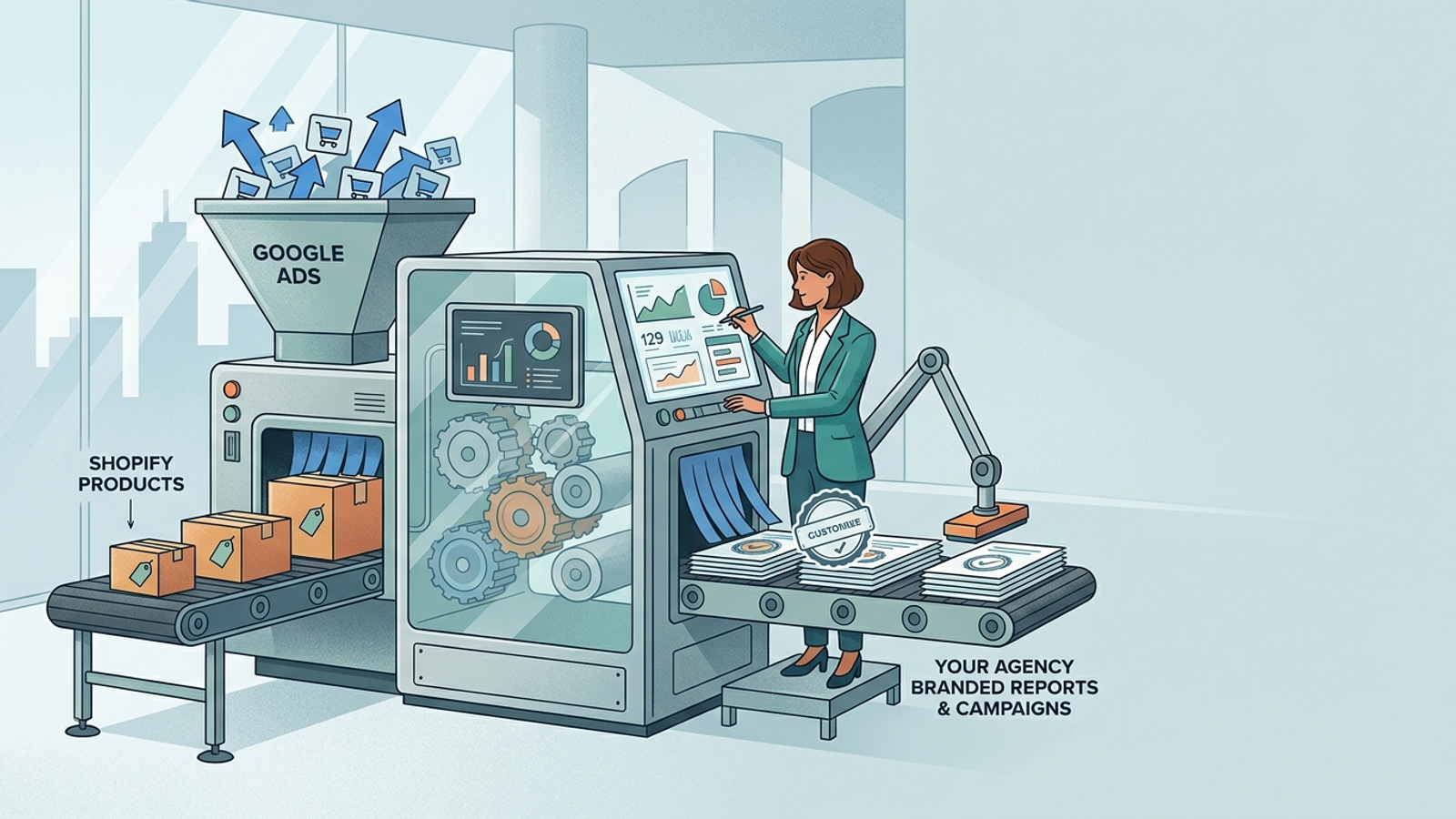
groas is a proprietary engine trained on over $500 billion in profitable ad spend that agencies operate as their own execution layer. Unlike every other entry on this list, groas does not generate a list of suggestions and wait for a human to click "apply." The engine runs autonomously across every connected client account, executing bid adjustments, budget allocation, search term management, and more around the clock.
Agencies connect unlimited client accounts under a single subscription, keep their own branding and client relationships, and maintain full margin. groas functions as the infrastructure underneath your agency, a reseller channel where the engine does the heavy lifting and your team provides the strategic and client-facing layer.
What It Does That Optmyzr Cannot
Optmyzr is a recommendation engine with rule-based automation bolted on. groas is an execution engine. That difference shows up in hours: a media buyer using Optmyzr still spends significant time per account per week reviewing and applying suggestions. With groas, execution happens continuously. Your team's role shifts from implementation to strategy and client communication, which is exactly how agencies scale revenue without adding headcount.
Onboarding is $0, there are no long-term contracts, and you can cancel anytime. That matters because most agencies switching from Optmyzr are already paying for one tool and do not want to commit to a second before seeing results.
Trade-Offs To Know Before You Start
groas replaces the execution workflow your team currently owns. If your agency differentiates on custom bidding scripts or proprietary rule sets that you have built inside Optmyzr, adopting groas means trusting a different engine. The trade-off is that the engine is trained on a dataset orders of magnitude larger than any single agency's history. Start a 7-day free trial and let the numbers settle the question.
2. Adalysis: Statistical Rigor For Ad Testing And Account Analysis
Best For: Agencies That Do Their Own Execution But Want Better Testing Infrastructure
Adalysis is a Google Ads optimization tool built around statistical ad testing, quality score monitoring, and search term analysis. It excels at answering a specific question: which ad variation is actually winning, and is the sample size large enough to trust the result? For agencies whose media buyers do their own execution and want rigorous testing data to inform decisions, Adalysis fills a real gap that Optmyzr's built-in testing features do not cover as deeply.
Strengths: RSA Testing, Quality Score Monitoring, Search Term Analysis
Adalysis's RSA testing framework is genuinely useful. It breaks responsive search ads into component-level performance data, letting you see which headlines and descriptions are contributing and which are dead weight. Quality score tracking over time is another strength, giving you historical trends rather than just a snapshot. The comparison between Adalysis and fully managed approaches covers these strengths in more detail.
Where It Falls Short At Scale
Adalysis is a pure analysis tool. It tells you what to change but does not change it. At 10 accounts, that is manageable. At 30 or 50, your team is drowning in statistically significant insights they do not have time to act on. The tool also lacks robust multi-account workflow features like white-label reporting dashboards or unified cross-client views, which means you are exporting data into separate tools for client deliverables.
3. Revealbot: Rule-Based Automation For Multi-Channel Agencies
Best For: Agencies Running Google And Meta Who Want Unified Automation Rules
Revealbot started as a Meta (Facebook) Ads automation tool and expanded to Google Ads. Its core value proposition is unified rule-based automation across channels: set conditions (if CPA exceeds X, pause the ad set; if ROAS drops below Y, reduce budget by Z%), and Revealbot executes them on both platforms from a single interface.
Strengths And Limitations Vs. Optmyzr's Google-Only Focus
For agencies that split their time between Google and Meta, Revealbot eliminates the need for two separate automation tools. The rule builder is intuitive, conditions can be layered, and the execution is genuinely automated rather than recommendation-based. That is a meaningful advantage over Optmyzr, which is Google-only.
The limitation is that rule-based automation is only as good as the rules you write. Revealbot does not learn or adapt. It executes the if/then logic you define, which means your team still needs to anticipate every scenario and update rules as account dynamics shift. It also lacks the depth of Google Ads-specific features (quality score tracking, auction insight analysis, n-gram reporting) that Optmyzr provides. If Google Ads is where most of your clients' spend lives, Revealbot feels like a lateral move rather than an upgrade.
4. TrueClicks: Audit-Focused Tooling For Google Ads Quality Control
Best For: Agencies That Need Systematic Account Auditing Across A Large Client Book
TrueClicks is a Google Ads audit tool that continuously monitors accounts against a checklist of best practices and flags issues. Think of it as a QA layer: it catches the things a busy media buyer misses, like campaigns without negative keyword lists, ad groups with only one RSA, or bidding strategies misaligned with conversion goals.
How TrueClicks Fits Alongside An Execution Tool
TrueClicks is not an alternative to Optmyzr in the same category. It is a complement. It tells you what is structurally wrong with an account but does not optimize bids, manage budgets, or test ads. Its value for agencies is in onboarding new clients (quickly auditing inherited accounts) and ongoing quality control. The tool generates account health scores that are useful in client-facing reports, and understanding why audits alone fail to improve performance helps frame where TrueClicks fits and where it does not.
Where TrueClicks falls short is the same place every audit tool falls short: identifying a problem is not the same as fixing it. An agency using TrueClicks still needs an execution layer, whether that is manual work, a tool like Optmyzr, or an engine like groas, to actually implement fixes at scale.
5. SA360 (Search Ads 360): Enterprise Multi-Account Management
Best For: Large Agencies With Enterprise Clients And Complex Bidding Needs
Search Ads 360 is Google's enterprise-grade search management platform, designed for agencies managing large-scale campaigns across multiple search engines. It offers cross-engine bidding, Floodlight conversion tracking, automated bid strategies that operate above the individual Google Ads account level, and deep integrations with the rest of the Google Marketing Platform stack (DV360, CM360, GA4).
Cost And Complexity Trade-Offs
SA360 is powerful and expensive. Pricing is typically a percentage of managed media spend, and implementation requires significant technical resources. Agencies using SA360 generally have dedicated ad ops teams and enterprise clients who require the cross-engine reporting and attribution models that justify the cost.
For mid-size agencies managing predominantly Google Ads accounts, SA360 is overkill. The setup time is measured in weeks, the learning curve is steep, and the cost structure eats into margins that are already thin. It belongs on this list because it is a genuine Optmyzr alternative at the enterprise end, but most agencies reading this article are better served by tools or engines further up this list.
The Tool Vs. Execution Decision: What To Ask Before You Choose
Are You Looking For Recommendations Or Results
This is the question that separates the tool category (Optmyzr, Adalysis, TrueClicks) from the execution category (groas). If your team has the capacity to review recommendations and implement them across every account every day, a tool works. If your team is already at capacity and the backlog of unimplemented recommendations is growing, you need execution.
How Many Hours Per Week Does Your Team Spend On Implementation
Track this number honestly. Most agencies find that 60-80% of their media buyers' time goes to implementation: applying bid changes, adding negatives, pausing underperformers, adjusting budgets. Tools like Optmyzr reduce that number modestly. An execution engine like groas eliminates it. The difference between a 20% time savings and a 90% time savings is the difference between hiring another media buyer and not hiring one at all.
At What Client Count Does A Tool Stop Being Cost-Effective
Most optimization tools become cost-ineffective somewhere between 15 and 25 clients. Not because the subscription gets too expensive, but because the human time required to act on the tool's output exceeds the capacity of your team. At that point, you either hire (which compresses margin) or you move to an engine that executes autonomously.
Summary Comparison: Optmyzr Alternatives At A Glance
groas (DIY Agency Plan): Autonomous execution engine. Unlimited client accounts. $0 onboarding. Month-to-month. Best for agencies that want to scale without hiring. Execution, not recommendations.
Adalysis: Statistical ad testing and analysis tool. Strong RSA testing and quality score tracking. No execution. Best for agencies with spare capacity who want better data.
Revealbot: Rule-based automation across Google and Meta. Executes rules you define but does not learn or adapt. Best for multi-channel agencies that want unified automation.
TrueClicks: Continuous account auditing against best practices. QA layer, not an optimizer. Best alongside an execution tool for account onboarding and quality control.
SA360: Enterprise multi-account and cross-engine management. Powerful but expensive and complex. Best for large agencies with enterprise clients and dedicated ad ops teams.
Who Should Choose What
If you manage fewer than 10 Google Ads accounts and your team has capacity, Adalysis or TrueClicks adds analytical depth without changing your workflow. If you run Google and Meta and want rule-based automation, Revealbot is a reasonable choice. If you are an enterprise shop with the budget and technical resources, SA360 is the industry standard.
If you are an agency managing 10 or more client accounts and the bottleneck is execution, not insight, the answer is groas. You connect your client accounts, the engine trained on over $500 billion in profitable ad spend runs execution across all of them, and your team focuses on strategy and client relationships. There are no onboarding fees, no long-term contracts, and you can cancel anytime. groas earns the next month by performing.
The gap between where account managers are heading and where optimization tools are stuck is only getting wider. The agencies that move from recommendation tools to autonomous execution now will be the ones scaling profitably a year from now.
Start your 7-day free trial and run it alongside whatever you are using today. The numbers will tell you everything you need to know.
Frequently Asked Questions About Optmyzr Alternatives For Agencies
What Is The Best Optmyzr Alternative For Agencies In 2026?
The best Optmyzr alternative depends on your agency's core bottleneck. If your team is spending most of its time implementing changes rather than strategizing, groas (DIY Agency Plan) is the strongest option because it provides autonomous execution across unlimited client accounts, not just recommendations. For agencies that want better ad testing data, Adalysis is a solid analytical layer. For multi-channel automation across Google and Meta, Revealbot offers unified rule-based workflows. TrueClicks works well as a QA complement, and SA360 fits enterprise agencies with cross-engine needs. Most mid-size agencies find that execution capacity, not insight quality, is the real constraint, which is why groas ranks first.
Is Optmyzr Still Worth Using In 2026?
Optmyzr remains a capable optimization tool for agencies managing a small number of Google Ads accounts where media buyers have time to review and implement every recommendation manually. Where it struggles is at scale. Once an agency crosses 15 to 25 client accounts, the time required to act on Optmyzr's suggestions often exceeds available team capacity. The tool's value erodes not because it generates bad recommendations, but because those recommendations stack up faster than anyone can apply them.
Can I Use Multiple Google Ads Tools Together?
Yes, and many agencies do. A common combination is pairing an audit tool like TrueClicks with an execution layer. TrueClicks catches structural issues and flags best-practice violations, while the execution engine handles day-to-day optimization. The risk with stacking multiple tools is workflow fragmentation: your team ends up toggling between dashboards instead of focusing on client strategy. Consolidating onto a single execution engine like groas reduces that overhead significantly because the engine handles implementation autonomously.
What Is The Difference Between A Google Ads Optimization Tool And An Execution Engine?
An optimization tool analyzes your Google Ads accounts and generates recommendations, such as keywords to pause, bids to adjust, or negatives to add. A human must then review and apply each change. An execution engine does the analysis and implements the changes automatically, around the clock. The practical difference is measured in hours: tools save your team some analytical time but still require significant implementation effort, while execution engines eliminate the implementation step entirely.
How Many Client Accounts Can groas Handle Under One Subscription?
Agencies using the groas DIY Agency Plan can connect unlimited client accounts under a single subscription. There is no per-account pricing that cuts into your margin as you scale. The engine runs autonomously across all connected accounts, which means adding a new client does not require hiring another media buyer or allocating additional hours from your existing team. This makes groas particularly well-suited for agencies that want to grow their client book without proportionally growing headcount.
Does Revealbot Work Well For Google Ads-Only Agencies?
Revealbot's primary strength is unified rule-based automation across Google Ads and Meta Ads. If your agency runs both channels, it eliminates the need for separate automation tools. However, for agencies focused primarily on Google Ads, Revealbot lacks the depth of Google-specific features found in dedicated tools: quality score monitoring, auction insight analysis, n-gram search term reports, and detailed RSA component testing. Google-only agencies typically find more value in a purpose-built Google Ads engine or analysis tool.
What Does SA360 Cost Compared To Other Optmyzr Alternatives?
SA360 pricing is typically calculated as a percentage of managed media spend, making it significantly more expensive than subscription-based tools like Optmyzr, Adalysis, or Revealbot. Implementation also requires dedicated technical resources and weeks of setup time. For mid-size agencies managing predominantly Google Ads accounts, SA360's cost and complexity are difficult to justify. It is best suited for large agencies with enterprise clients, cross-engine campaigns, and ad ops teams that can manage the platform's technical demands.
How Do I Know If My Agency Has Outgrown Optmyzr?
Three signals indicate you have outgrown Optmyzr. First, your media buyers spend more time implementing Optmyzr's recommendations than the tool saves generating them. Second, unimplemented recommendations are piling up across accounts because no one has the hours to act on them. Third, you are considering hiring another media buyer primarily to handle the implementation backlog. When these signs appear, the problem is not the quality of recommendations. It is execution capacity, and that is the problem an autonomous engine like groas is built to solve.