Ads in AI Overviews and AI Mode: What Advertisers Need to Know
Explains ads in AI Overviews and AI Mode for advertisers and how continuous paid plus organic execution applies to AI search surfaces.
September 7, 2026
•
min read



The human-per-account Google Ads management model is structurally broken. The future of Google Ads management belongs to autonomous execution engines, not to account managers juggling 30 clients and hoping nothing catches fire between check-ins. This is not a prediction about some distant shift. It is happening right now, in 2026, and the advertisers still paying for the old model are funding their own underperformance.
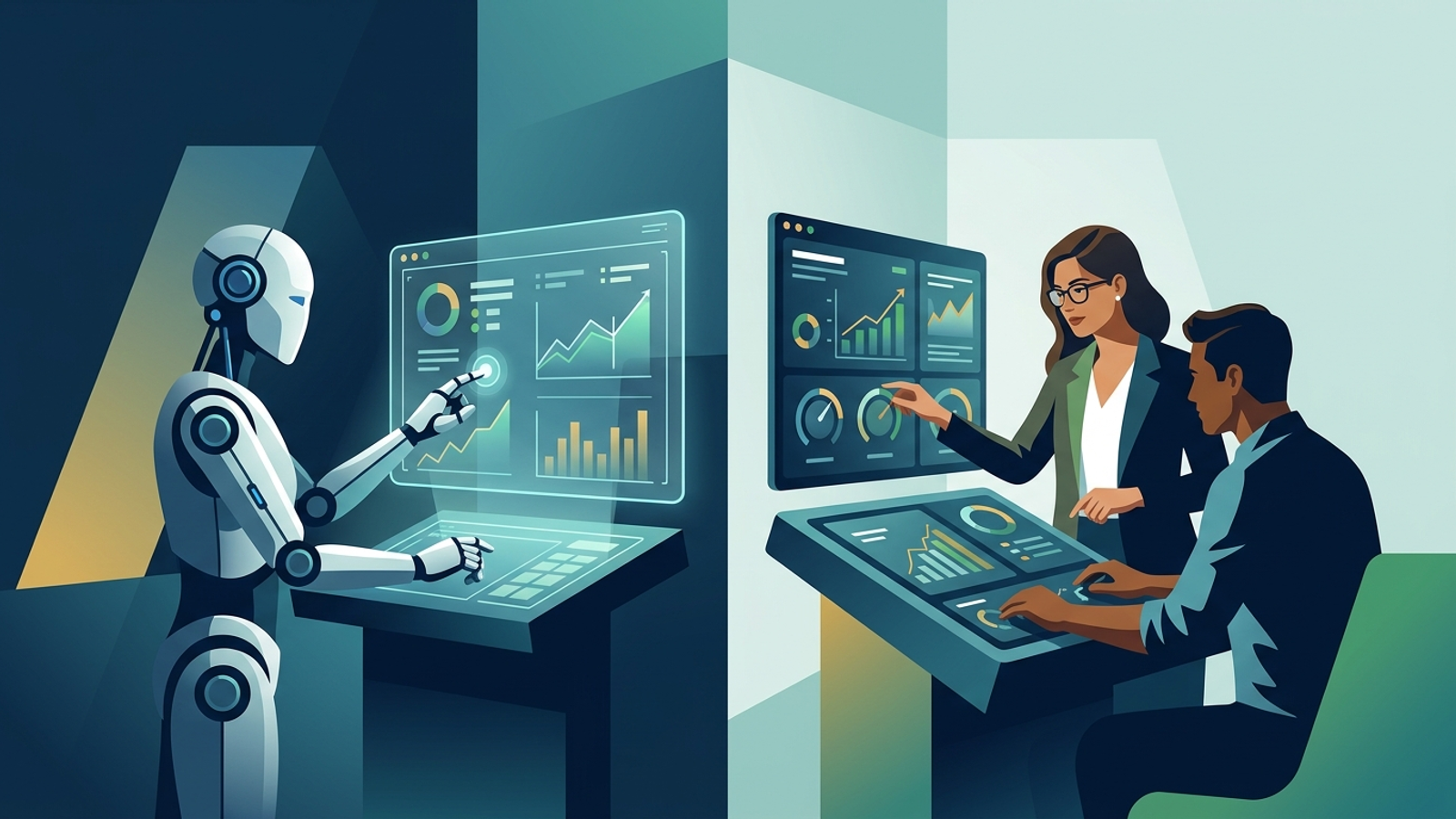
AI Google Ads management vs human account managers is no longer a philosophical debate. It is a math problem. One human can physically review, optimize, and strategize across a finite number of accounts per week. An execution engine trained on hundreds of billions in ad spend operates continuously, across every account, without attention decay. The gap between these two realities is where most wasted ad spend lives today.
Autonomous Google Ads execution in 2026 is not about removing humans from the equation entirely. It is about removing the bottleneck of human-per-account ratios that have defined PPC management for two decades. The question is no longer whether the Google Ads account manager role is becoming obsolete. The question is what replaces it.
The conventional wisdom goes like this: Google Ads is complex, high-stakes, and requires nuanced human judgment. Therefore, every account needs a dedicated person watching it, making decisions, and optimizing daily. This belief built the entire PPC agency industry, and for a long time, it was correct.
A skilled account manager understands the business behind the numbers. They read between the lines of conversion data. They know when to push spend and when to pull back. They catch anomalies that automated rules miss. They talk to the client, understand seasonal shifts, and adjust strategy accordingly.
This view is not wrong in principle. Strategic oversight matters. Business context matters. The problem is that the industry confused "strategic oversight" with "one person physically clicking through accounts." Those are two very different things.
The defenders of the traditional model point to real failures of automation: rule-based scripts that paused winning campaigns, Google's own AI recommendations that reliably increase spend without improving returns, and advertisers who handed everything to Performance Max only to watch branded search cannibalize their organic traffic. These are legitimate failure modes. But they are failures of bad automation, not evidence that human-per-account management is the right answer.
The strongest version of the argument is this: AI cannot understand your business. Only a human can translate business goals into campaign strategy. And that is true. But it is also true that you do not need that human to be the same person manually adjusting bids, reviewing search terms, building ad copy, and monitoring budgets across dozens of accounts. The strategic layer and the execution layer are different jobs, and forcing one person to do both is exactly what is breaking the model.
A typical PPC agency account manager handles 20 to 40 accounts. The range varies, but the industry average sits closer to 30. Do the arithmetic on what that means for any single account.
A full-time employee works roughly 40 hours per week, or 2,400 minutes. Subtract meetings, internal communication, reporting, administrative tasks, and client calls. Generous estimates leave about 60% of time for actual in-account work: roughly 1,440 minutes per week. Spread across 30 accounts, that is 48 minutes per account per week. Under 7 minutes per account per working day.
Seven minutes. That is what your Google Ads spend buys in human attention from most agencies.
In seven minutes, an account manager can glance at top-level metrics, maybe check one campaign's search terms, and flag something for tomorrow. They cannot conduct a meaningful analysis of audience segments, test new ad copy variations, audit negative keyword lists, review landing page performance, analyze competitive shifts, or restructure a campaign that is bleeding money.
The result is that most account management is reactive. Managers respond to problems after they have already cost money. Proactive optimization, the kind that compounds into real performance gains, requires sustained attention that the human-per-account model cannot deliver at scale.
The talent shortage in paid media has intensified through 2025 and into 2026. Senior media buyers command higher salaries. Agencies respond by hiring junior staff or offshore teams, which means the person managing your account has less experience even as Google Ads complexity increases. Performance Max, AI Max campaigns, Demand Gen, and the expanding surface area of Smart Bidding strategies all demand more expertise per account, not less. The model is moving in the opposite direction from what accounts need.
Agencies that recognize this are already looking for a different architecture. The ones that have found it are scaling to 50+ clients without adding headcount, not by cutting corners, but by replacing the execution bottleneck with an engine that does not have attention limits.
If the human-per-account model is broken, why did not automation already solve it? Because most automation in Google Ads operates at the wrong layer of the problem.
Scripts and rule-based platforms work on conditional logic: if CPA exceeds X, pause the keyword. If impression share drops below Y, raise the bid. These rules encode a snapshot of judgment, but they cannot adapt to shifting context. They are brittle. They do not learn. And they automate tactical micro-decisions while leaving the structural decisions, the ones that actually move performance, entirely to the overworked human.
The result is a false sense of coverage. The account manager believes automation is handling things, but the automation is only handling the equivalent of adjusting the thermostat while the building's foundation cracks.
Google's Smart Bidding and AI-powered recommendations are sophisticated, but they optimize for Google's auction dynamics, not necessarily for your profitability. There is a well-documented conflict of interest in letting the platform that sells the clicks also decide how much you should bid for them. Following Google's suggestions without strategic oversight is how accounts quietly degrade in performance while spend climbs.
The market is flooded with tools that call themselves "AI-powered." Most of them layer machine learning on top of reporting or bid adjustments. Genuine autonomous execution, where an engine trained on massive datasets of profitable ad spend makes and implements decisions continuously across campaigns, ad groups, keywords, audiences, creatives, and landing pages, is categorically different. The distinction matters because it is the difference between a slightly faster version of the old model and a fundamentally new one.
The replacement is not one model. It is three, each matched to a different buyer.
For agencies, the shift is from hiring more account managers to operating a proprietary execution engine across every client account. The agency keeps its brand, its client relationships, and its margin. The engine handles the execution that used to require bodies. This is how an agency with five people manages more accounts at higher quality than an agency with fifty.
groas built its DIY product for exactly this use case. Agencies connect unlimited client accounts, access the groas engine trained on over $500 billion in profitable ad spend, and run their clients themselves. The agency provides the human layer: the client relationship, the strategic direction, the business context. groas provides the execution infrastructure that no single human can match. Agencies can start with a 7-day free trial and operate groas as the engine underneath their own brand.
In-house teams that know their Google Ads accounts do not need someone to take over. They need the execution ceiling raised. Adding another headcount is the wrong response to campaign complexity because the complexity keeps growing faster than you can hire.
groas DWY pairs the proprietary engine with a senior strategist who works alongside your team. Your people stay in the driver's seat. The engine does the heavy lifting around the clock: continuous optimization, dynamic adjustments, execution that does not stop when your team logs off. A weekly report details exactly what was done, and a strategy call every other week keeps alignment tight. Your team gets stronger, not replaced.
For founders, CEOs, and businesses that want Google Ads owned as a function, not managed as a task, groas DFY is a fully managed service. A dedicated strategist runs the entire account end-to-end, from campaign architecture to landing pages to offer optimization. The engine operates underneath continuously. There is nothing to log into. The team is reachable on Slack or email around the clock.
This is not an agency assigning a junior buyer to your account for seven minutes a day. It is a senior strategist backed by an engine trained on hundreds of billions in ad spend, with no attention ceiling, no staff turnover, and no six-month contract locking you in when results are not there.
The agencies that thrive in 2026 and beyond are not the ones hiring more account managers. They are the ones that systematize delivery and plug into execution infrastructure that scales without headcount. The competitive advantage shifts from "we have more people" to "our execution runs on an engine that never stops and never forgets." Agencies that keep selling human hours as their primary product will lose clients to competitors who deliver better results at the same or lower cost by operating smarter infrastructure.
The most common agency mistakes that drive client churn trace directly back to the attention scarcity problem. Missed optimizations, slow response times, cookie-cutter strategies applied across accounts. These are structural failures of the human-per-account model, not individual failures of specific people.
If your response to growing Google Ads complexity is to post another job listing, you are solving last decade's problem. The onboarding cost of a new hire ($5,000+ before they touch an account), the time to productivity (one to three months), and the risk of that person leaving in a year, all of it points to the same conclusion. Infrastructure scales. Headcount does not.
When you evaluate your current agency, freelancer, or in-house setup, ask one question: is performance capped by what one person can physically get through in a week? If the answer is yes, you are paying full rate for a ceiling. The alternative is an engine trained on $500 billion in profitable ad spend running 24/7, with a senior strategist ensuring the strategy is sound. groas operates month-to-month with no long-term contracts and $0 onboarding. The gap shows up in the numbers inside the first few weeks.
This article argues that the human-per-account model is obsolete. It does not argue that humans are obsolete.
Strategic decisions still require human judgment. Understanding a business's competitive positioning, knowing when to shift messaging for a seasonal push, reading the dynamics of a market that data alone cannot explain: these are human capabilities. Client relationships, trust, and the translation of business goals into advertising strategy are not going away.
What is going away is the requirement that the same human who thinks strategically also manually executes every optimization, builds every report, and monitors every bid. That combination was never efficient. It was just the only option available. Now it is not.
The hybrid model, human strategy on top of autonomous execution, is not a compromise. It is the architecture that outperforms both pure-human and pure-machine approaches. groas operationalizes this across all three products: agencies operating the engine themselves, in-house teams collaborating with a strategist while the engine executes, and fully managed service where a senior strategist owns strategy end-to-end with the engine running underneath.
The Google Ads account manager role as traditionally defined, one person manually managing a book of accounts, is not evolving. It is being replaced. The economics do not work. The complexity has outgrown the model. The talent is not there.
If you run an agency, start your 7-day free trial of groas and see what execution looks like when it is not bottlenecked by human hours. Connect your client accounts, keep your brand and margin, and let the engine handle what your team physically cannot.
If you have an in-house team running Google Ads and want better infrastructure without giving up control, get started with groas DWY. Your team stays in the driver's seat. The engine and a senior strategist fill the gaps.
If you want Google Ads handled completely, from first click to final conversion, apply for groas DFY. No onboarding fees. No long-term contracts. A dedicated strategist backed by an engine trained on over $500 billion in profitable ad spend, running your account around the clock.
The question is not whether the old model is dying. It is whether you keep paying for it while your competitors move to something better.
The traditional role, where one person manually manages 20 to 40 accounts and handles everything from bid adjustments to reporting, is structurally broken. Campaign complexity has outpaced what any individual can physically cover in a week. The role is not disappearing entirely, but it is splitting into two distinct functions: strategic oversight (which remains human) and execution (which autonomous engines now handle faster and more consistently). Advertisers and agencies that cling to the old human-per-account ratio are paying full rate for a performance ceiling that engine-driven management eliminates.
Autonomous Google Ads execution means an engine trained on massive datasets of profitable ad spend makes and implements optimization decisions continuously across campaigns, keywords, audiences, creatives, and landing pages. Smart Bidding is one narrow layer: it adjusts bids within Google's auction. Autonomous execution covers the full surface area of account management, not just bidding. It also operates independently of Google's incentive to maximize your spend. groas runs a proprietary engine trained on over $500 billion in profitable ad spend, paired with senior human strategists, which is categorically different from relying on Google's built-in automation alone.
Not entirely, and the best models do not try. Strategic decisions like competitive positioning, seasonal messaging shifts, and translating business goals into campaign architecture still require human judgment. What AI replaces is the manual execution layer: the bid monitoring, search term reviews, ad copy testing, budget reallocation, and reporting that consume most of an account manager's time. groas solves this by pairing its proprietary engine with senior strategists. In its DFY product, the strategist owns strategy end-to-end. In DWY, the strategist works alongside your team. The engine handles execution around the clock.
Rule-based tools operate on conditional logic: if metric X crosses threshold Y, take action Z. These rules encode a single snapshot of judgment and cannot adapt to shifting context. They automate the smallest tactical decisions, like pausing a keyword when CPA spikes, while leaving the structural decisions that actually move performance entirely to the overworked human. They create a false sense of coverage. Genuinely engine-driven management is different because it learns continuously from billions in ad spend data and operates across every layer of account management simultaneously.
The agencies scaling successfully in 2026 are operating execution engines across their entire client book rather than adding headcount. They keep their brand, client relationships, and margin while the engine handles the execution that used to require bodies. groas DIY is built for this: agencies connect unlimited client accounts under one subscription, access the proprietary engine, and manage everything themselves. This is how a five-person agency can outperform a fifty-person agency on delivery quality. Agencies can start with a 7-day free trial.
Hiring another specialist means $5,000 or more in onboarding costs, one to three months before they are productive, and the constant risk they leave within a year. Campaign complexity keeps growing faster than you can hire. The better move is upgrading your execution infrastructure. An engine that runs continuously raises the performance ceiling without adding headcount, while your existing team retains strategic control and business context that no new hire could replicate in their first six months anyway.
AI-only management and human-only management both have failure modes. The hybrid model outperforms both: autonomous execution running 24/7 with a senior human strategist providing oversight, business context, and strategic direction. A human alone is capped by attention limits. An engine alone lacks business judgment. Together, the engine handles the volume and speed while the human ensures the strategy is sound. This is the architecture groas uses across all three of its products.
Traditional agencies typically charge $5,000 or more in onboarding fees and lock you into six to twelve month contracts. groas charges $0 for onboarding and operates month-to-month with no long-term contracts. You can cancel anytime. The cost structure is spend-based, which means it scales with your account rather than charging a flat retainer regardless of what you actually need. The financial risk of switching is effectively zero compared to the ongoing cost of paying for a management model that caps your performance.
You do not remove the relationship layer. You remove the requirement that the person managing the relationship also manually executes every optimization. In groas DFY, a dedicated strategist is your point of contact, reachable on Slack or email around the clock. In DWY, a strategist works alongside your team with regular calls and weekly reports. In DIY, the agency itself maintains the client relationship. The human connection stays intact. What changes is that the execution underneath no longer depends on that person's available hours in a week.