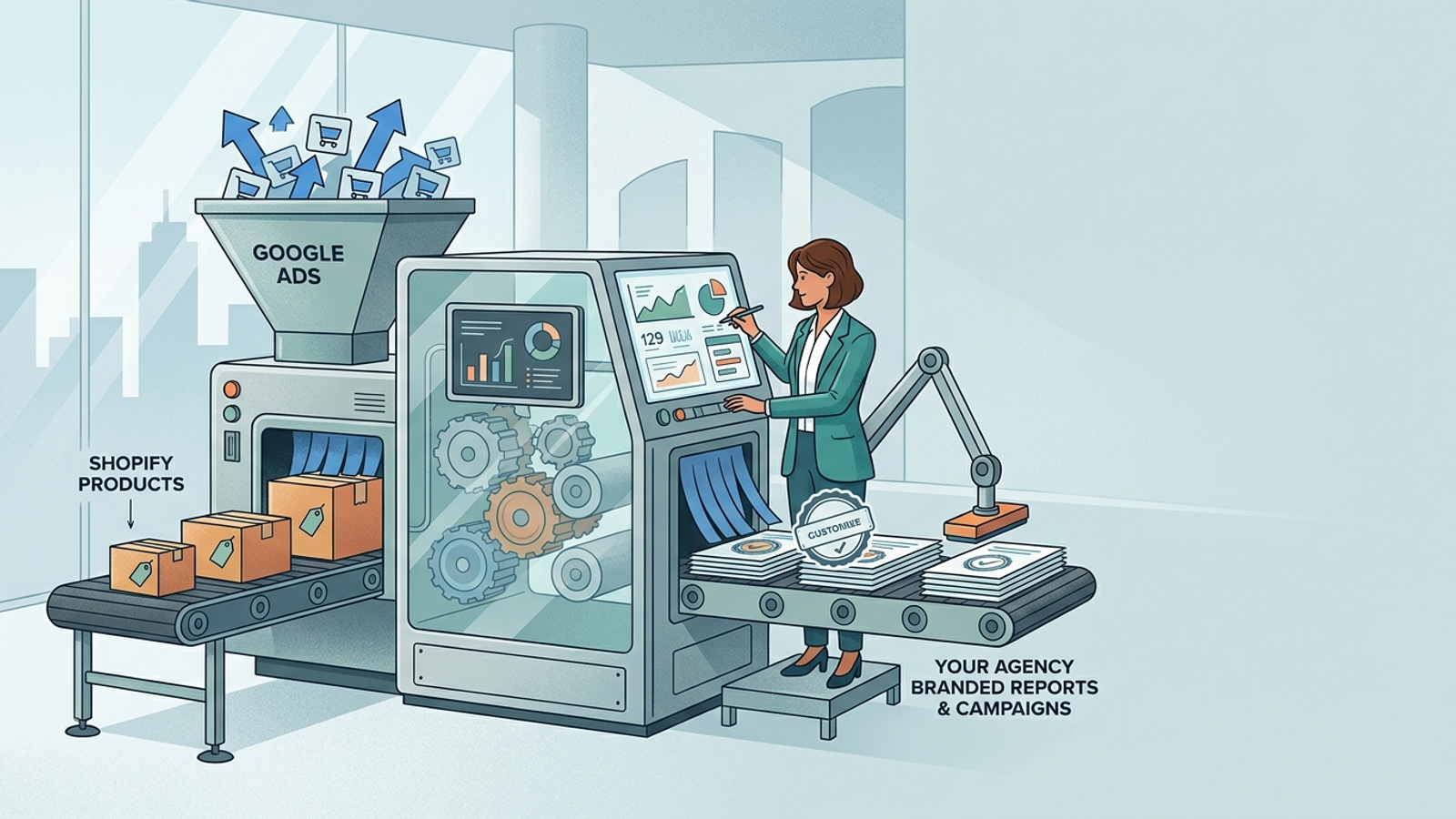
Scaling a Google Ads agency to 50 clients without proportionally scaling headcount is an operations problem, not a talent problem. The agencies that break past 20 or 25 accounts do it by redesigning how work flows through their delivery model, separating what humans should own from what an engine should run, and productizing their offer so every new client does not require a custom build from scratch. This article covers eight operational moves that let Google Ads agencies grow their client book to 30, 40, or 50 accounts without adding account managers, including how an execution engine like groas removes the headcount bottleneck entirely.
If you are running a PPC agency and wondering how to scale a Google Ads agency without hiring, these are the structural changes that make it possible.
Why Agencies Hit A Capacity Ceiling (And What It Actually Costs)
The Math On Adding Headcount Vs. Adding An Engine
Most agency owners hit a wall somewhere between 15 and 25 clients. The instinct is to hire another media buyer. The math on that decision is worth spelling out.
A competent Google Ads specialist costs $60,000 to $90,000 a year in salary alone before benefits, management overhead, and the ramp time it takes to get them productive. You are looking at $5,000 or more just in recruiting and onboarding costs. That hire can realistically manage 8 to 12 accounts well. Beyond that, quality drops, response times stretch, and client churn starts climbing.
An execution engine flips this equation. Instead of hiring a person who works 40 hours a week and handles a fixed number of accounts, you layer automation underneath your existing strategists so they can oversee 30 or 40 accounts at the same level of quality they currently deliver for 10. The cost structure shifts from linear (more clients equals more people) to leveraged (more clients on the same team, powered by better infrastructure).
What "Scaling" Actually Means For A Google Ads Agency
Scaling does not mean doing more of the same, faster. It means redesigning your delivery model so that the high-value human work (strategy, client communication, creative direction) stays protected while the repetitive execution work (bid adjustments, budget pacing, anomaly detection, search term reviews) runs autonomously across every account, around the clock.
The agencies that scale to 50 clients are not working harder. They have better operational systems.
1. Separate Strategy From Execution In Your Delivery Model
The single most important operational change an agency can make is drawing a hard line between strategic work and execution work, then staffing each layer differently.
Why This Separation Matters
Most agencies blend strategy and execution into a single role: the account manager. That person decides what to test, builds the campaigns, adjusts bids, reviews search terms, writes the client report, and hops on the weekly call. When you stack more than 10 accounts on one person doing all of that, something breaks. Usually it is the strategic thinking that goes first because the execution tasks have hard deadlines.
How To Implement It
Map every task your team does for a client in a given month. Tag each task as either "strategy" (requires judgment, client context, creative thinking) or "execution" (repeatable, rules-based, high-frequency). You will typically find that 60% to 70% of hours go to execution. That is the capacity you reclaim by moving execution to an engine or a systematized process. Your strategists then manage the client relationship and make the decisions that actually move performance, while the engine handles the rest.
This is exactly the model that agencies running on groas use. The groas engine handles bid management, budget pacing, and campaign optimization across every connected account, and the agency's team stays focused on strategy and client relationships. The result is that agencies scale without hiring by automating execution.
2. Use An Autonomous Engine For Bid Management And Budget Pacing Across All Accounts
Manual bid management across 30 or 40 accounts is physically impossible for a small team. Even "semi-automated" approaches where a media buyer reviews Smart Bidding recommendations and applies them manually do not scale past 15 accounts without quality degradation.
What An Autonomous Engine Actually Does
An autonomous engine runs bid adjustments, budget allocation, and pacing continuously, not just during business hours. It processes signals across all accounts simultaneously, catching patterns that a human reviewing accounts one at a time would miss. This is not the same as turning on Google's Smart Bidding and walking away. Smart Bidding is an input. Without strategic oversight, Smart Bidding frequently underperforms because it optimizes in a vacuum without business context.
The Scale Advantage
When you run 30 accounts through an engine trained on hundreds of billions in ad spend, every account benefits from the aggregate learning. One account's data is limited. Thirty accounts' worth of data, layered on top of an engine built from $500 billion or more in profitable spend, creates a compounding advantage. This is the core of what groas provides to agencies through its DIY product: a proprietary engine that agencies operate themselves, connecting unlimited client accounts under one subscription.
3. Templatize Onboarding So New Accounts Launch In Days, Not Weeks
Agency client capacity is not just about ongoing management. It is also about how long it takes to bring a new client live. If onboarding takes two to three weeks of a media buyer's time, you are paying the opportunity cost of not being able to take on another client during that window.
What Templatized Onboarding Looks Like
Build a standardized onboarding workflow with pre-built campaign structures by industry vertical, a consistent naming convention, a shared intake questionnaire that captures everything you need in one pass, and automated account setup where possible. The goal is reducing onboarding from a custom project to a repeatable process that takes two to three days.
Where Agencies Waste Time
The biggest time sink in onboarding is not campaign building. It is the back-and-forth with clients on access, goals, and creative assets. A well-designed intake form and a clear "what we need from you before we start" document cuts this cycle from weeks to days.
4. Build A Reporting Layer That Clients Can Read Without A Weekly Call
Weekly reporting calls are one of the biggest hidden costs in agency operations. A 30-minute call with a 15-minute prep window, multiplied by 25 clients, eats 18 hours a week of a strategist's time. That is nearly half a full-time position spent on reporting alone.
Self-Serve Reporting That Actually Works
The fix is not eliminating client communication. It is building a reporting layer clear enough that clients get their answers before the call. Dashboards need to show three things: what happened this period, why it happened, and what the agency is doing about it. When clients can see that in a dashboard, the weekly call becomes biweekly, and biweekly calls become monthly strategic reviews.
Reducing Call Load Without Losing Trust
Agencies worry that fewer calls means less sticky clients. The opposite is usually true. Clients who can see exactly what is happening in their account at any time feel more confident, not less. The reporting layer becomes the trust mechanism, not the call cadence.
5. Define Which Decisions Are Human And Which Are Machine
Scaling breaks down when there is no clear decision framework. If every bid change, budget shift, and keyword decision requires a human to approve it, you have not automated anything. You have just added a dashboard to the same manual workflow.
Building A Decision Matrix
Create a simple matrix. On one axis, list decision types (bid adjustments, budget pacing, search term negatives, campaign pauses, new keyword adds, ad copy changes, strategy pivots, client communication). On the other axis, mark each as "machine decides," "machine recommends, human approves," or "human decides." The first category should contain the highest-frequency, lowest-judgment tasks. The third should contain anything that requires client context or strategic reasoning.
Common Mistakes Here
Most agencies either automate too little (keeping humans in the loop on every bid change) or automate too carelessly (letting Smart Bidding run unchecked without guardrails). The agencies that scale well avoid common Smart Bidding mistakes by setting clear boundaries around what the machine owns and what the human owns.
6. Run All Accounts Under One MCC With Automated Anomaly Alerts
If your media buyers are logging into individual client accounts to check performance, you are burning hours on navigation alone. A properly configured MCC (My Client Center) with automated anomaly alerts is the operational backbone of any scaled agency.
What Anomaly Alerts Should Cover
At minimum, you need alerts for: spend pacing more than 15% ahead or behind target, conversion volume dropping below a rolling average, cost per acquisition spiking above a defined threshold, campaign status changes (paused by Google, disapprovals, billing issues), and budget exhaustion before end of day or period. These alerts should surface to the strategist, not require them to go hunting.
Why MCC Alone Is Not Enough
MCC gives you visibility, but it does not give you action. You still need an execution layer that can respond to those alerts. When a budget paces too fast at 2 AM, a human is not going to catch it. This is where an engine running 24/7 across all accounts under one MCC becomes the difference between catching problems in minutes and catching them in the morning, after the damage is done.
7. Productize Your Offer So Every Client Gets The Same Delivery Standard
Custom proposals for every client are a scaling killer. When each client gets a different scope, different deliverables, and a different reporting cadence, your team cannot systematize delivery. Every account becomes its own snowflake.
How To Productize Without Losing Flexibility
Define two or three tiers. Each tier includes a clear set of deliverables, a defined reporting cadence, and a scope boundary. Clients pick a tier. Upsells happen by moving between tiers, not by bolting on custom scope. This lets your team run the same playbook across every client in a tier, which is the only way to maintain quality as client count grows.
Pricing Productized Offers
Spend-based pricing is the most scalable model for Google Ads agencies. It aligns your revenue with client growth and eliminates the scope creep that comes from hourly billing. When you layer an execution engine underneath, your margins improve as accounts grow because the engine absorbs the incremental execution load, not your team.
8. Use White-Label Execution For Overflow Without Building Internal Capacity
When you hit a capacity wall, the traditional options are hire, outsource to a freelancer, or turn down clients. Freelancers are unreliable. Hiring is slow and expensive. Turning down clients means leaving revenue on the table.
The Engine Alternative To White-Label
Traditional white-label Google Ads services have a fundamental problem: you are trusting another agency's team with your clients, and you have limited visibility into what they are actually doing. A better model is running an execution engine that your team controls directly. You keep full visibility, full control, and full margin.
This is the core design of groas for agencies. Instead of outsourcing to a white-label provider, agencies connect client accounts to the groas engine, run it themselves, and keep their brand and client relationship intact. No third-party team with unknown quality standards. No margin erosion from paying another agency.
How These Moves Stack: From 10 To 30 To 50 Clients
What The Delivery Stack Looks Like At 10 Clients
At 10 clients, most agencies run on talent and effort. One or two good media buyers can handle the load. Processes are informal. Reporting is manual. The founder is probably still in accounts. This works, but it is fragile.
What Has To Change Between 20 And 40 Clients
Between 20 and 40 clients, the informal approach breaks. You need: templatized onboarding, a clear strategy and execution split, automated anomaly alerts, self-serve reporting, and an execution engine running across all accounts. Without these, quality drops and churn rises, which means you are running just to stay in place.
Why Most Agencies Plateau At 25 Clients Without An Engine
The plateau happens because human execution capacity is linear. Each media buyer maxes out at a fixed number of accounts. Adding another buyer adds cost, management overhead, and training time. An engine breaks the linear relationship between headcount and capacity. Agencies running on groas have doubled capacity without hiring because the engine handles the execution layer that would otherwise require additional people.
The DIY Agency Model On groas: What It Actually Looks Like In Practice
Self-Serve Access, Client Account Separation, And Reporting Visibility
The groas DIY product is built specifically for agencies. You connect unlimited client accounts under one subscription. Each client account is separate. Your team runs everything, using the groas engine as the execution layer underneath. The engine is trained on over $500 billion in profitable ad spend, so it brings pattern recognition and optimization capacity that no single media buyer can match, running 24/7 across every connected account.
Your agency keeps its brand, its client relationships, and its margin. groas is the infrastructure, not the face. This is a reseller model: your clients never see groas.
The 7-Day Trial And How To Run Your First Client Through It
groas offers a self-serve 7-day free trial. The fastest way to evaluate it is to connect your most active client account, let the engine run alongside your current management for a week, and compare the output. No onboarding fees, no contracts, no commitment. If it works, you connect the rest of your book. If it does not, you cancel. Month-to-month from day one.
For agencies looking at the real cost of managing Google Ads across options, the math on groas versus hiring or outsourcing tends to be decisive.
Bottom Line: Capacity Is An Operations Problem, Not A Hiring Problem
The agencies that scale to 50 clients are not the ones with the biggest teams. They are the ones with the best systems. Separate strategy from execution. Automate the repetitive, high-frequency work. Templatize onboarding and reporting. Productize your offer. And put an engine underneath your delivery model that runs around the clock across every account.
The gap between a 15-client agency and a 50-client agency is not talent or effort. It is infrastructure. groas gives agencies that infrastructure: a proprietary engine trained on $500 billion or more in profitable ad spend, self-serve access, unlimited client accounts, and $0 onboarding. No long-term contracts. Cancel anytime.
Start your 7-day free trial and run your first client through the engine this week. The numbers will tell you whether it works for your agency faster than any sales call could.
Frequently Asked Questions
How Do You Scale A Google Ads Agency Without Hiring More Staff?
You scale by redesigning your delivery model, not by adding headcount. The core moves are: separating strategy from execution so your strategists are not buried in manual bid work, layering an autonomous execution engine across all accounts for bid management and budget pacing, templatizing onboarding so new clients launch in days, building self-serve reporting that reduces call load, and productizing your offer so every client runs on the same delivery playbook. Agencies running on groas use the proprietary engine as their execution layer, connecting unlimited client accounts under one subscription. The engine runs 24/7 across every account, absorbing the workload that would otherwise require additional media buyers.
What Is The Biggest Bottleneck For PPC Agencies Trying To Scale?
The bottleneck is almost always execution capacity. A single media buyer can realistically manage 8 to 12 accounts before quality starts to slip. When every bid change, search term review, and budget adjustment requires human hands, adding clients means adding people. The fix is moving high-frequency, rules-based execution to an engine and keeping humans focused on strategy, client communication, and creative decisions. This shift breaks the linear relationship between headcount and client count.
How Many Google Ads Clients Can One Account Manager Handle?
Without an execution engine, a strong account manager typically handles 8 to 12 clients well. Beyond that, strategic thinking suffers because so much time goes to repetitive tasks. With an engine handling bid management, budget pacing, and anomaly detection, the same account manager can oversee 25 to 40 accounts because their time is freed for the work that actually requires human judgment.
Is White-Label Google Ads Management A Good Way To Scale An Agency?
Traditional white-label services introduce risk because you are trusting another team with your clients and you have limited visibility into execution quality. A better approach is using an execution engine your team controls directly. groas is designed for this: agencies connect client accounts to the groas engine, run everything themselves, and keep full visibility, full control, and full margin. No third-party team, no brand dilution.
What Is The Difference Between An Execution Engine And Smart Bidding?
Smart Bidding is one input inside Google Ads. It optimizes bids in isolation without broader business context. An execution engine like the groas engine goes further: it handles bid management, budget pacing, anomaly detection, and optimization across all accounts simultaneously, trained on over $500 billion in profitable ad spend. Smart Bidding without strategic oversight frequently underperforms. An execution engine provides the guardrails and cross-account intelligence that Smart Bidding alone cannot.
How Do I Productize My Google Ads Agency Offer?
Define two or three tiers with clear deliverables, a defined reporting cadence, and explicit scope boundaries for each. Clients choose a tier. Upsells happen by moving between tiers, not by adding custom scope. This lets your team run the same playbook for every client in a given tier, which is the only way to maintain delivery quality as your client count grows past 20 or 30.
What Should Automated Anomaly Alerts Cover In A Google Ads MCC?
At minimum, set alerts for: spend pacing more than 15% ahead or behind target, conversion volume dropping below a rolling average, cost per acquisition spiking above a set threshold, campaign status changes like disapprovals or billing issues, and budget exhaustion before end of period. These alerts need to surface to the strategist proactively. Without an engine that can also act on anomalies around the clock, problems caught overnight still go unresolved until morning.
How Does The groas DIY Product Work For Agencies?
The groas DIY product gives agencies direct, self-serve access to a proprietary engine trained on over $500 billion in profitable ad spend. You connect unlimited client accounts under one subscription. Your team runs everything: strategy, client communication, and decision-making. The engine handles bid management, budget pacing, and optimization 24/7 underneath. Your clients never see groas. It starts with a 7-day free trial, costs $0 to onboard, and runs month-to-month with no long-term contract.
How Long Does It Take To See Results After Implementing These Operational Changes?
The timeline depends on where you are starting. Templatizing onboarding and building a reporting layer can be done in a few weeks. Implementing an execution engine like groas can happen immediately since the trial is self-serve. Agencies typically see the capacity impact within the first month as execution hours drop and strategists can take on more accounts. The operational compounding effect, where all eight systems reinforce each other, builds over the first 60 to 90 days.
Should I Hire Another Media Buyer Or Invest In An Execution Engine?
Hiring adds $60,000 to $90,000 a year in salary plus benefits, recruiting costs, and ramp time, and that person can handle roughly 8 to 12 more accounts. An execution engine provides leveraged capacity: your existing team can oversee significantly more accounts because the engine absorbs the repetitive execution work. For most agencies, the engine delivers better economics and faster scale without the management overhead and turnover risk that come with hiring.