YouTube Ads in 2026: Why Frequency Is Rising and What to Fix First
YouTube ad loads are getting denser. See the policy requirements, placement problems, and frequency controls that can protect your CPA.
September 4, 2026
•
min read



Scaling a PPC agency without hiring is an operations problem, not a staffing problem. The agency in this story was running around 40 Google Ads client accounts across a team of five media buyers, watching margins compress as account volume grew. Client results were slipping, churn signals were appearing in the data, and the instinct to hire more managers was about to make things worse. Instead of adding headcount, the agency restructured its delivery model around autonomous execution, separating strategy ownership from execution labor and plugging the groas engine underneath its entire client book. Within 90 days, accounts per manager nearly doubled, client performance improved across the portfolio, and monthly recurring revenue grew because churn dropped rather than because sales closed more deals.
This is a representative scenario drawn from the patterns agencies face when they try to scale Google Ads delivery linearly. The details reflect common agency economics and operational realities, not a single named account.
The agency had grown from 15 to 40 active Google Ads accounts over roughly 18 months. Revenue grew, but not as fast as the workload. Each media buyer was managing between seven and nine accounts, with total managed spend sitting around $400K per month across the book.
The math looked like this: five full-time media buyers, plus a founder still doing strategy and sales, plus one part-time reporting person. Payroll and overhead ate most of the margin. Every new client added revenue but also added hours, and the agency was already asking its team to stretch.
The real problem was not that the team was bad. They were competent. The problem was that competent people have a fixed number of hours in a week, and Google Ads optimization at scale does not respect that constraint.
The first sign was not a client complaint. It was the data. Click-through rates were steady, but conversion rates had softened across about a third of the accounts. Cost per acquisition crept up in accounts that were previously stable. Search term reports were not getting reviewed weekly anymore because there was not enough time.
The founder noticed that newer clients, the ones onboarded in the last quarter, were performing worse than older accounts. Not because the accounts were harder, but because the media buyers had less bandwidth to do the initial deep work that sets an account up for long-term performance.
Two clients churned in the same month. Both cited "results not where we expected" during their exit calls. Neither had received a proactive strategy recommendation in over six weeks.
The founder ran a two-week time audit. The results were not surprising, but they were clarifying. Across the five media buyers, actual optimization work (bid adjustments, search term mining, ad copy testing, audience refinements, campaign restructuring) accounted for roughly 30% of their hours. Reporting consumed about 25%. Client communication and internal admin took another 25%. The remaining 20% went to onboarding new accounts and putting out fires.
That meant each media buyer was spending roughly 12 hours per week on the work that actually moves performance. Spread across eight accounts, that is about 90 minutes of optimization per account per week. For accounts spending $8K to $15K per month, 90 minutes is not enough.
The churn risk did not show up in client satisfaction surveys. It showed up in performance trends. Accounts where negative keywords had not been updated in over 30 days started bleeding spend into irrelevant queries. Accounts where ad copy had not been refreshed showed declining quality scores. Accounts where bid strategies had not been recalibrated after seasonal shifts were overspending on low-intent traffic.
The pattern was consistent: accounts that received less than two hours of optimization per week showed measurable performance decay within 45 days. By the time a client noticed and complained, the damage to their confidence in the agency was already done.
The instinct was to hire two more media buyers. The math killed that instinct quickly. Two junior hires would cost at least $120K per year in salary alone, plus onboarding time, plus the ramp period where they are not yet productive. The agency would need to sign five to six new clients just to cover the additional payroll, and those new clients would consume the new hires' capacity before the existing accounts got any relief.
This is the trap most agencies fall into. Growing headcount in proportion to client count is a linear cost model applied to a business that needs leverage. The economics never catch up. You hire to absorb current demand, the new hire fills up, you need to hire again, and margin stays flat or gets worse.
The core insight was this: most of what a media buyer does in a given week is execution, not strategy. Bid adjustments, search term negation, ad rotation, budget pacing, audience exclusions. These are important tasks, but they are not tasks that require senior strategic judgment every time. They require pattern recognition applied at speed and scale.
Strategy is different. Strategy is deciding which campaigns to build, how to structure an account for a client's business model, when to shift budget between channels, and how to interpret performance data in the context of a client's goals. Strategy requires a human who understands the business.
The agency decided to stop treating these as the same job. Execution would become infrastructure. Strategy would stay human.
The agency connected its client accounts to the groas engine through the DIY product, which is built specifically for agencies running client Google Ads accounts. groas operates as a reseller channel: the agency keeps its client relationships, its brand, and its margin. The engine handles the execution underneath.
What changed operationally was significant. The groas engine, a proprietary system trained on over $500 billion in profitable ad spend, took over the continuous optimization work: bid management, search term analysis, budget allocation, ad testing cycles, and audience refinements. It runs 24/7, not just during business hours. It processes signals across every connected account simultaneously, applying patterns from hundreds of billions in spend data to each individual account.
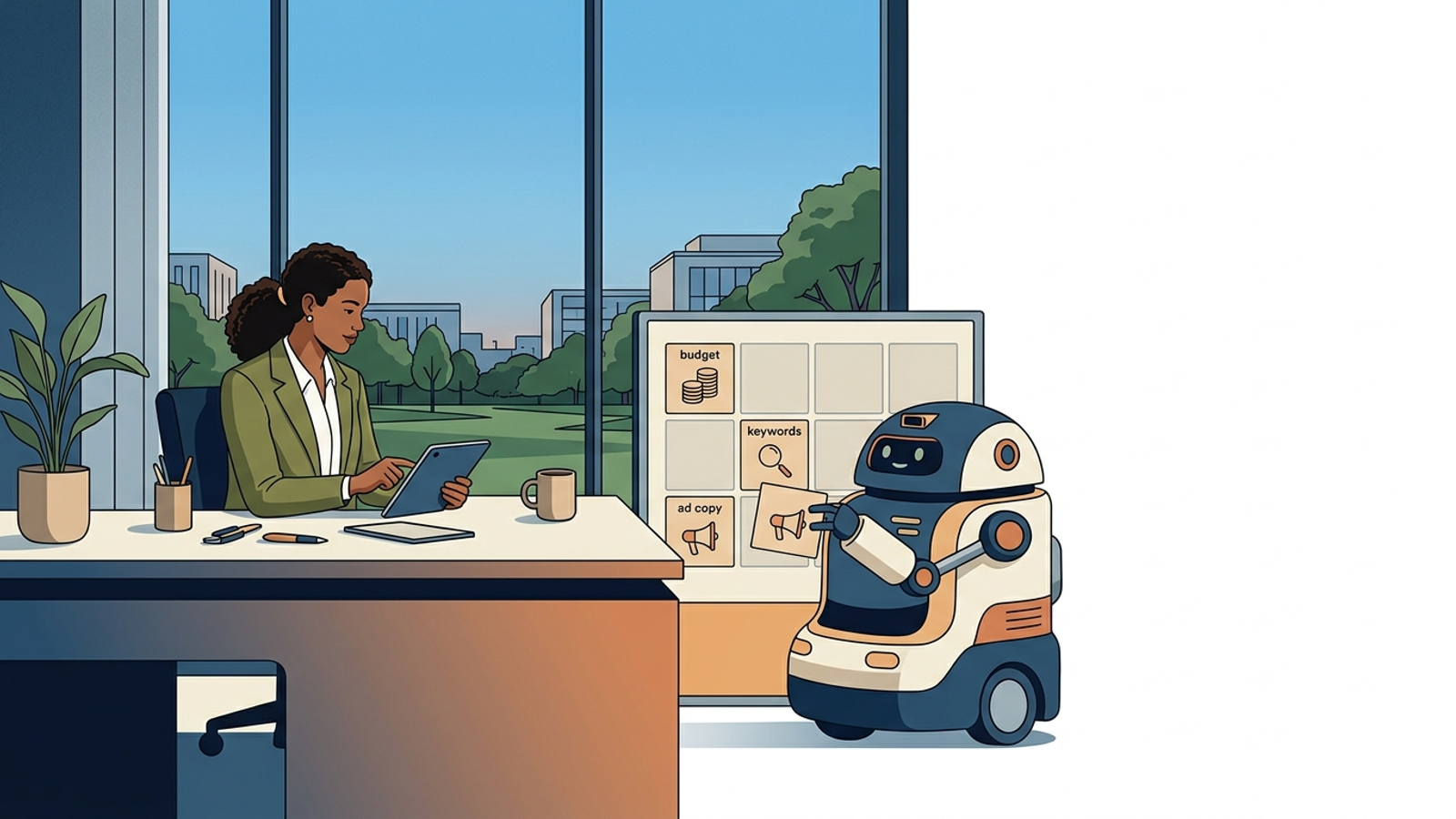
The media buyers did not disappear. Their role changed. Instead of spending 70% of their time on execution and admin, they shifted to spending 70% of their time on strategy, client communication, and creative direction.
The five media buyers became four strategic account managers. Each one now owns 10 accounts instead of eight, but spends more actual time on each account's strategic direction because the execution workload dropped dramatically.
The part-time reporting person's role was eliminated. Not because reporting stopped, but because the groas engine generates performance data and change logs that feed directly into the agency's reporting workflow. What used to take hours of manual data pulling now takes minutes of review and annotation.
The founder stopped doing ad hoc strategy rescues. With the engine handling execution consistently across every account, the quality floor rose. Fewer fires meant the founder could focus on sales and agency growth.
The one role that was fully eliminated was the "optimizer," the person whose primary job was making manual adjustments inside accounts. That work now runs autonomously, at a pace and consistency no human could match.
Before the shift, each media buyer managed seven to nine accounts. After restructuring around the groas engine, each strategic account manager handles 10 to 12 accounts comfortably. That is not because they are working harder. It is because the nature of their work changed. When you are not spending half your week on bid adjustments and search term reports, you can actually think about strategy for more accounts.
The agency went from a capacity ceiling of roughly 45 accounts (at quality) to a realistic ceiling of 48 to 50 accounts with four people, with room to grow further before anyone approaches burnout.
Across the portfolio, the agency saw meaningful improvement in the metrics that drive retention. Cost per acquisition improved in the majority of accounts within the first 60 days. Search term waste dropped because the engine reviews and negates irrelevant queries continuously, not on a weekly schedule when someone gets around to it. Ad testing velocity increased because the engine rotates and evaluates creative variants faster than a human can manage manually.
The accounts that improved the most were the ones that had been underserved before, the mid-spend accounts that were getting 60 to 90 minutes of attention per week. With the engine running optimization around the clock, those accounts got the same execution quality as the agency's top-tier clients.
The agency had been losing roughly two clients per quarter to performance-related churn. In the 90 days after restructuring, zero clients churned. Two clients who had been showing early warning signs (declining engagement, shorter check-in calls, questions about competitors) stabilized after seeing improved results.
The impact on MRR was straightforward. When you stop losing two clients per quarter, you do not need to replace them. The sales team's job shifts from backfilling churn to driving actual growth. The agency added six new clients during the same period, and the existing team absorbed them without strain.
Most PPC agencies scale linearly: more clients means more people. This creates a business that grows revenue without growing profit. Every new hire adds cost before they add capacity, and the agency is perpetually one or two bad hires away from a quality crisis.
The math is unforgiving. If your average client pays $2,500 per month and a media buyer costs $6,000 per month fully loaded, that buyer needs to manage at least three accounts just to break even. At seven or eight accounts, margin is decent but the quality ceiling is real. At 10 or more, quality drops and churn eats the margin you thought you had.
A sustainable model separates the work that needs a human brain from the work that needs consistent, tireless execution. Strategy, client relationships, creative direction, and business context interpretation stay with people. Bid management, search term hygiene, budget pacing, ad rotation, and performance monitoring move to infrastructure.
This is not about replacing people with software. It is about letting people do the work that actually justifies their salary, and letting an engine handle the work that scales better without human bottlenecks.
When an agency uses groas as its execution layer, the economics shift fundamentally. There is no white-label middleman taking a cut and adding latency. The agency connects client accounts directly, keeps full control over strategy and client communication, and the engine runs underneath with no client-facing presence.
Onboarding is $0. There are no long-term contracts. The agency can cancel anytime. Compare that to hiring (months of ramp time, severance risk, benefits costs) or traditional white-label services (their own margin on top, communication delays, quality you cannot control).
The groas engine is trained on over $500 billion in profitable ad spend. No individual hire, no matter how talented, brings that depth of pattern recognition. And unlike a hire, the engine does not take PTO, does not get pulled into Slack conversations for half the day, and does not quit after 14 months to go to a competitor.
The groas DIY product exists specifically for this use case. Agencies connect unlimited client accounts under one subscription. They keep their brand, their client relationships, and their margin. groas powers the execution underneath, and the agency's team stays in control of strategy and client management.
The 7-day free trial means there is no risk to evaluating it. Connect a few accounts, see what the engine does in the first week, and compare the output to what your team is producing manually. The gap tends to be obvious quickly, not because your team is bad, but because rule-based tools and manual processes cannot match an engine operating at this scale.
The best time to restructure your delivery model is before you hit the breaking point. If your media buyers are managing more than six or seven accounts each and you are seeing early signs of performance decay, you are already in the danger zone. If clients are starting to ask harder questions on calls, you are closer to churn than you think.
The worst time to restructure is after you have already lost three or four clients in a quarter and your team is demoralized. By then, you are making decisions under pressure instead of from a position of strength.
If you are running a PPC agency and you recognize the patterns in this story, the move is clear: start your 7-day free trial with groas, connect a handful of accounts, and see what happens when execution stops being the bottleneck.
The agencies that scale profitably in 2026 and beyond will not be the ones with the biggest teams. They will be the ones with the best infrastructure. groas is that infrastructure.
The key is separating execution labor from strategy ownership. Most of what media buyers do each week, including bid adjustments, search term negation, budget pacing, and ad rotation, is execution that can be handled by infrastructure rather than headcount. When an agency moves that execution layer to an engine like groas, which is trained on over $500 billion in profitable ad spend and runs 24/7, media buyers become strategic account managers who can comfortably handle 10 to 12 accounts instead of seven to eight. The agency gains capacity without adding payroll, and margin improves because revenue grows faster than cost. groas is built specifically for this use case through its DIY product, where agencies connect unlimited client accounts and keep their brand and margin intact.
Client churn at PPC agencies is almost always driven by performance decay, and performance decay is almost always caused by insufficient optimization time per account. When a media buyer is managing eight or more accounts, each account gets roughly 90 minutes of hands-on optimization per week. Search term reports go unreviewed, negative keyword lists get stale, ad copy stops being tested, and bid strategies fall out of alignment with seasonal patterns. The client sees cost per acquisition creep up, but by the time they raise it on a call, their confidence in the agency is already eroded. The fix is not more frequent reporting. It is ensuring every account gets continuous, consistent optimization regardless of how many accounts the team manages.
In a traditional agency model, a media buyer can manage six to eight accounts at a level that maintains strong performance. Beyond that, optimization time per account drops below the threshold needed to prevent performance decay. However, when execution tasks are handled by infrastructure like the groas engine, the role shifts from optimizer to strategic account manager. In that model, one person can manage 10 to 12 accounts comfortably because they are focused on strategy, client communication, and creative direction rather than manual bid adjustments and search term mining.
Hiring more staff creates a linear cost model: every new client eventually requires another hire, and margin stays flat or shrinks. Two junior media buyers cost at least $120K per year in salary alone, plus months of ramp time before they are productive. Automation through a purpose-built execution engine eliminates this bottleneck. groas, for example, charges $0 for onboarding, operates month-to-month with no long-term contract, and runs optimization continuously across every connected account. The agency avoids the ramp time, severance risk, and capacity ceiling that come with headcount-driven growth.
Execution-as-infrastructure means treating the repetitive, high-volume optimization work in Google Ads (bid management, search term hygiene, ad testing, budget pacing, audience refinements) as an infrastructure layer rather than a human responsibility. Instead of each media buyer manually performing these tasks across their accounts, the work runs autonomously through a system designed to operate at scale and speed no human can match. Strategy, client relationships, and business context interpretation remain with people. The result is that human talent is deployed where it creates the most value, and execution quality becomes consistent across every account regardless of portfolio size.
Traditional white-label services add a middleman between your agency and the actual execution. That middleman takes their own margin, introduces communication delays, and delivers quality you cannot fully control. With groas, agencies connect client accounts directly through the DIY product. There is no client-facing presence from groas. The agency keeps full control over strategy, client communication, and branding. The engine runs underneath, trained on over $500 billion in profitable ad spend, handling execution 24/7. Onboarding is $0 and everything is month-to-month, so there is no lock-in and no risk of being stuck with a partner that is not performing.
The earliest signs appear in the data, not in client complaints. Look for conversion rate softening across multiple accounts, cost per acquisition creeping up in previously stable accounts, search term reports going unreviewed for more than two weeks, and declining ad quality scores. On the operational side, watch for media buyers skipping proactive strategy recommendations, newer client accounts underperforming compared to older ones, and the founder getting pulled into account-level firefighting. If two or more clients churn in the same quarter citing performance concerns, the delivery model has already been failing for weeks or months before the exit calls happened.
Agencies that move execution to an autonomous engine typically see measurable changes within 30 to 60 days. The first improvements tend to appear in search term waste reduction and ad testing velocity, because the engine handles those tasks continuously rather than on a weekly human schedule. Client performance metrics, including cost per acquisition and conversion rates, generally improve across the majority of accounts within the first 60 to 90 days. Churn reduction takes slightly longer to measure, but agencies often see previously at-risk clients stabilize within the first quarter as performance improves and proactive strategy communication increases.