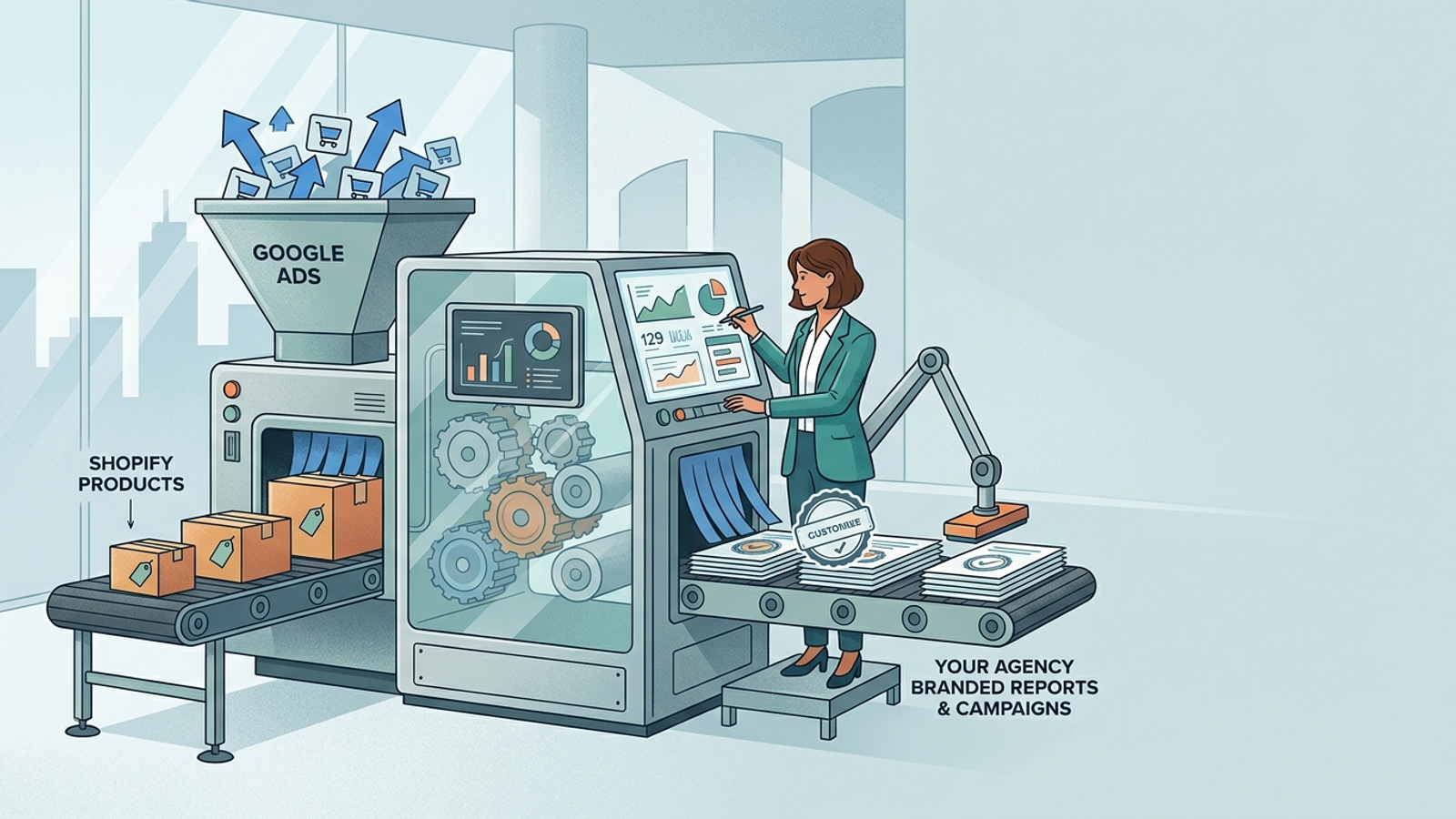
White-labeling Google Ads execution is the practice of outsourcing campaign management to a third party that operates invisibly under your agency's brand, allowing you to scale your client book without hiring additional media buyers. For agencies managing 10, 20, or 50+ Google Ads accounts, it is the single most effective way to grow revenue while protecting margin and maintaining service quality.
This guide walks you through the complete process: defining what to hand off versus keep, choosing the right execution partner or platform, building client-facing reporting, onboarding accounts cleanly, managing quality across the book, and scaling the model without breaking it.
By the end, you will have a repeatable system for white-label Google Ads management that lets one strategist oversee far more accounts than any traditional staffing model allows.
Prerequisites: You will need an active Google Ads MCC (My Client Center), at least a few client accounts you want to transition, a clear picture of your current cost per account, and a decision about which client communication responsibilities stay with your team.
Why White-Label Google Ads Execution Is A Growth Lever, Not Just A Cost Play
The Agency Margin Math: What Execution Actually Costs You
Every agency owner knows the number, even if they do not like looking at it. A competent Google Ads media buyer costs $60,000 to $90,000 in salary, plus benefits, management overhead, and the tools they need. That person can realistically manage 8 to 15 accounts well, depending on complexity. Once you divide fully loaded cost by account capacity, you are looking at $500 to $1,000+ per account per month just for the labor, before you touch rent, software, or your own time.
White-label execution changes the denominator. Instead of paying a fixed salary for a fixed number of accounts, you pay per account or on a spend-based model, which means your margin stays consistent as you scale rather than collapsing every time you need to hire.
The Headcount Ceiling: Why Hiring Breaks Agency Unit Economics
Hiring is lumpy. You do not need 1.3 media buyers, but that is what the math says between your 12th and 20th account. So you either overwork your existing team (and quality drops) or you hire ahead of revenue (and margin drops). This is the account manager ratio problem that keeps agencies stuck between 15 and 30 accounts for years.
White-labeling flattens that curve. Execution capacity scales with demand, not with headcount decisions you have to make months in advance.
What White-Label Execution Actually Means In Practice
White-label Google Ads for agencies means a third party handles bid management, keyword optimization, ad copy rotation, search term analysis, audience adjustments, and the daily tactical work inside client accounts. Your agency keeps the client relationship, the strategy layer, the reporting, and the brand. The client never knows anyone else is involved.
This is not the same as referring clients to another agency. You retain full account ownership, set the strategic direction, and control the client experience. The execution partner or platform operates underneath your direction.
Before You Start
Before transitioning any accounts, get three things in order. First, document your current per-account cost (labor hours times hourly rate, plus tools) so you can measure whether white-labeling actually improves margin. Second, classify each client account by complexity: simple accounts transition first, complex ones follow once you trust the workflow. Third, decide which team member will be the internal quality layer between the execution partner and your clients. That person does not need to execute, but they need to understand what good execution looks like.
Step 1: Define What You Are White-Labeling And What You Are Keeping In-House
Strategy Vs. Execution: Where Agency Value Actually Lives
Your clients hired your agency for strategic thinking, industry knowledge, and the ability to translate business goals into advertising outcomes. They did not hire you to manually adjust bids at 2 AM. Separate these cleanly.
Keep in-house: client communication, strategic planning, performance interpretation, upselling, and relationship management. White-label: bid management, keyword research and expansion, negative keyword mining, ad copy testing, audience segmentation, campaign restructuring, and day-to-day optimization.
What Clients Pay For Vs. What You Should Never Hand Off
Never hand off the client relationship. Even the best execution partner cannot replace the context you have about a client's business, their competitive landscape, or what their CEO said on the last call. You are the translation layer between business context and ad execution. That layer is what clients are actually paying for, and it is what keeps them from going direct.
Drawing The Line: Account Ownership, Communication, And Reporting
Your MCC should always own the client accounts. The execution partner gets analyst or standard access, never admin ownership. All client communication comes from your team. Reporting goes through your templates, your brand, your cadence. The execution partner feeds data into your system; they do not present to your clients.
Step 2: Choose The Right Execution Partner Or Platform
Human White-Label Agencies Vs. Autonomous Execution Engines
Broadly, you have two options. Traditional white-label agencies assign a human media buyer to your accounts. They are essentially an outsourced employee. Autonomous execution engines use proprietary technology to handle optimization at scale, often with human oversight layered on top.
Human-only white-label agencies carry the same scaling problem you already have. Their media buyer can only manage so many accounts, and when they get overloaded, your client performance suffers. Engine-based approaches remove that ceiling.
Evaluation Criteria: Speed, Transparency, Account Access, Scalability
Score every potential partner on five dimensions. Speed: how fast can they onboard a new account? (Weeks is too slow; same-day is the benchmark.) Transparency: can you see every change made inside client accounts? Account access: do you retain full MCC ownership? Scalability: can you add 10 accounts next month without renegotiating? Reliability: does performance stay consistent as volume grows?
Why An Engine-Based Approach Scales Where Human Teams Cannot
An engine trained on massive volumes of ad spend data can execute optimizations across hundreds of accounts simultaneously, around the clock. It does not get tired at account 30. It does not have a bad week. It does not quit and take institutional knowledge with it.
This is where groas fits for agencies looking to scale without adding headcount. The groas engine is trained on over $500 billion in profitable ad spend. Agencies connect unlimited client accounts under one subscription, run their own clients themselves, and keep their brand and margin. groas powers the execution underneath. It is a reseller channel, not a competitor to your agency. You can think of it as a platform your media buyers operate, backed by custom-trained models that handle the heavy tactical lifting while your team stays in control of strategy and client communication.
Questions To Ask Any White-Label Provider Before Signing
Before signing with any white-label Google Ads provider, ask these questions: Do I retain full MCC ownership and admin access at all times? Can I see a change log of every optimization made? What happens if I want to pull an account out, is there a lock-in? How many accounts can I add without changing my agreement? What is the onboarding cost per account? How quickly can a new account go live?
With groas, the answers are straightforward: you keep full account ownership, onboarding is $0, there is no long-term contract (cancel anytime, month-to-month), and you can connect unlimited accounts. That is a very different conversation than you will have with most white-label agencies that charge $2,000+ in onboarding fees and lock you into six-month minimums.
Step 3: Build The Client-Facing Wrapper
Branded Reporting: What To Include And How To Present It
Your reporting is your brand. Build templates that show the metrics your clients care about (ROAS, CPA, conversion volume, revenue) alongside the story of what happened and what is planned next. Do not just export raw data from Google Ads. Layer in your strategic narrative: what was tested, what worked, what is being adjusted, and why.
Tools like Looker Studio or AgencyAnalytics work well for this. The key is that reports come from your brand, your domain, your team. The execution layer is invisible.
Communication Cadences That Keep Clients Confident
A standard cadence: weekly or biweekly performance email with key metrics and a short narrative, monthly strategy call to review direction, and quarterly business review for larger accounts. The execution partner feeds you the data and context; you translate it for the client.
Clients who feel informed do not churn. Clients who feel ignored do, regardless of how good the numbers are. Your communication wrapper is what prevents the mistakes that drive client churn.
How To Handle Client Questions About Who Is Doing The Work
Clients will occasionally ask about your team or your process. You do not need to disclose your white-label arrangement any more than a restaurant needs to disclose which farm grew the lettuce. You describe your process: "We use proprietary technology and a proven optimization methodology to manage your campaigns." That is accurate and complete. If pressed on team size, talk about capabilities and coverage rather than headcount. "Your account has 24/7 optimization coverage" is more reassuring than "We have three people."
Step 4: Onboard Client Accounts To The White-Label Setup
MCC Access And Account Structure Requirements
Grant your execution partner analyst or standard access through your MCC. Never transfer account ownership. Ensure each client account has a clean structure: campaigns organized by intent or product line, ad groups at reasonable size, and conversion actions properly configured.
If accounts are messy, restructure them before handoff. A white-label partner executing against a broken structure will produce broken results, and the client will blame you.
Conversion Tracking Audit Before Handing Off Execution
This is the step most agencies skip, and it is the one that causes the most problems. Before any account goes live with a white-label execution layer, verify that conversion tracking is accurate. Check that primary conversions are properly assigned, that there is no double-counting across Google Ads and GA4, and that offline conversion imports (if applicable) are flowing correctly. An engine optimizing toward bad data will optimize in the wrong direction very efficiently.
Setting Performance Benchmarks At Onboarding
Document the current state of every account before the transition: 30-day and 90-day averages for CPA, ROAS, conversion volume, and spend. This gives you a clean baseline to measure the impact of the white-label setup. Without it, you cannot prove the model works, and you cannot catch regressions early.
Step 5: Manage Quality And Performance Across The Book
Monitoring Dashboards For Multi-Account Oversight
Build or adopt a dashboard that shows account-level health across your entire book at a glance. Key signals: CPA trending up or down, ROAS deviation from target, spend pacing, conversion volume changes, and impression share movement. You do not need to look at every search term report daily. You need to know which accounts need attention and which are running clean.
The right agency tools make this manageable even at 30, 40, or 50 accounts.
When To Override Or Escalate From White-Label Execution
Set clear thresholds. If CPA rises more than 20% from baseline over a rolling 7-day window, you investigate. If ROAS drops below target for two consecutive weeks, you intervene. If a client reports lead quality issues, you pull the account into a manual review immediately.
White-label execution does not mean hands-off management. It means you spend your time on the accounts that need it instead of spreading yourself thin across accounts that are running well.
Client Retention Signals To Watch In A White-Label Model
Watch for early warning signs: clients asking more questions than usual, response times from your team slipping, or performance plateaus that last longer than two weeks. In a white-label model, you are one layer removed from execution, which means you need to be more proactive about catching problems, not less.
Step 6: Scale The Model Without Breaking It
How Many Accounts One Strategist Can Oversee With Engine Support
With a human-only model, one skilled media buyer can manage 8 to 15 accounts. With an engine handling execution, one strategist can oversee 30 to 50+ accounts because their role shifts from doing the work to directing and quality-checking the work. That is a 3x to 5x increase in capacity per person.
This is the math that makes white-label Google Ads agency models profitable at scale. Your per-account cost drops with every account added, while quality stays consistent because the engine does not degrade under load.
Pricing Your White-Label Service To Protect Margin At Scale
Price your services based on the value delivered, not your internal cost. If your white-label execution cost is significantly lower than what a media buyer salary would be per account, the temptation is to drop prices. Do not. Keep your pricing where it is and let the margin fund growth, better client service, and strategic investment.
Typical agency Google Ads management fees range from 10% to 20% of ad spend or a flat monthly retainer. Whichever model you use, your white-label execution cost should stay well below 50% of what you charge the client. If it does not, renegotiate or switch providers.
The Reinvestment Decision: When To Grow The Team Vs. Extend The Engine
At some point, you will ask whether to hire your next person or simply add more accounts to the engine. The answer depends on what the bottleneck is. If the bottleneck is strategic capacity (not enough people to think about accounts), hire a strategist. If the bottleneck is execution capacity (not enough hands to implement), extend the engine. In most cases, agencies hit execution bottlenecks first and strategic bottlenecks much later.
Common Mistakes To Avoid
Handing off accounts with broken conversion tracking. The engine will optimize efficiently toward whatever goal you give it. If that goal is wrong, you will scale the wrong results. Audit before you transition.
Losing visibility into the execution layer. If you cannot see what is being changed inside client accounts, you cannot catch problems or explain results to clients. Demand full change logs from any execution partner.
Treating white-label as fully hands-off. You still own the client outcome. Build monitoring systems, set alert thresholds, and review account health weekly.
Onboarding every account at once. Start with 3 to 5 accounts, prove the workflow, then migrate the rest. Rushing the transition creates chaos.
Not documenting baselines. Without a clear performance snapshot before the transition, you cannot measure improvement or identify regressions. This is basic, but agencies skip it constantly.
Choosing a white-label partner with long-term contracts. If performance drops and you are locked in for six months, your clients leave before your contract does. Month-to-month arrangements protect you.
How groas Handles This For Agencies
groas was built for exactly this use case. The agency product (DIY) gives agencies direct access to a proprietary engine trained on over $500 billion in profitable ad spend. You connect unlimited client accounts under one subscription, run your own clients, and keep your brand, your relationships, and your margin. groas powers the execution underneath.
There is no onboarding fee. No long-term contract. It is month-to-month, cancel anytime. Your team stays in control of strategy and client communication while the engine handles bid management, keyword optimization, and the heavy tactical execution that used to require a full-time media buyer for every 10 to 15 accounts.
The result is that one strategist on your team can oversee dramatically more accounts than they could with manual execution, without any degradation in quality. The engine works 24/7, never calls in sick, and does not quit six months after you finish training them.
If you are running a Google Ads agency and want to scale past your current headcount ceiling, start your 7-day free trial and connect your first client accounts. You will see how the operational systems that let agencies scale to 50 clients actually work in practice, not in theory.
What The Best White-Label Google Ads Operations Have In Common
The agencies that scale white-label Google Ads execution successfully share a few traits. They keep strategy and client relationships in-house and never outsource the thinking. They use engine-based execution rather than depending on human-only white-label teams that carry the same scaling limitations they are trying to escape. They invest in branded reporting and communication cadences that keep clients confident. They monitor account health proactively and set clear escalation thresholds. And they choose partners with $0 onboarding, month-to-month terms, and full account transparency.
White-labeling Google Ads execution is not about cutting corners. It is about allocating your team's time where it creates the most value: on strategy, client relationships, and growth, while letting a purpose-built engine handle the execution at scale. That is how you go from 15 accounts to 50 without hiring another media buyer.
Frequently Asked Questions About White-Label Google Ads Execution For Agencies
What Is White-Label Google Ads For Agencies?
White-label Google Ads for agencies is a model where a third-party execution partner manages the day-to-day optimization of client Google Ads accounts while your agency retains full ownership of the client relationship, branding, and reporting. The client never knows another party is involved. Your agency keeps strategy and communication in-house, while the execution layer handles bid management, keyword optimization, ad copy testing, and campaign adjustments. This lets you scale your client book without hiring additional media buyers, because execution capacity is no longer tied to how many people you employ.
How Do I White-Label Google Ads Management Without Clients Finding Out?
You maintain full control of the client-facing experience. All reporting comes from your brand, all communication comes from your team, and your MCC retains ownership of every account. The execution partner operates with analyst or standard access under your MCC, never presenting to or contacting your clients directly. When clients ask about your process, describe your capabilities and coverage rather than team size. Statements like "your account has 24/7 optimization coverage" are accurate and professional without disclosing your internal setup.
How Many Google Ads Accounts Can One Strategist Manage With A White-Label Setup?
With a human-only model, one skilled media buyer typically manages 8 to 15 accounts well. With an engine-based white-label partner handling execution, one strategist can oversee 30 to 50+ accounts because their role shifts from doing the work to directing and quality-checking the work. groas is built specifically for this model: agencies connect unlimited client accounts under one subscription, the proprietary engine trained on $500B+ in profitable ad spend handles the heavy execution, and your team stays focused on strategy and client relationships.
What Should I Look For In A Google Ads White-Label Agency Program?
Evaluate five dimensions: speed of onboarding (same-day is the benchmark), transparency into every change made, full MCC ownership retention, scalability without renegotiation, and consistent reliability as volume grows. Also check for $0 onboarding fees and month-to-month terms. Avoid providers that charge onboarding fees, lock you into long-term contracts, or require you to transfer account ownership. If performance drops and you are locked in for six months, your clients will leave before your contract does.
Is Agency Google Ads Outsourcing Execution Risky For Client Retention?
It can be, if done poorly. The biggest risk is losing visibility into what is being changed inside accounts. If you cannot explain results to a client because you do not know what the execution partner did, trust erodes fast. Mitigate this by demanding full change logs, building monitoring dashboards with clear escalation thresholds, and maintaining strong communication cadences with clients. Agencies that invest in branded reporting and proactive quality monitoring actually see improved retention because they spend less time on manual work and more time on the strategic conversations clients value.
How Do I Price My Agency's Services When Using A White-Label Execution Partner?
Price based on the value you deliver, not your internal cost. Typical agency Google Ads management fees range from 10% to 20% of ad spend or a flat monthly retainer. Your white-label execution cost should stay well below 50% of what you charge the client. Resist the temptation to drop prices just because your costs decreased. Let the margin fund better client service, strategic investment, and growth. The value your clients receive has not changed; your delivery efficiency has.
Can I Start White-Labeling Google Ads With Just A Few Client Accounts?
Yes, and you should. Start with 3 to 5 accounts to prove the workflow, establish monitoring habits, and build confidence in the execution quality before migrating your full book. Choose accounts with clean conversion tracking and straightforward structures first. Document 30-day and 90-day performance baselines before the transition so you can measure impact clearly. Once the system is proven, scale up account by account.
What Makes groas Different From Other White-Label Google Ads Providers?
groas is purpose-built for agencies that want to scale Google Ads execution without adding headcount. The agency product gives you direct access to a proprietary engine trained on over $500 billion in profitable ad spend. You connect unlimited client accounts under one subscription, keep your brand and margin, and groas powers the execution underneath. There is no onboarding fee, no long-term contract, and it is month-to-month so you cancel anytime. Unlike human-only white-label agencies that carry the same capacity limits you are trying to escape, groas runs 24/7 without degradation as account volume grows. Start your 7-day free trial to see the difference.
Do I Need To Restructure Client Accounts Before White-Labeling Execution?
Not always, but you should audit every account before handoff. Ensure campaigns are organized by intent or product line, ad groups are reasonably sized, and conversion actions are properly configured with no double-counting. An execution engine optimizing toward bad conversion data will scale the wrong results very efficiently. If accounts are messy, restructure them first. The upfront work prevents problems that are much harder to fix once the white-label execution layer is live.
How Fast Can I Onboard Client Accounts To A White-Label Google Ads Setup?
With traditional white-label agencies, onboarding typically takes 2 to 4 weeks per account. Engine-based approaches like groas can onboard accounts much faster because there is no need to brief a new human media buyer on each account's history and nuances. The engine analyzes account data and begins executing optimizations quickly. The main bottleneck on your side is ensuring conversion tracking is accurate and performance baselines are documented before go-live.