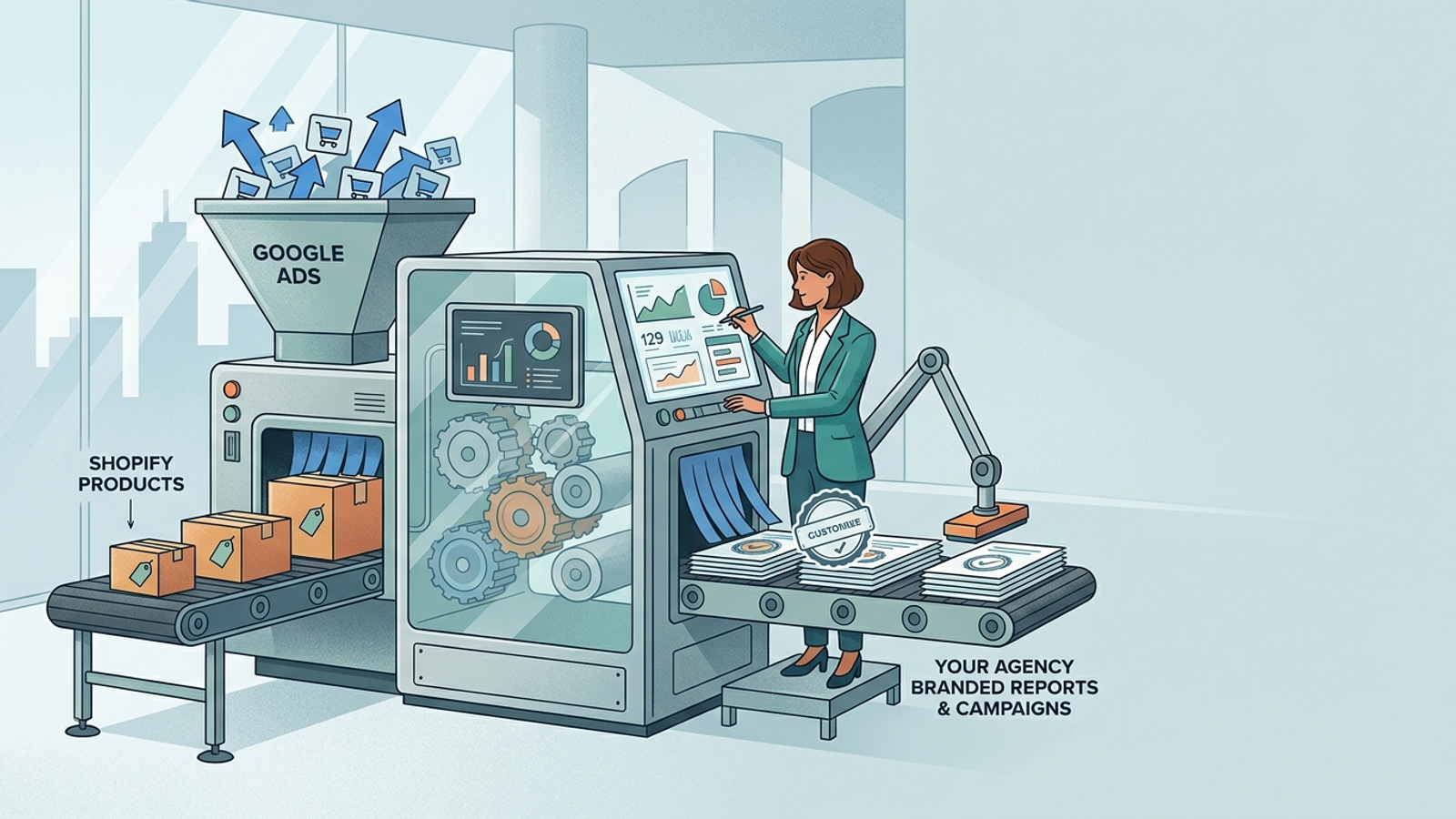
White-label Google Ads is a business model where an agency sells Google Ads management under its own brand while a third-party partner handles the actual campaign execution behind the scenes. It is one of the fastest paths to building a profitable agency because it decouples revenue growth from headcount growth. Instead of hiring another media buyer every time you sign a new client, you plug into an execution layer that scales with your book.
By the end of this guide, you will know how to define a white-label Google Ads offer, choose the right execution partner, build a reporting stack your clients trust, price for margin, onboard cleanly, and scale past 20 accounts without hiring execution staff.
What you will need before starting:
- A registered agency or consulting entity
- At least one active or incoming Google Ads client (or a concrete plan to acquire them)
- A clear understanding of your role: you are the client relationship and strategy layer; the execution layer sits underneath
- Familiarity with Google Ads account structure, even if you are not the one building campaigns
Before You Start: Understand What You Are Actually Selling
White-label PPC management is not outsourcing. Outsourcing implies you are handing off a problem. White-labeling means you are building a product on top of someone else's execution infrastructure, the same way SaaS companies build on AWS without telling customers about it.
Before you build anything, get clear on one thing: your clients are buying your brand, your communication, and your strategic guidance. They never see or interact with the execution engine underneath. This means your reputation lives and dies on two factors: execution quality you do not directly control, and client communication you do control entirely. Every step below is designed to make both of those reliable at scale.
If you want a deeper look at the tools that help agencies manage multiple accounts, that is worth reading alongside this guide.
Step 1. Define Your White-Label Offer Before You Build Anything
The most common mistake agencies make when going white-label is skipping offer definition. They sign a client, scramble to fulfill, and end up promising things the execution layer cannot deliver.
Start by writing down exactly what a client gets from you. This includes deliverables (campaign builds, ongoing optimization, reporting), communication cadence (weekly emails, monthly calls, Slack access), and response times (how fast you reply to a client question, how fast a change gets made in the account).
Decide What You Are Reselling: Execution, Reporting, Or Both
Some agencies white-label only execution: the partner runs campaigns, and the agency builds its own reports. Others white-label the full stack: execution plus a reporting layer the partner provides. Both work. The choice depends on how much control you want over the client experience versus how much time you want to save.
If you are starting with fewer than five clients, white-label both. You need to minimize your own operational burden early so you can focus on acquiring more clients. As your book grows, you may pull reporting in-house for tighter brand control.
Set Client-Facing SLAs You Can Actually Deliver Against
Write SLAs that your execution partner can meet, not SLAs that sound impressive in a sales deck. If your partner makes campaign changes within 48 hours, do not promise clients same-day changes. Overpromising on SLAs is the number one driver of churn in white-label agencies. This is one of the most common agency mistakes that drive client churn.
Step 2. Choose Your Execution Layer
This is the decision that determines whether your white-label model is profitable or a liability. You have two paths: build in-house or partner with an execution engine.
Build In-House Vs. Partner With An Engine (The groas DIY Model)
Building in-house means hiring media buyers. Each competent Google Ads specialist can manage roughly 8 to 15 accounts depending on complexity. Every new hire adds salary, benefits, management overhead, and risk of turnover. Your margin shrinks every time you scale.
The alternative is partnering with an execution engine. The groas DIY product was built specifically for this model. Agencies connect unlimited client accounts under one subscription, get direct access to a proprietary engine trained on over $500 billion in profitable ad spend, and run their clients themselves. You keep your brand, your client relationships, and your margin. groas powers the execution underneath. It is self-serve, starts with a 7-day free trial, and requires no onboarding fee.
The economics are stark. An in-house media buyer costs you $60,000 to $90,000 per year fully loaded and manages a fixed number of accounts. An engine scales with your book without adding headcount. The account manager ratio problem is the single biggest constraint on agency profitability, and white-labeling onto an engine eliminates it.
What To Evaluate In Any White-Label Google Ads Partner
Look for five things: execution quality (ask for case examples and account-level metrics), scalability (can the partner handle 5 accounts and 50 accounts without degradation), reporting flexibility (can you brand or customize output), onboarding speed (weeks is too slow; instant or same-day is the standard), and contract terms (avoid 6 to 12 month lock-ins that trap you if the partner underdelivers).
Red Flags That Signal A Partner Will Underdeliver
If a white-label partner requires a long-term contract, that is a red flag. They are locking you in because they know retention depends on the contract, not performance. If they cannot articulate what technology or methodology runs underneath their execution, they are likely just another team of offshore media buyers with a white-label skin. If onboarding takes more than a few days, they are operationally immature.
Step 3. Build A Client-Facing Reporting Stack That Hides The Engine
Your clients should never know (or care) what runs underneath. Reporting is where you make white-label invisible.
White-Label Dashboard Options And What They Should Show
At minimum, your client-facing reports need: spend, conversions, cost per conversion, ROAS or CPA trends, and a plain-language summary of what changed and why. Tools like Looker Studio, AgencyAnalytics, or Databox let you pull Google Ads data into branded dashboards.
Do not overwhelm clients with metrics they did not ask for. A founder wants to know: did we make money, and what are you doing to make more? Give them that answer in the first three lines of every report.
Cadence And Format: What Clients Actually Want To See
Weekly email summaries for active optimization periods. Monthly strategy reports for mature accounts. A live dashboard they can check anytime but that you do not expect them to interpret on their own. The report is not the product. Your interpretation of the data is the product.
Step 4. Price The Offer For Margin, Not For Competition
Pricing is where most white-label agencies leave money on the table. They look at what competitors charge and undercut. That is a race to the bottom.
How To Calculate Your Blended Margin Across A Client Book
Your blended margin is total revenue from all clients minus the total cost of your execution layer (partner fees, any in-house labor, tools) divided by total revenue. Healthy white-label agencies target a blended margin of 50% or higher. If your margin falls below 40%, you are either underpriced or your execution costs are too high.
Track margin per client, not just in aggregate. Some clients are margin-positive at 60%+; others may be margin-negative because of high-touch demands. Know which is which so you can reprice or fire unprofitable accounts.
Tiered Pricing That Reflects Account Complexity
Do not charge every client the same flat fee. An e-commerce brand spending $50,000 per month on Google Ads with 200 SKUs is a fundamentally different account than a local service business spending $3,000. Build at least three tiers based on ad spend ranges and account complexity. Each tier should carry its own margin target. Scaling agency revenue without adding headcount becomes possible when your pricing reflects the actual work each account demands.
Step 5. Onboard The First Three Clients Before You Scale
Do not try to sign 15 clients in month one. Sign three, deliver well, and build your onboarding playbook from what you learn.
Why Onboarding Is Where White-Label Operations Break Down
Onboarding is the highest-risk moment in any client relationship. The client just gave you money and access. If the first two weeks feel disorganized, they start questioning the decision. In a white-label model, you are coordinating between the client and an execution layer they cannot see. Any gap in communication or timeline becomes your problem.
Build a written onboarding checklist: account access credentials, conversion tracking verification, business context brief (margins, LTV, geographic focus), and a kickoff call where you set expectations for the first 30 days.
The First 30 Days: What Needs To Happen And Who Owns It
Days 1 to 3: get full account access, run an initial audit, and brief the execution layer. Days 4 to 10: the execution engine restructures or optimizes campaigns based on the audit. Days 11 to 20: monitor early performance, make initial adjustments, send the first weekly report. Days 21 to 30: conduct the first strategy call with the client, present findings, and lay out the 60-day plan. You own the client communication. The engine owns the execution. Draw that line clearly.
For agencies using the groas engine, onboarding cost is $0 and time-to-start is immediate. You connect the client's Google Ads account, the engine goes to work, and you focus on the client relationship. Compare that to the weeks it takes to brief a freelancer or the months it takes to hire and train an in-house media buyer.
Step 6. Scale The Client Book Without Adding Execution Headcount
This is where white-label becomes a real business instead of a side hustle.
The Account Ratio That Makes White-Label Profitable At Scale
When your execution layer is human-only, one media buyer managing more than 15 accounts means quality drops. That is the ceiling that kills most agencies. When your execution layer is an engine, the ceiling lifts dramatically. Your constraint shifts from "how many accounts can one person manage" to "how many client relationships can one account manager maintain."
A single account manager focused on communication and strategy (not execution) can handle 20 to 30 client relationships when the execution is automated underneath. That is the ratio that makes white-label Google Ads for agencies genuinely scalable. The operational systems required to scale to 50 clients are well-documented, and they all assume the execution layer is not your bottleneck.
When To Hire A Strategist Vs. When To Add More Engine Capacity
Hire a strategist when your client communication quality starts slipping: calls are being rescheduled, reports are late, or you are losing context on individual accounts. Do not hire another media buyer. The execution engine scales. The human layer scales by adding people who talk to clients and interpret data, not people who push buttons inside Google Ads.
Common Mistakes To Avoid
Telling clients about the execution layer. Your clients are buying your agency. The engine is your infrastructure, not a selling point you share with end clients. Keep it invisible.
Promising custom campaign builds when the engine handles structure. If your execution partner has a methodology for campaign architecture, do not override it with bespoke requests from every client. That defeats the purpose of scalable execution.
Underpricing to win deals. Competing on price attracts clients who will leave for a cheaper option. Compete on results, communication quality, and strategic insight. Those clients stay.
Skipping the onboarding playbook. Every client you onboard without a documented process is a client you might lose in the first 60 days. Build the playbook after client one, refine after client three, and systematize it permanently.
Ignoring margin per client. Blended margin hides problems. A single high-maintenance, low-spend client can tank your effective hourly rate. Review margin by client quarterly and either reprice or exit unprofitable relationships.
Scaling before systems are stable. If your reporting, communication, and onboarding are still ad hoc, adding more clients makes things worse, not better. Fix the system at three clients before growing to ten.
What Agencies Running White-Label Google Ads On The groas Engine Get
groas was built for exactly this use case. The DIY product is a reseller channel designed for agencies who want to scale their Google Ads client book without adding headcount, without sacrificing execution quality, and without locking into long-term contracts.
Here is what it looks like in practice. You connect unlimited client accounts under one subscription. The groas engine, trained on over $500 billion in profitable ad spend, runs execution 24/7 across every connected account. You manage the client relationship, set strategy, and deliver reporting under your own brand. groas powers everything underneath.
There are no onboarding fees. The subscription is month-to-month, cancel anytime. You do not pay per account, and you do not need to hire media buyers to grow. The engine handles bid management, audience targeting, ad copy iteration, and campaign structure at a level that a single human physically cannot replicate across a growing book.
The comparison to hiring is simple. An in-house media buyer costs $60,000+ per year, takes months to onboard, and manages a fixed number of accounts before quality drops. The groas engine runs continuously, does not quit, does not need managing, and scales with your client book. Your margin stays intact as you grow.
If you are building or scaling a white-label Google Ads operation, start your 7-day free trial and connect your first client account today. You keep the client, the brand, and the margin. groas runs the engine underneath.
The Bottom Line
White-label Google Ads is a high-margin agency model when you get the structure right: a clear offer, a scalable execution layer, a reporting stack that maintains your brand, pricing that protects margin, a repeatable onboarding process, and discipline about when to hire strategists versus when to lean on the engine.
The agencies that fail at white-label treat it as outsourcing. The agencies that succeed treat it as infrastructure. Your clients buy your expertise and your relationship. The execution engine is the foundation you build on, not the product you sell.
groas gives agencies that foundation with zero onboarding cost, instant setup, month-to-month flexibility, and an engine trained on more profitable ad spend than any single team could accumulate in a lifetime. Start your 7-day free trial and see what your first three client accounts look like running on the groas engine.
Frequently Asked Questions About White-Label Google Ads For Agencies
What Is White-Label Google Ads Management?
White-label Google Ads management is a model where an agency sells Google Ads services under its own brand while a third-party partner handles the actual campaign execution behind the scenes. The end client never knows a separate entity is running the campaigns. The agency owns the relationship, communication, and strategic guidance. The execution partner owns bid management, campaign structure, ad copy, and optimization. This model lets agencies scale their client book without hiring media buyers for every new account, keeping margins high and operational complexity low.
How Do I Choose A White-Label PPC Partner?
Evaluate five criteria: execution quality (ask for real account-level performance data), scalability (confirm they can handle your current book and your growth target without quality drops), reporting flexibility (can you brand or customize their output), onboarding speed (same-day or instant is the standard), and contract terms (avoid 6 to 12 month lock-ins). groas is purpose-built for this model. The DIY product gives agencies direct access to a proprietary engine trained on over $500 billion in profitable ad spend, with $0 onboarding, month-to-month terms, and unlimited client accounts under one subscription.
How Many Clients Can One Person Manage In A White-Label Model?
When execution is handled by an engine rather than a human media buyer, the bottleneck shifts from campaign management to client communication. A single account manager focused on strategy and relationship management can handle 20 to 30 client accounts when execution is automated underneath. Compare that to 8 to 15 accounts per media buyer in a traditional agency model. The difference in margin and scalability is significant.
Should I Tell My Clients About The White-Label Partner?
No. Your clients are buying your agency, your brand, and your strategic expertise. The execution engine is your infrastructure, similar to how a SaaS company runs on AWS without disclosing that to users. Keep reporting under your own brand, maintain all client communication yourself, and treat the execution layer as invisible. Transparency about your methodology is fine. Naming the partner behind the scenes is unnecessary and can undermine client confidence in your agency.
What Margin Should A White-Label Google Ads Agency Target?
Healthy white-label agencies target a blended margin of 50% or higher across their client book. If your margin drops below 40%, you are either underpriced or your execution costs are too high. Track margin per individual client, not just in aggregate. Some accounts will be highly profitable while others may be margin-negative due to high complexity or high-touch demands. Review per-client margin quarterly and reprice or exit unprofitable relationships.
How Do I Price White-Label Google Ads Services?
Build tiered pricing based on ad spend ranges and account complexity. A local service business spending $3,000 per month is a fundamentally different account than an e-commerce brand spending $50,000 with hundreds of SKUs. Each tier should carry its own margin target. Do not compete on price. Compete on results, communication quality, and strategic insight. Agencies that undercut on price attract clients who leave for the next cheapest option.
What Is The Fastest Way To Start A White-Label Google Ads Agency?
The fastest path is pairing your client acquisition and communication skills with an execution engine that requires no onboarding time or upfront cost. groas offers exactly this with the DIY product: connect your first client's Google Ads account, start a 7-day free trial, and the engine goes to work immediately. There is no onboarding fee, no long-term contract, and no limit on the number of client accounts you connect. You focus on winning and retaining clients while groas handles execution.
What Reports Should I Send To White-Label Clients?
At minimum, every client report should include spend, conversions, cost per conversion, ROAS or CPA trends, and a plain-language summary of what changed and why. Clients do not want raw data dumps. They want answers to two questions: did we make money, and what are you doing to make more? Send weekly email summaries during active optimization periods, monthly strategy reports for mature accounts, and provide a live dashboard they can check anytime.
How Long Does It Take To Onboard A White-Label Google Ads Client?
With a structured playbook, onboarding should take no more than 30 days from signed contract to first strategy call. Days 1 to 3 cover account access and auditing. Days 4 to 10 cover campaign restructuring. Days 11 to 20 cover initial monitoring and the first weekly report. Days 21 to 30 cover the first strategy call and a 60-day roadmap. When you use the groas engine, setup is instant and there are no onboarding fees, so the timeline is constrained only by how fast you collect account access and business context from the client.