AI Google Ads tools fail at strategic decisions because they are built to optimize within a system, not to question whether the system itself is still right. The limitations of AI Google Ads management are not about processing power or data volume. They are about the fundamental gap between pattern execution and strategic judgment. AI can bid faster, test more variants, and react to auction signals in milliseconds. But it cannot tell you that your market shifted last Tuesday, that your highest-converting lead source sends garbage to your sales team, or that your brand just appeared next to content that will cost you customers. This distinction between autonomous execution and autonomous strategy is not academic. It is the difference between scaling profitably and scaling a mistake at machine speed.
The "set it and forget it" narrative around AI-powered Google Ads management has never been more popular, or more dangerous. Here is what that narrative gets right, what it gets catastrophically wrong, and why the best-performing accounts in 2026 are built on structured collaboration between engines and humans.
What Most People Believe About AI Google Ads Management
The prevailing view goes something like this: Google's algorithms have gotten so good that the best thing you can do is feed them data, set a target, and get out of the way. Smart Bidding handles the auctions. Broad match handles the queries. Performance Max handles the asset combinations. The AI learns, iterates, and improves continuously. Human intervention only disrupts the machine learning process, introduces bias, and slows things down.
This view has a real foundation. Google's auction-time bidding genuinely does process more signals than any human team could evaluate. Automated systems genuinely do execute at a speed and consistency that manual management cannot touch. And there are real examples of accounts where reducing human meddling improved performance.
The problem is that this narrative conflates execution with strategy. It assumes that because AI has won the bid-level optimization game, it has also won the strategic thinking game. It has not. And the accounts that treat these two things as interchangeable are the ones that wake up months later wondering why their cost per acquisition tripled while their "AI-optimized" campaigns kept spending confidently the entire time.
The conventional wisdom is not wrong about what AI can do. It is wrong about what AI can do alone.
What AI Actually Gets Right (And Gets Right At Scale)
Before dismantling the limitations, it is worth being precise about where AI Google Ads management genuinely outperforms humans. Ignoring this would be intellectually dishonest, and it would weaken the real argument about where AI falls short.
Bid Optimization: Where AI Has Already Won
Auction-time bidding is a solved problem for machines. An engine processing thousands of contextual signals (device, location, time of day, user history, query intent) in the milliseconds before each auction can set bids more precisely than any human adjusting modifiers once a day. This is not controversial. It is arithmetic.
Pattern Recognition Across Thousands Of Auctions
AI excels at spotting micro-patterns across enormous data sets. Which combination of audience signals and keyword clusters converts at what rate on which days. Humans doing this work across even 50 campaigns would take weeks to surface what a well-trained model finds in hours.
Speed Of Execution No Human Team Can Match
Changes that a media buyer implements over a morning, like adjusting bids across 200 ad groups, pausing underperformers, reallocating budget to what is working, an engine handles in seconds. This speed advantage compounds. Over weeks and months, the cumulative execution gap between a machine and a human team is enormous.
None of this is disputed. The question is what happens when the problem stops being an optimization problem and becomes a judgment problem.
The 7 Things AI Google Ads Management Still Gets Wrong
These are not edge cases. These are the strategic decisions that determine whether an account scales profitably or simply scales. And they are precisely where the google ads robot limitations become impossible to ignore.
1. Recognizing When A Market Has Fundamentally Shifted
AI optimizes based on historical patterns. When the underlying market changes, whether a competitor launches a disruptive offer, a regulatory change alters buyer behavior, or macroeconomic conditions shift demand, the model keeps optimizing toward a reality that no longer exists. It will eventually adjust, but "eventually" can mean weeks of wasted spend. A human reading industry news, talking to the sales team, or simply watching the competitive landscape catches these shifts in real time. A model waits for the data to tell it something is wrong, which only happens after the damage is done.
2. Interpreting Offline Conversion Quality Signals
AI can optimize toward conversion volume. It struggles profoundly with conversion quality when that quality is determined offline. A law firm running Google Ads might see hundreds of form fills that the algorithm treats as equal, while the intake team knows that only a fraction are viable cases. AI tools do not call your leads. They do not sit in on sales calls. They do not know that the "conversion" from Tuesday was a tire-kicker and the one from Thursday became a six-figure client. Without human feedback loops interpreting what happens after the click, AI optimizes toward the wrong outcome.
3. Applying Brand Safety Judgment In Real Time
Where your ads appear carries reputational weight that no algorithm fully grasps. AI can follow placement exclusion lists, but it cannot anticipate emerging brand safety risks: a publisher suddenly hosting controversial content, a YouTube channel shifting tone, or a news cycle making certain placements toxic. These are judgment calls that require cultural context, awareness of current events, and an understanding of how your specific brand would be perceived. The ai google ads tool risks here are not hypothetical. They are the kind of exposure that costs brands real trust.
4. Crafting Net-New Creative Concepts With Real Differentiation
AI can iterate on existing ad copy. It can test headlines, swap value propositions, and optimize toward higher click-through rates. What it cannot do is originate a genuinely differentiated creative concept. It cannot look at your competitive landscape and decide that the entire category is saying the same thing and you need to come at buyers from a completely different angle. It remixes what exists. Human strategists create what does not exist yet. Google's own AI recommendations often optimize for metrics that serve Google's revenue rather than your differentiation, which makes this gap even more consequential.
5. Navigating Legal, Compliance, Or Category Restrictions
Healthcare, financial services, legal, alcohol, cannabis-adjacent, gambling. Dozens of verticals operate under advertising restrictions that change by jurisdiction, platform policy update, and sometimes by the week. AI tools do not read regulatory updates. They do not understand that a compliant ad in one state is a violation in another. They do not know that Google's policy enforcement is inconsistent and that what got approved yesterday might get flagged tomorrow. Human oversight here is not a nice-to-have. It is the difference between running ads and having your account suspended.
6. Making Budget Allocation Calls Across Business Units
An AI engine optimizing a Google Ads account sees the account. It does not see the business. It does not know that your highest-margin product line is launching a new version next quarter, that your East Coast sales team is understaffed and cannot handle more leads, or that the CEO just decided to deprioritize a service line. Budget allocation across business units, geographies, and product lines requires business context that lives in conversations, board meetings, and Slack channels. No model has access to that context unless a human feeds it in and makes the call.
7. Knowing When To Stop Spending Entirely
This might be the most important limitation. AI Google Ads management tools are built to optimize spend, not to question whether spending should happen at all. There are legitimate scenarios where the right strategic decision is to pause everything: the product is not ready, the landing page is broken in a way metrics do not capture, the sales team is drowning, or the unit economics simply do not work at current CPAs. An engine trained to maximize performance within constraints will keep spending right up to the constraint boundary. It will never pull the plug. That requires a human who understands the business well enough to say "stop."
What This Means For The Human-Plus-Engine Model
Why The Best Outcomes Come From Structured Collaboration
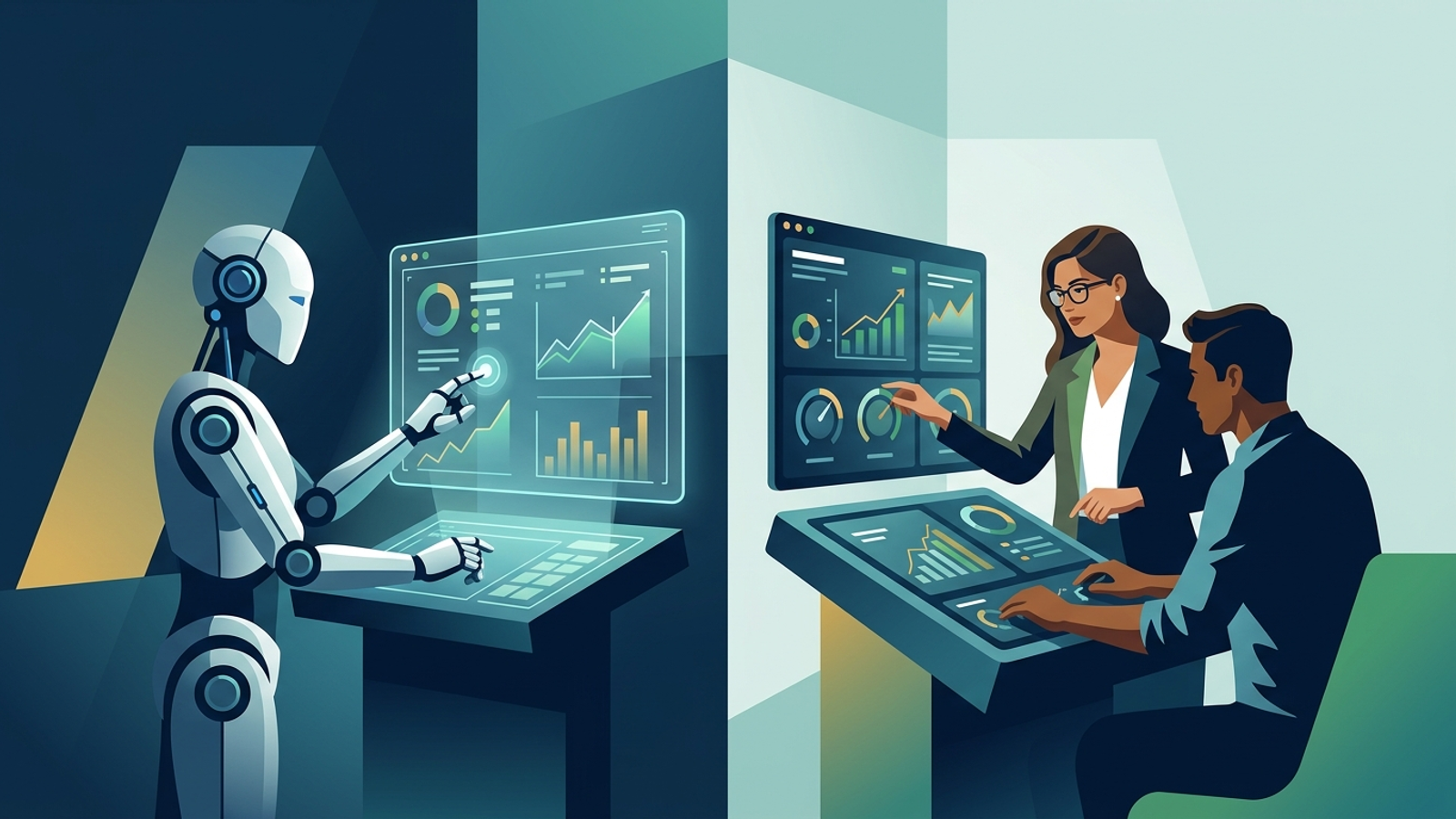
The argument here is not that AI is bad or that humans should manage Google Ads manually. That ship sailed years ago, and the case for account managers working the old way has weakened considerably. The argument is that the best outcomes come from a specific structure: let the engine handle what it handles better than humans (bid optimization, pattern recognition, speed of execution), and let senior humans handle what the engine cannot (strategic judgment, business context, creative differentiation, risk assessment).
This is not a compromise. It is the architecturally correct way to run Google Ads at scale. The accounts that outperform are not the ones with the best AI or the best strategist. They are the ones where those two layers work in a structured rhythm, with clear ownership of what each layer controls.
The groas Approach: Engine Does What It Does Best, Strategists Do The Rest
This is precisely what groas is built to do. A proprietary engine trained on over $500 billion in profitable ad spend runs execution around the clock: bid adjustments, pattern detection, budget pacing, auction-level optimization. It does not sleep, does not lose focus, and does not cap out at whatever one person can physically get through in a week.
On top of that engine, the human layer operates differently depending on the product. For businesses that want Google Ads fully handled, groas offers a fully managed service where a dedicated senior strategist owns every strategic decision: budget allocation, creative direction, market response, compliance, and the judgment calls no engine can make. For teams with in-house Google Ads knowledge, groas pairs the engine with a strategist who works alongside your team while you stay in control. And for agencies managing client accounts, groas provides direct access to the engine so agency media buyers can scale execution across unlimited accounts without hitting the ceiling of manual work.
The core difference from every other option: groas does not ask you to choose between AI speed and human judgment. The engine handles execution at machine scale. The strategist handles everything that requires thinking about the business, not just the account. Month-to-month, no long-term contracts, $0 onboarding. groas earns the next month by performing.
What To Ask Any AI Google Ads Platform About Its Limitations
If you are evaluating any AI-powered Google Ads solution, these questions separate the serious options from the marketing:
When the model encounters a market shift it has not seen before, what happens? Who intervenes, how fast, and based on what information?
How do you incorporate offline conversion quality data, and who decides when the model's optimization target is wrong?
What is your process for brand safety beyond static exclusion lists?
Who makes budget allocation decisions when the right call requires business context the model does not have?
Under what circumstances would you recommend pausing spend entirely, and who makes that call?
If the answer to any of these is "the AI handles it," that tells you everything about where the ceiling is. The gap between what these tools grade as "good" and what actually drives profitability is well documented.
The Bottom Line: Autonomous Execution Is Not The Same As Autonomous Strategy
The limitations of AI Google Ads management are not temporary gaps waiting to be patched in the next model update. They are structural. Strategic decisions require business context, judgment under uncertainty, and the ability to question whether the current approach should exist at all. These are not engineering problems. They are human problems.
The accounts that win are not the ones running the most advanced AI. They are the ones that pair autonomous execution with deliberate, senior-level strategic oversight in a structured collaboration. The engine does what engines do best. Humans do what humans do best. Neither layer pretends to do the other's job.
If you are currently running Google Ads with a pure-AI tool and wondering why performance plateaus or degrades in ways the dashboard cannot explain, the answer is almost certainly in one of the seven gaps above. And if you are relying on a traditional agency where a single account manager is both the strategist and the executor, you are paying for a ceiling that gets lower every month.
groas eliminates both failure modes. The engine runs execution 24/7 at a scale no human team matches. The strategist makes the calls no engine should. Whether you want that fully managed, collaborative with your team, or powering your agency underneath, the structure is the same: the right layer handling the right decisions, every hour of every day.
For businesses that want Google Ads fully handled: apply for groas. For teams that want the engine plus a strategist alongside them: get started with groas. For agencies ready to scale execution: start your 7-day free trial.
The question is not whether AI should run your Google Ads. It is whether AI should run your Google Ads alone. The answer, for any account where the numbers actually matter, is no.
Frequently Asked Questions
What Are The Main Limitations Of AI Google Ads Management?
The core limitations of AI Google Ads management are structural, not technical. AI cannot recognize when a market has fundamentally shifted, interpret offline conversion quality, apply brand safety judgment in real time, craft genuinely differentiated creative concepts, navigate legal and compliance restrictions, make budget allocation calls that require business context, or decide when to stop spending entirely. These are judgment problems, not optimization problems. AI excels at bid-level execution and pattern recognition at scale, but it cannot replace the strategic thinking that determines whether an account scales profitably or simply scales a mistake faster.
Can AI Fully Replace A Human Google Ads Strategist?
No. AI can replace the manual execution work a human strategist does, like bid adjustments, pacing, and auction-level optimization. But it cannot replace strategic judgment: reading market shifts, understanding offline lead quality, making budget decisions based on business context, or knowing when to stop spending. The best-performing accounts pair AI execution with senior human strategy. groas is built on this exact model, with a proprietary engine handling execution 24/7 and senior strategists making every strategic call the engine cannot.
What Does "Set It And Forget It" Get Wrong About Google Ads AI?
The "set it and forget it" narrative conflates execution with strategy. AI bidding tools genuinely optimize auctions better than humans. But they cannot question whether the optimization target itself is correct, whether market conditions have changed, or whether the business context has shifted. Accounts that run on autopilot often see performance degrade in ways the dashboard does not surface, like declining lead quality, brand safety exposure, or budget misallocation. Human oversight is not interference with the algorithm. It is the layer that catches the problems algorithms are structurally unable to see.
What Are The Risks Of Using AI Google Ads Tools Without Human Oversight?
The primary risks include optimizing toward low-quality conversions, continued spending during market shifts or broken funnels, brand safety exposure from emerging placement risks, compliance violations in regulated industries, and budget misallocation when business priorities change. AI tools optimize within the system they are given. Without human oversight interpreting what happens outside the account, whether in the sales pipeline, the competitive landscape, or the regulatory environment, the engine keeps executing confidently toward outcomes that may no longer serve the business.
How Does groas Handle The Gap Between AI Execution And Human Strategy?
groas pairs a proprietary engine trained on over $500 billion in profitable ad spend with senior human strategists. The engine runs execution around the clock: bidding, pattern recognition, budget pacing, and auction-level optimization at a speed and scale no human team matches. The strategist handles everything that requires business context and judgment: market shifts, creative direction, budget allocation, compliance, and the decision to change course or stop spending entirely. This structured collaboration is available fully managed, alongside your in-house team, or as an engine agencies operate directly.
What Should I Ask An AI Google Ads Tool Before Signing Up?
Ask how the system handles situations the model has not seen before, who intervenes during market shifts, how offline conversion quality is incorporated, what the brand safety process looks like beyond exclusion lists, and under what circumstances they would recommend pausing spend entirely. If every answer points back to "the AI handles it" with no human judgment layer, you are looking at a tool with a hard ceiling on strategic performance. The best solutions combine engine-level execution with senior human oversight.
Is AI Good Enough To Manage Google Ads For Complex Or Regulated Industries?
AI execution is valuable in every industry, but complex and regulated verticals like legal services, healthcare, and financial services expose AI's limitations most clearly. Advertising restrictions change by jurisdiction and sometimes by the week. Google's policy enforcement is inconsistent. Compliance decisions require judgment that no model currently possesses. In these verticals especially, human strategic oversight is not optional. It is the difference between running ads and having your account suspended.
Why Do AI-Optimized Google Ads Accounts Still Hit Performance Plateaus?
Performance plateaus in AI-managed accounts typically trace back to one of the seven strategic gaps AI cannot address: a market that shifted without the model recognizing it, optimization toward the wrong conversion type, stale creative that the AI iterates on without originating new concepts, or budget allocation that no longer matches business priorities. The engine keeps optimizing within its constraints, but if the constraints themselves are wrong, optimization just means reaching the wrong ceiling faster. Breaking through requires the kind of strategic reassessment only a human can perform.
How Do I Know If My Google Ads Account Needs Human Strategy On Top Of AI?
If your CPA has risen without a clear cause, if lead quality has declined while conversion volume looks stable, if you are in a regulated industry, if your business priorities have shifted but your campaigns have not, or if you cannot explain why performance changed, your account likely needs human strategic oversight. These are the patterns that AI tools miss because they optimize within the account without visibility into the business. Any account where the numbers actually matter benefits from structured collaboration between engine execution and human judgment.