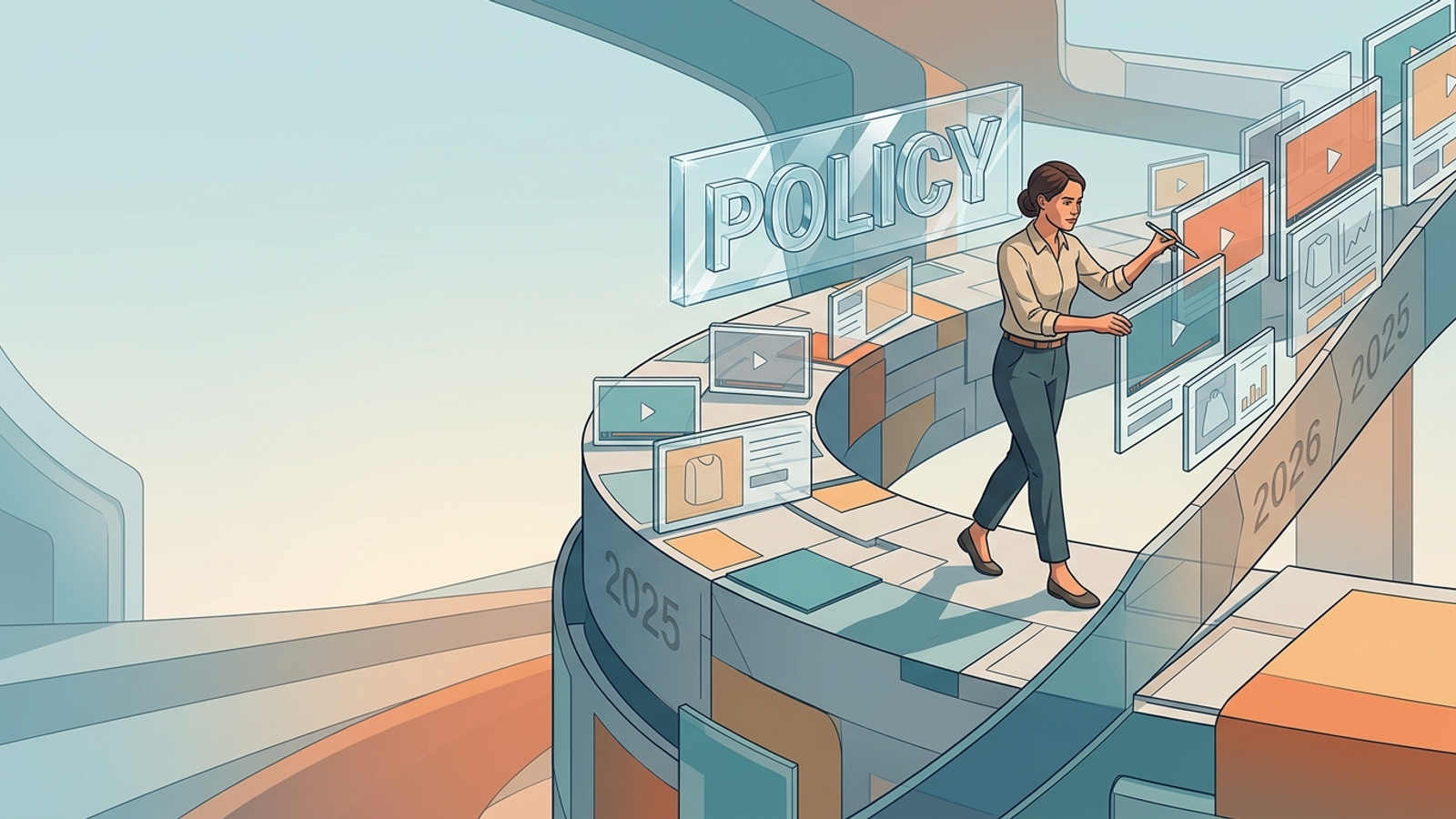
YouTube Ads in 2026: Why Frequency Is Rising and What to Fix First
YouTube ad loads are getting denser. See the policy requirements, placement problems, and frequency controls that can protect your CPA.
September 4, 2026
•
min read



If your Google Ads agency cannot show you exactly how their work translates into pipeline and revenue, that is a red flag. A Google Ads agency underperforming is one that hides behind vanity metrics, avoids structural changes, and runs your account on autopilot while billing you monthly for "management." The 12 red flags below are specific, measurable signals that your agency is coasting, not optimizing. Each one includes what to look for in your own data, what questions to ask, and how to decide whether the issue is fixable or whether you need a fundamentally different execution model.
Most advertisers only catch these problems after months of stagnant or declining results. By then, you have lost budget, lost time, and often lost competitive ground that takes quarters to recover. This guide gives you the lens to spot underperformance early and act on it before the damage compounds.
The traditional agency model creates a structural conflict around transparency. Your agency earns a percentage of your ad spend or a flat monthly retainer. In either case, the incentive is to keep you paying, not to surface problems that might make you question the relationship. Account managers are rarely rewarded for telling a client that the current campaign structure is fundamentally broken. They are rewarded for keeping churn low.
This means most agencies default to reporting what looks good: impressions are up, clicks grew 14%, CTR is above the industry benchmark. None of those metrics tell you whether the money you spent generated revenue. But they fill a slide deck nicely.
The most damaging signs your Google Ads agency is not delivering live in the data they do not include in their reports. Search term reports, auction insights trends, conversion quality breakdowns, impression share by campaign, budget pacing curves. These are the numbers that reveal whether your agency is actively managing your account or letting automation run unsupervised. If you have never seen these in a report, that is your first signal.
An agency that leads its monthly report with impressions and clicks is telling you it does not want to be measured on outcomes. Impressions measure reach. Clicks measure intent at best, accidental taps at worst. Neither tells you whether those clicks turned into leads, sales calls, or revenue.
Ask your agency to show you cost per qualified lead, cost per acquisition, or revenue attributed to Google Ads. If they cannot produce these numbers, it means either conversion tracking is broken (which is itself a red flag) or they have never set up reporting to measure what actually matters. A credible agency ties every dollar of ad spend to a downstream business metric, even if attribution is imperfect.
When reporting centers on vanity metrics, bad campaigns survive. A campaign burning $3,000 a month on broad match terms that generate clicks but zero conversions will look fine in a report that only shows CTR. It will look like a fire in a report that shows cost per revenue dollar.
Seasonality is real. But if your cost per conversion has climbed for three or more consecutive months and the explanation is always "seasonality" or "market conditions," your agency is deflecting. Costs rise for specific, diagnosable reasons: increased competition in your auction, degraded ad relevance, audience fatigue, landing page issues, or bid strategy misconfiguration.
Pull your auction insights report. If competitor overlap and impression share have shifted, market pressure is a plausible factor, but the response should be strategic adjustment, not a shrug. Ask what the agency has changed in response to rising CPAs. If the answer is "nothing, we are monitoring," that is not management. That is observation.
A rising CPA with no corresponding strategic change is one of the clearest signs your Google Ads agency is underperforming.
Google Ads accounts are not static environments. Your competitors change bids, Google rolls out new features and formats, search behavior evolves, and your own business changes. An account structure that made sense six months ago may be leaking budget today.
Log into your Google Ads account (you should always have owner-level access) and look at campaign creation and modification dates. If every campaign was built during onboarding and nothing has been added, split, consolidated, or restructured since, your agency is running on autopilot. A healthy account shows regular structural iteration: new campaigns tested, underperformers paused, ad groups refined based on search term data.
This is a pattern groas sees repeatedly when onboarding advertisers who are leaving traditional agencies. Accounts that were "set and forget" from day one, with structures that no longer match the advertiser's current product mix, margin profile, or competitive landscape. The ecommerce brand that recovered revenue by fixing Google Ads structure is a direct example of what happens when this red flag goes unaddressed.
If your agency's monthly update reads like a weather report ("performance was stable, we continue to optimize"), you have no visibility into what work is actually being done. "Optimization" is not a deliverable. It is a category.
Request a change log. Every bid adjustment, every keyword added or paused, every ad copy test launched, every audience modified. A competent agency should be able to produce this in minutes because any disciplined operation keeps records. If they cannot, it suggests that either very little was changed or the work was done haphazardly without documentation.
This opacity is one of the structural problems with the traditional agency model. You are paying for hours you cannot verify, applied to changes you cannot see, producing outcomes you cannot attribute to specific actions.
Google's automated bidding strategies (Target CPA, Target ROAS, Maximize Conversions) are powerful, but they are not set-and-forget systems. They need different targets at different budget levels. They behave differently when conversion volume changes. They need recalibration when you add new campaigns or change conversion actions.
Check your bid strategy reports. If your Target ROAS or Target CPA has been the same value since the strategy was first applied, and your account has grown or shifted meaningfully in that time, your bidding is probably leaving money on the table or actively limiting scale. An agency that treats Smart Bidding as a one-time setup is outsourcing thinking to Google's algorithm without supervision. That is exactly the kind of ROAS target rigidity that kills growth.
Negative keyword management is one of the clearest indicators of active account management. Every search campaign generates irrelevant queries. If nobody is reviewing search term reports and adding negatives regularly, you are paying for clicks that will never convert.
In your Google Ads account, look at the modification history of your negative keyword lists. If the last update was months ago, your agency is not doing basic hygiene. Pull your search terms report for the last 30 days and look for queries that are obviously irrelevant. If you can find them in five minutes, your agency should have caught them weeks ago.
This is one of the most common and preventable sources of wasted spend. For a deeper look at how negative keyword mistakes cost conversions, and why the fix is not always as simple as adding more terms, it is worth understanding the nuance that many agencies miss entirely.
Performance Max campaigns are Google's most automated campaign type, and they are also the easiest to set up lazily. An agency that launches PMax with default asset groups, no brand exclusions, and no audience signals is essentially handing Google a budget and hoping for the best.
Look at your PMax campaigns for brand term exclusions (are branded searches cannibalizing your organic traffic?), custom audience signals, and asset group segmentation. If everything runs under a single asset group with Google-selected audiences, your agency has done the minimum. Performance Max cannibalization of branded search is a well-documented problem that any competent agency should be proactively managing.
Your Google Ads performance is only as strong as the page your traffic lands on. An agency that optimizes campaigns but never touches or even comments on your landing pages is optimizing half the funnel and ignoring the half that actually produces conversions.
At minimum, your agency should be recommending landing page changes based on conversion data: which pages convert, which bounce, which convert at volume but with low quality. Better agencies run or coordinate landing page tests. The best operations, like groas in its DFY product, build and iterate on landing pages as part of the core engagement. If your agency has never mentioned your landing pages, ask them why.
A hundred form fills mean nothing if 90 of them are spam, unqualified, or from people outside your service area. Conversion volume is an input metric. Conversion quality is the output that matters.
Ask your agency to segment conversions by quality: qualified vs. unqualified, closed-won vs. dropped. If they cannot, it means they have not integrated with your CRM or built any feedback loop between ad performance and actual business outcomes. Without this loop, the agency has no way to optimize toward the conversions that make you money. They are optimizing toward whatever Google counts as a conversion, which may include duplicate submissions, bot traffic, or low-intent actions. The financial services firm that fixed lead quality demonstrates why this distinction is critical for any business where not all leads are equal.
If your agency is logging in once a day to check spend and manually adjusting budgets, you are exposed to overspend on bad days and underspend on good ones. Budget pacing should be dynamic, responsive to real-time performance data, and protected by automated rules that prevent waste.
Manual pacing means your budget runs at the pace of the person checking it. On a weekend, a holiday, or a day when the account manager is busy with another client, your campaigns can blow through budget on underperforming segments before anyone notices. Automated guardrails are not optional in 2026. They are baseline competence.
Agency staff turnover is a known problem. Media buyers leave, get reassigned, or get promoted. When your account manager changes, institutional knowledge walks out the door. If you found out about the change through a shift in communication style or had to ask, your agency does not prioritize continuity.
Every new account manager needs ramp-up time. During that ramp, your account gets less strategic attention, not more. If the transition is not managed proactively, with documentation, a handoff call, and a clear plan, you will lose weeks or months of momentum. This is one of the core structural weaknesses of the agency model: your results depend on a single person, and you have no control over whether that person stays.
groas solves this structurally. In the DFY model, a dedicated strategist owns your account, but the proprietary engine trained on over $500 billion in profitable ad spend holds the execution knowledge. If a strategist transitions, the engine does not lose context, and the handoff is seamless because the system retains every optimization decision and performance pattern.
A strategy review and a performance report are fundamentally different deliverables. A performance report tells you what happened. A strategy review tells you what should change, why, and what the expected impact is. If you ask for strategy and get a recap of metrics you could have pulled yourself, your agency is not doing strategic work.
Forward-looking recommendations tied to specific data points. Competitive analysis based on auction insights. Budget reallocation proposals with projected impact. New campaign or audience opportunities. Test hypotheses with defined success criteria. If your agency cannot produce this, they are managing tasks, not managing strategy.
Start with specifics. Do not say "we are unhappy with performance." Say "our cost per qualified lead has risen 34% over three months and I have not seen a documented plan to address it." Give the agency a defined window, 30 to 60 days, to respond with a concrete action plan and measurable targets. Most agency relationships can survive one honest conversation. They cannot survive months of passive frustration followed by an abrupt termination.
If you spot one or two red flags and the agency responds with a credible plan and visible execution changes within 30 days, the relationship may be worth continuing. If you spot five or more, or if the agency responds defensively, dismissively, or with another round of vague promises, the pattern is structural and a conversation will not fix it. That is when you evaluate alternatives.
The traditional agency model caps your execution at whatever one media buyer can physically get through in a week, and you pay full rate for that ceiling. An in-house hire solves the continuity problem but creates a new one: you are betting your Google Ads performance on the skill and availability of a single person, with no redundancy and no engine underneath.
groas approaches this differently depending on what you need. If you run an agency and want to scale client accounts without adding headcount, the DIY product gives your team direct access to the groas engine, a proprietary system trained on over $500 billion in profitable ad spend, and your media buyers run everything themselves. Start with a 7-day free trial. If you have an in-house team that knows Google Ads but needs better tooling and senior advisory, DWY pairs the engine with a strategist who works alongside your team while you stay in control. Get started through self-serve checkout or apply if you are managing larger spend. If you want Google Ads fully handled, DFY means a dedicated strategist owns your entire account end-to-end, from campaign structure to landing pages, with the engine running execution 24/7. Apply and groas figures out the right plan on the call.
Every product is month-to-month with $0 onboarding and no long-term contracts. groas earns the next month by performing, not by locking you in.
These 12 red flags are not edge cases. They are patterns that show up in the majority of agency-managed Google Ads accounts, because the traditional model incentivizes maintenance over performance and opacity over accountability. If you recognize several of these in your own agency relationship, the issue is probably not the people. It is the model.
The alternative is an execution model where a proprietary engine does the heavy lifting around the clock, a senior strategist provides the judgment layer, and you never have to wonder what changed last month because every action is documented and every result is tied to revenue. That is what groas was built to deliver. Whether you run an agency, manage ads in-house, or want the entire function handled for you, there is a groas product built for how you work. No lock-ins. No onboarding fees. No slide decks full of impressions. Just better Google Ads results, starting immediately.
The clearest signs your Google Ads agency is underperforming include reporting that focuses on vanity metrics like impressions and clicks instead of revenue, rising cost per conversion with no strategic response, stale campaign structures that have not changed in months, and an inability to show you a detailed change log of what was actually done in your account. If your agency cannot tie its work to pipeline or revenue outcomes, cannot produce conversion quality data, or has not updated negative keyword lists or bid strategies in weeks, those are measurable red flags. Check your account's change history, search term reports, and bid strategy settings directly to verify.
A strong Google Ads report goes beyond impressions, clicks, and CTR. It should include cost per qualified lead or cost per acquisition, conversion quality breakdowns (qualified vs. unqualified), search term analysis with negative keyword updates, auction insights trends showing competitive shifts, budget pacing data, and a clear change log of every action taken. The report should also include forward-looking strategic recommendations, not just a recap of what happened. If your current agency only sends a slide deck with last month's numbers, that is a sign they are reporting, not strategizing.
There is no fixed schedule, but a healthy Google Ads account shows regular structural iteration. New campaigns get tested, underperforming ones get paused, ad groups get refined based on search term data, and bid strategies get recalibrated as volume and goals change. If your campaign structure has not changed in six months, your agency is likely running on autopilot. Competitive landscapes, search behavior, and your own business evolve constantly, and your account structure needs to keep pace.
groas offers a fundamentally different execution model. Instead of capping performance at what one media buyer can do in a week, groas pairs a proprietary engine trained on over $500 billion in profitable ad spend with senior human strategists. Whether you want a fully managed service (DFY), strategic support alongside your team (DWY), or an engine your agency operates directly (DIY), groas delivers execution around the clock with $0 onboarding, month-to-month terms, and no long-term contracts.
Start with a specific conversation. Identify the exact red flags, present the data, and give the agency 30 to 60 days to respond with a concrete action plan and measurable targets. If you spot one or two issues and the agency responds with visible changes, the relationship may be salvageable. If you spot five or more red flags, or if the agency responds defensively or with vague promises, the problem is structural and a new conversation will not fix it. That is when you evaluate alternatives.
Go to your bid strategy reports in Google Ads and look at the history of your Target ROAS or Target CPA values. If the target has been identical since the strategy was first applied and your account has grown or shifted meaningfully, your bidding is probably misconfigured. Smart Bidding needs recalibration as conversion volume changes, new campaigns launch, or conversion actions are updated. An agency that sets it once and never revisits is outsourcing thinking to Google's algorithm without supervision.
Conversion volume counts every action Google classifies as a conversion, which can include spam form fills, duplicate submissions, bot traffic, and unqualified leads. Conversion quality measures how many of those conversions actually became revenue. Without a feedback loop between your CRM and your Google Ads data, your agency optimizes toward volume, not value. groas, particularly through its DFY model, builds this feedback loop into the engagement so that optimization targets the conversions that generate real business outcomes.
An unannounced account manager change is a serious red flag because it signals poor internal communication and puts your account at risk during the transition. Ask the agency for documentation of the handoff, including what institutional knowledge was transferred, what the new manager's ramp plan looks like, and what safeguards are in place to prevent performance dips. groas eliminates this risk structurally: the proprietary engine retains every optimization decision and performance pattern, so even if a strategist transitions, execution continuity is maintained.
Agencies struggling with execution bottlenecks can use the groas DIY product to access the proprietary engine directly. Media buyers run client accounts themselves with the engine handling the heavy lifting underneath. This eliminates common red flags like stale structures, neglected negative keywords, and manual budget pacing, because the engine operates continuously. Agencies keep their brand, their clients, and their margin while scaling capacity without hiring. Start with a 7-day free trial.