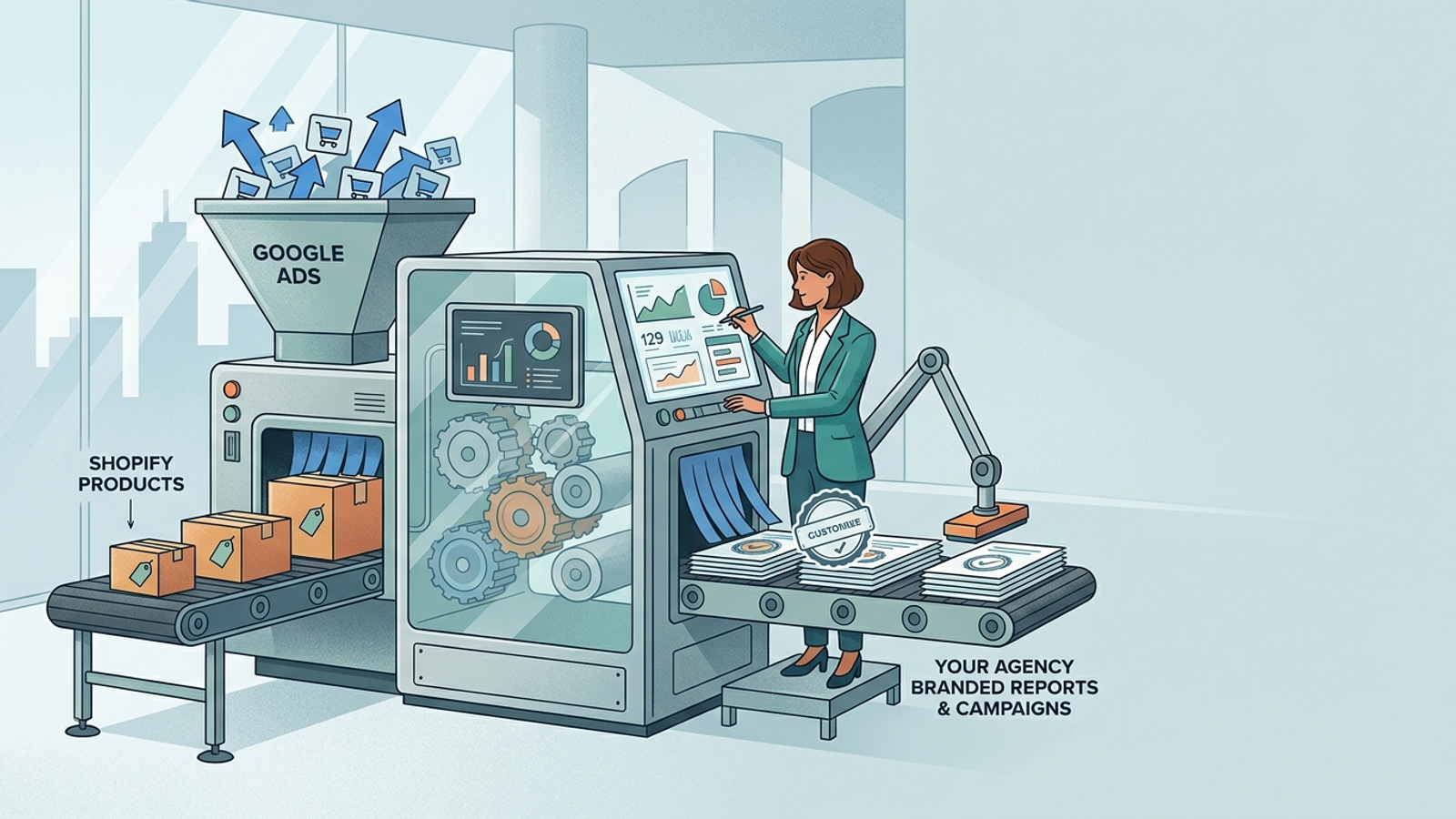
White-labeling Google Ads means delivering paid search management to clients under your agency's brand while an execution engine handles the campaign work behind the scenes. A white label Google Ads agency model lets you scale your client book without hiring account managers, maintain your margins, and deliver performance that keeps clients retained month after month.
This guide walks through every step of building a white-label Google Ads operation in 2026, from defining service tiers and selecting an execution engine to onboarding clients, building reporting, pricing for margin, and retaining accounts at scale. By the end, you will have a repeatable system for running 20, 30, or 50 Google Ads clients without adding a single account manager to your payroll.
You will need: an agency MCC (My Client Center) in Google Ads, a clear picture of your current client count and average ad spend per client, a reporting tool or willingness to set one up, and a pricing model you are willing to rethink.
Before You Start
Before building a white-label Google Ads service, get three things sorted.
First, audit your current delivery. How many hours does each account actually consume per week? Most agencies undercount this because they do not track the time spent on bid adjustments, search term reviews, and ad copy testing separately from "strategy" time. Get real numbers.
Second, know your margins. If you are charging $1,500 per month per client and an account manager costs $5,000 per month fully loaded, you need at least four clients per manager just to break even on labor. That is before overhead, tools, and your own margin.
Third, decide what "white label" means for your agency. It ranges from full-service delivery (the engine does everything, you present the results) to partial execution (the engine handles bidding and optimization, your team handles creative and client communication). The answer shapes every decision that follows.
Step 1. Define Your White-Label Service Tier Structure
Your service tier structure determines what clients receive, what the engine handles, and where your team spends time. Getting this wrong creates scope creep, margin erosion, and client confusion.
What To Include In A Fully White-Labeled Google Ads Package
A complete white-label Google Ads package covers: campaign builds, keyword research, ad copy creation, bid management, audience targeting, search term mining, negative keyword management, landing page recommendations, and performance reporting. The engine should handle all of these. Your team handles the client relationship, strategic framing, and upsells.
Tiering By Ad Spend: When To Use Light-Touch Vs. Full Execution
Build at least two tiers. A light-touch tier (typically for clients spending under $5,000 per month in ad spend) where the engine runs autonomously and your team reviews performance weekly. A full-execution tier (clients spending $10,000 or more) where you layer in proactive strategy recommendations and more frequent communication. The gap between the two is not the engine's work. It is your team's attention. As discussed in why agencies underperform at scale, the bottleneck is always human attention, not technical execution.
Setting Client Expectations Around Access And Reporting Frequency
Spell out in your service agreement: clients get view-only access to their Google Ads account (or no direct access, depending on your model), reports delivered weekly or biweekly, and a strategy call monthly. Setting this upfront prevents the "why did you change my bids" conversations that drain account manager time.
Step 2. Choose The Right Execution Engine For Your Brand
The engine you pick determines your delivery ceiling. Choose wrong and you are right back to hiring account managers to patch the gaps.
Rule-Based Tools Vs. AI-Assisted Platforms Vs. Autonomous Engines
Rule-based tools (scripts, automated rules inside Google Ads) break the moment an account gets complex. AI-assisted platforms (Optmyzr, Adalysis, and similar) help your team work faster but still require a human to make every decision. Autonomous engines run execution continuously, adjusting bids, testing ads, mining search terms, and reallocating budget without waiting for a person to log in. For a white-label operation, the question is simple: does the engine reduce the human hours per account enough to change your economics?
What To Look For: Attribution Depth, Scalability, Reporting White-Labeling
Evaluate any execution engine on four criteria. Attribution depth: can it tie performance back to actual business outcomes, not just clicks and conversions? Scalability: does adding 10 more accounts require 10 times the setup work? Reporting: can output be white-labeled under your agency brand? And continuity: does it work 24/7, including weekends and holidays when your account managers are offline? For a deeper comparison of agency tools, see 8 Google Ads agency tools to scale past 20 client accounts.
How The groas Engine Works As An Agency Execution Layer
groas built its DIY product specifically for this use case. Agencies connect unlimited client accounts under one subscription through the groas engine, a proprietary system trained on over $500 billion in profitable ad spend. The agency keeps the client relationship, the brand, and the margin. groas powers the execution underneath. It is a reseller channel: your clients never see groas, they see your agency. The engine handles bidding, optimization, search term analysis, and continuous testing around the clock. Your media buyers stop drowning in repetitive tasks and start focusing on strategy and client retention. There is no onboarding fee, no long-term contract, and you can start with a 7-day free trial.
Step 3. Build Your Client Onboarding System
A repeatable onboarding system is what separates agencies running 8 accounts from agencies running 50. Every new client should follow the same sequence with minimal custom work.
Access Requirements, Billing Setup, And Goal Alignment
For each new client, collect: Google Ads account access (invite your MCC as a manager), conversion tracking verification (confirm that the right actions are tracked and firing), billing ownership clarity (client pays Google directly, you charge your management fee separately), and goal definition (CPA target, ROAS target, or lead volume target with a quality qualifier).
The Onboarding Documents And Workflows Agencies Use At Scale
Create three standard documents. First, an onboarding questionnaire covering business model, target audience, competitive landscape, seasonality, and historical performance. Second, a technical checklist: conversion tracking, Google Analytics 4 linking, Google Merchant Center (if applicable), and remarketing audiences. Third, a kickoff summary you send back to the client confirming goals, timelines, and reporting cadence. These three documents, templatized, cut onboarding time to under two hours per client.
How To Set Up MCC Access For Multi-Client Management
In your Google Ads MCC, request manager access to each client account. Set the access level to "admin" so the engine can make changes. Organize accounts by tier (light-touch vs. full-execution) using labels or sub-manager accounts. This structure lets you apply engine settings at scale without opening each account individually. For agencies using groas, connecting a new client account to the engine is handled directly through the MCC, no migration, no rebuilds, no downtime.
Step 4. Create A Reporting Stack Clients Actually Read
Reporting is where client retention is won or lost. Most agencies send reports nobody reads, then wonder why clients leave. For a white-label operation, the report IS your product in the client's eyes.
What To Include In A White-Label Google Ads Report
Include: a top-line summary (spend, conversions, CPA or ROAS, trend vs. prior period), a brief narrative explaining what happened and what is changing next, campaign-level performance broken out by objective, and one insight the client did not ask for. Skip vanity metrics like impressions and CTR unless they serve a specific strategic point. Agencies that tie reports to outcomes rather than activity metrics see significantly lower churn.
Connecting Performance Data To Business Outcomes
The strongest white-label reports translate Google Ads data into business language. Instead of "CPA dropped 12%," write "you acquired 14 more customers this month at the same budget." If your client sells services, show cost per qualified lead. If they sell products, show ROAS against their margin threshold. This is where the gap between tools and real execution becomes obvious.
Automated Reporting Cadences That Keep Clients Retained
Set up automated report delivery: a brief performance snapshot weekly (can be automated through Looker Studio or your reporting tool), a full performance review monthly, and a quarterly business review (QBR) where you present strategy. Automate everything except the QBR narrative. Consistent delivery signals competence even when results temporarily dip.
Step 5. Set Margin-Protective Pricing For White-Label Delivery
Pricing is where most white-label Google Ads operations fail silently. You acquire clients, deliver results, and still lose money because the pricing model does not scale.
Why Percentage-Of-Spend Pricing Destroys Agency Margins At Scale
Percentage-of-spend pricing (charging 15-20% of ad spend) works at low spend levels but collapses as accounts grow. A client spending $100,000 per month does not require 10 times the work of a client spending $10,000, but you are paying your engine and your team as if it does. Worse, when clients cut spend during slow months, your revenue drops while your costs stay flat.
Flat-Fee And Value-Based Models That Protect Profitability
Flat-fee tiers (e.g., $X for accounts spending $5-10K, $Y for $10-25K) give you predictable revenue per client. Value-based pricing (tied to outcomes like leads generated or revenue influenced) aligns incentives but requires strong attribution. Most agencies running white-label at scale use a tiered flat-fee model with performance bonuses for accounts that hit specific targets.
How To Price White-Label Google Ads Without Losing The Client
Price against the alternative, not your costs. Your client's alternative is hiring an in-house person ($5,000 or more per month fully loaded, plus onboarding, plus management overhead) or going to a traditional agency ($5,000+ onboarding fees and 6-12 month lock-ins). Your white-label service with $0 onboarding, month-to-month commitment, and engine-powered execution is a fundamentally different value proposition. Lead with that positioning.
Step 6. Scale The Book Without Adding Headcount
This is the entire point. Scaling past 20 clients without proportionally scaling headcount requires deliberate workflow design and the right engine underneath. See also: 7 ways Google Ads agencies scale revenue without adding headcount.
Account Manager Ratios: How Many Clients Per Strategist
In a traditional agency, one account manager handles 8-12 clients before quality drops off a cliff. With an autonomous engine handling execution, one strategist on your team can effectively oversee 20-30 accounts because the day-to-day bid changes, search term reviews, and ad testing happen without them. Their role shifts from "doing the work" to "reviewing the engine's work and managing the client relationship." This distinction is critical.
The Workflows That Let One Person Run 20 Accounts Well
Structure your week. Monday: review engine alerts and performance anomalies across all accounts. Tuesday through Thursday: proactive strategy work on your highest-spend accounts and any flagged underperformers. Friday: client communication, report review, and next-week planning. Block time for each activity. The moment your team starts reacting to client emails in real time, the entire system collapses.
When To Bring A Human Strategist In Vs. Let The Engine Run
Let the engine run on: bid adjustments, budget pacing, ad rotation testing, negative keyword additions from search term analysis, and audience refinements. Bring a human in for: new campaign launches, major strategic pivots, seasonal planning, landing page strategy, and anything that requires understanding the client's business context. groas handles this split cleanly for agencies using the DIY product. The engine runs 24/7. Your team engages when strategy demands it.
Step 7. Retain Clients By Tying Performance To Their Goals
Acquiring white-label clients is expensive. Retaining them is where profit compounds. The agencies that keep clients longest are the ones that avoid the mistakes that drive churn.
QBR Frameworks That Reduce Churn
Run a quarterly business review for every client, not just the big spenders. The QBR covers: performance against the goals set at onboarding, what changed in the competitive landscape, what the engine tested and what worked, and the strategy for the next 90 days. Keep it to 30 minutes. A QBR that runs over an hour signals disorganization, not thoroughness.
Proactive Communication That Prevents Surprise Cancellations
Most clients do not leave because of bad results. They leave because they feel ignored. Set up proactive alerts: when a client's CPA spikes more than 20%, when spend pacing falls behind, or when a campaign is underdelivering, the client hears from you before they notice it themselves. This single practice eliminates the majority of surprise cancellations.
How To Upsell White-Label Clients Without Losing Trust
Upsells work when they are tied to the client's goals, not your revenue targets. If a client's Google Ads account is performing well and they have budget capacity, recommend expanding to YouTube or Performance Max before they ask. If their landing pages are leaking conversions, flag it with data and offer the fix. The agencies that scale past $1 million in annual revenue almost always do it through expansion revenue from existing clients, not new logos alone.
Common Mistakes To Avoid
Choosing an engine that requires per-account setup work. If onboarding each new client to your execution engine takes hours of configuration, you have not actually solved the scalability problem. Look for engines where connecting a new account is measured in minutes.
Letting clients access the engine directly. The moment a client sees the tool behind the curtain, your agency's perceived value drops. Keep the engine behind your brand. Clients get reports and strategy, not dashboards.
Underpricing to win clients. White-label Google Ads is a premium service. Competing on price attracts clients who churn the fastest and complain the most. Price for the value of your execution quality and the engine's capabilities.
Skipping the QBR. Agencies that skip quarterly reviews see meaningfully higher churn. The QBR is not optional. Build it into your delivery workflow from the first client.
Treating all accounts the same. A $3,000 per month spend account and a $50,000 per month spend account need different attention levels. Tier your service delivery and your internal workflows accordingly.
Ignoring landing page performance. You can run perfect Google Ads campaigns and still fail if the landing page does not convert. Include landing page audits in your service, or partner with an engine that addresses post-click performance.
How groas Powers White-Label Google Ads For Agencies
Everything described in this guide, from tier structure to execution to scaling past 20 clients, is exactly what the groas DIY product was built to enable. Agencies connect unlimited client accounts under one subscription. The proprietary engine, trained on over $500 billion in profitable ad spend, handles execution 24/7: bidding, optimization, search term management, and continuous testing. Your team provides the strategy layer, client communication, and brand.
There are no onboarding fees. No long-term contracts. You cancel anytime. The engine runs under your brand, your clients never see groas, and you keep your margin.
The difference between groas and bolting together a stack of rule-based tools and scripts is the depth of the engine. This is not automated rules reacting to threshold triggers. It is custom-trained models making decisions across every dimension of account management, continuously, informed by patterns from hundreds of billions in ad spend data.
If you are building or scaling a white-label Google Ads operation, start your 7-day free trial and connect your first client account in minutes.
The Bottom Line
Building a white-label Google Ads agency without hiring account managers is not a theory. It is an operational model that hundreds of agencies are running right now. The sequence is clear: define your service tiers, select an execution engine that actually eliminates human hours per account, systematize onboarding and reporting, price to protect your margins, and retain clients by tying everything back to their business goals.
The agencies that execute this well are scaling their client books while their competitors are posting job listings for account managers they cannot afford. The engine you choose determines whether you join the first group or stay stuck in the second. groas was built specifically for agencies in this position. No onboarding fees, no lock-ins, unlimited client accounts, and a proprietary engine that does not stop working when your team logs off. Start your 7-day free trial and see the difference in the first week.
Frequently Asked Questions About White-Label Google Ads For Agencies
What Is A White-Label Google Ads Service For Agencies?
A white-label Google Ads service is an execution layer that runs campaign management behind the scenes while the agency maintains the client relationship, branding, and margin. The agency sells Google Ads management under its own name, but an external engine or provider handles bidding, optimization, ad testing, search term mining, and reporting. The client never knows a third party is involved. This model lets agencies scale their client book without proportionally increasing headcount or delivery costs.
How Many Clients Can One Person Manage With A White-Label Google Ads Model?
With a traditional manual workflow, one account manager typically handles 8 to 12 clients before quality degrades. When an autonomous execution engine handles the day-to-day work (bid adjustments, search term reviews, ad rotation testing), one strategist can effectively oversee 20 to 30 accounts. Their role shifts from doing repetitive tasks to reviewing engine output and managing client communication. groas enables this ratio for agencies through its DIY product, where the proprietary engine runs execution 24/7 and the agency's team focuses on strategy and retention.
How Do I Price White-Label Google Ads Without Losing Margin?
Avoid pure percentage-of-spend pricing, which collapses at scale because larger accounts do not require proportionally more work. Instead, use tiered flat fees based on ad spend brackets, with optional performance bonuses for accounts hitting specific targets. Price against the client's alternative (hiring in-house at $5,000 or more per month, or using a traditional agency with $5,000+ onboarding fees and 6-12 month lock-ins), not against your internal costs.
What Should A White-Label Google Ads Report Include?
A strong white-label report includes: a top-line summary of spend, conversions, and CPA or ROAS with trend comparisons to the prior period; a brief narrative explaining what changed and what is planned next; campaign-level performance by objective; and at least one proactive insight. Skip vanity metrics like raw impressions unless they serve a specific strategic point. Always translate Google Ads data into business outcomes the client actually cares about.
Can I Use groas To White-Label Google Ads For My Agency Clients?
Yes. The groas DIY product is built specifically as a reseller channel for agencies. You connect unlimited client accounts under one subscription. The proprietary engine, trained on over $500 billion in profitable ad spend, handles execution around the clock. Your clients never see groas. You keep your brand, your client relationships, and your margin. There are no onboarding fees, no long-term contracts, and you can start with a 7-day free trial.
What Is The Difference Between Rule-Based Tools And An Autonomous Engine For White-Label Delivery?
Rule-based tools execute pre-set scripts and automated rules inside Google Ads. They break when accounts get complex and still require a human to make every meaningful decision. An autonomous engine, by contrast, runs execution continuously, adjusting bids, testing ads, mining search terms, and reallocating budget without waiting for a person. The difference for agencies is operational: rule-based tools reduce hours per account marginally, while an autonomous engine can fundamentally change your account manager ratio.
How Do I Onboard A New Client Into A White-Label Google Ads System?
Create a standard three-document workflow: an onboarding questionnaire (business model, targets, audience, competitive landscape), a technical checklist (conversion tracking, GA4 linking, remarketing audiences), and a kickoff summary confirming goals, timeline, and reporting cadence. Collect Google Ads MCC manager access, verify billing ownership, and define the primary KPI. With templatized documents, onboarding should take under two hours per client.
How Do I Prevent Client Churn In A White-Label Google Ads Operation?
Run quarterly business reviews for every client. Set up proactive communication alerts for CPA spikes, spend pacing issues, or underdelivering campaigns so clients hear from you before they notice problems. Upsell based on client goals, not your revenue targets. Most clients leave because they feel ignored, not because results are bad. Consistent, proactive communication is the single highest-leverage retention practice.
Do I Need To Give Clients Access To Google Ads If I White-Label?
Not necessarily. Many agencies provide view-only access or no direct access at all, depending on the service agreement. The key is setting expectations at onboarding. Spell out in writing what access the client receives and what reporting cadence they can expect. Keeping clients out of the engine interface protects your agency's perceived value and prevents situations where clients make changes that conflict with the engine's optimizations.
What Is The Fastest Way To Start A White-Label Google Ads Agency?
Define two service tiers (light-touch and full-execution), select an execution engine that connects to your MCC with minimal setup, templatize your onboarding documents, set up automated reporting, and price using tiered flat fees. The fastest path to delivery is choosing an engine like groas that requires no per-account configuration, no onboarding fees, and no long-term contract. You can connect your first client account in minutes and start delivering results the same week.