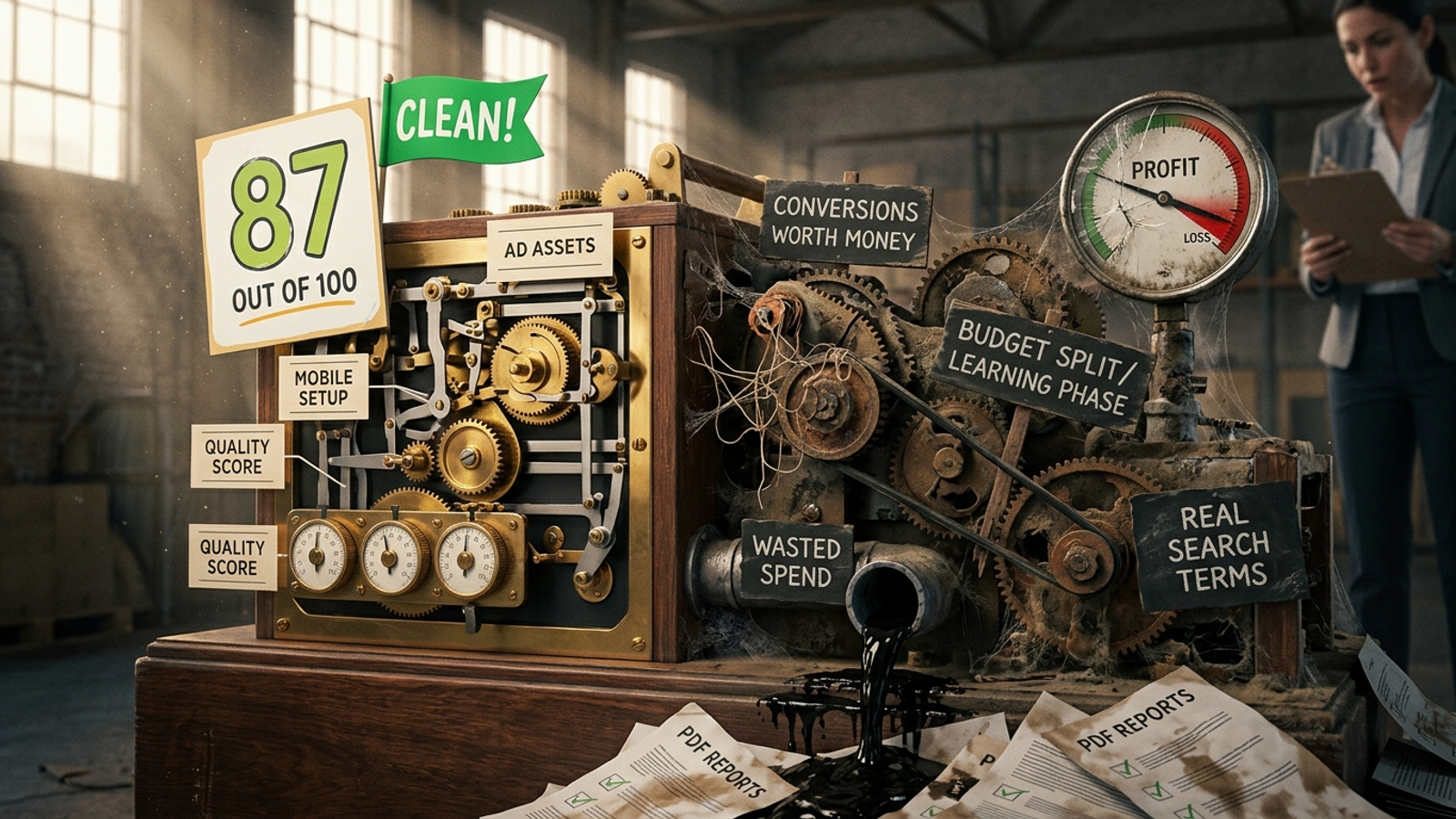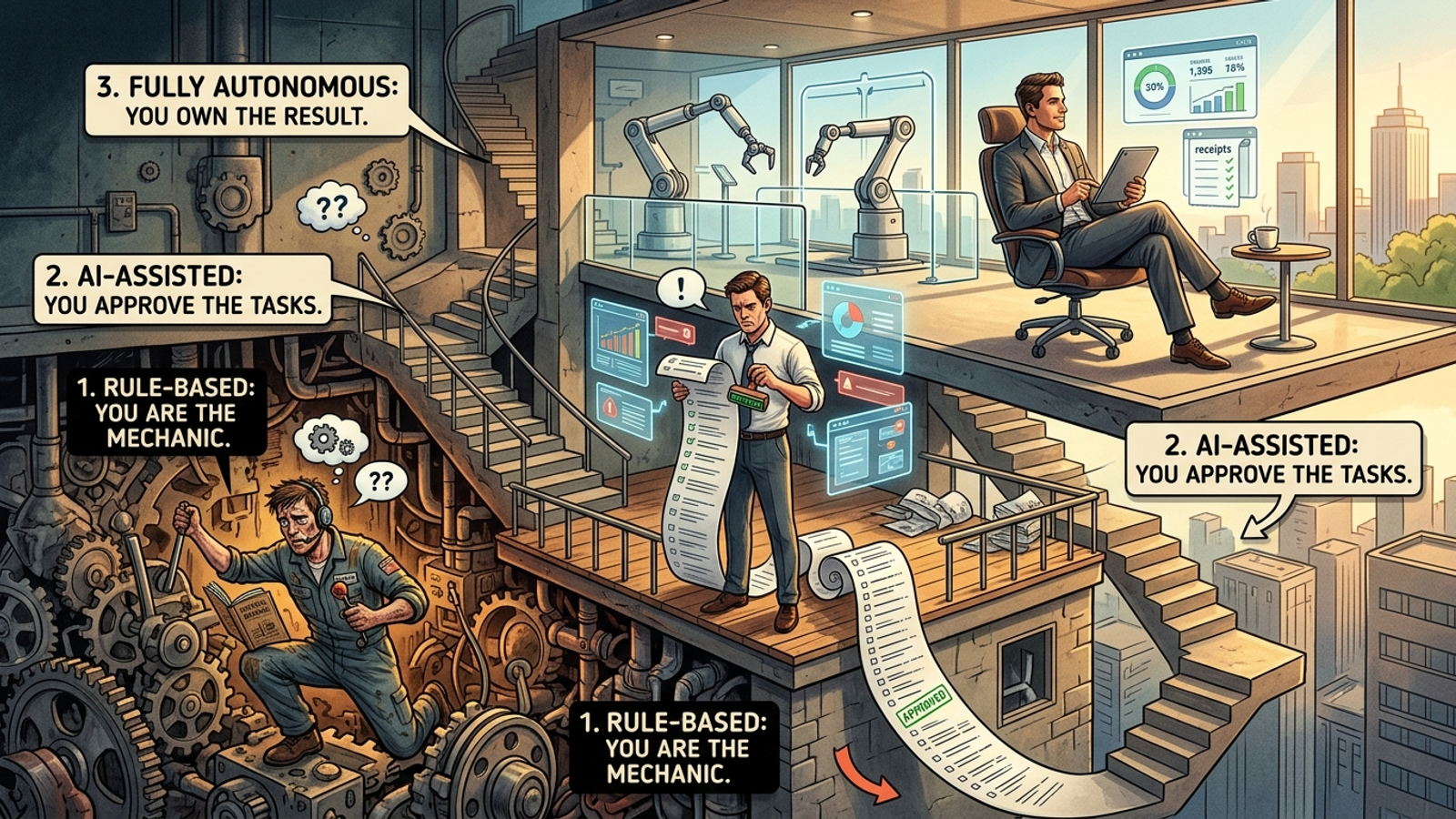
PPC Automation Tools in 2026: Choose by the Work You Still Have to Do
A practical framework for choosing rule-based, AI-assisted, or fully autonomous PPC automation based on workload, spend, control, and team capacity.
September 20, 2026
•
min read


Opteo, Adzooma, and groas represent three fundamentally different approaches to Google Ads management. Opteo and Adzooma are recommendation-based tools that surface suggestions for a human to review and approve. groas is an autonomous management engine trained on over $500 billion in profitable ad spend that executes around the clock, paired with senior human strategists depending on the product tier.
Short answer: groas is the best choice if you are an agency scaling a client book, an in-house team that wants more than suggestions, or a business that wants Google Ads fully handled. Here is why. Recommendation tools like Opteo and Adzooma cap out at the speed a human can click "approve." They create more work as you add accounts. groas removes that ceiling entirely by running execution autonomously while keeping senior human strategy in the loop. If you are comparing opteo vs adzooma vs groas, the real question is whether you want a tool that tells you what to do or an engine that does it.
Opteo: Best for solo account managers handling a small number of accounts who want a second pair of eyes on optimization opportunities. It is a recommendation engine, not an execution engine. You still do all the work.
Adzooma: Best for beginners or small businesses that want a free or low-cost dashboard to surface basic optimizations across Google, Facebook, and Microsoft Ads. It is lighter than Opteo and designed for simplicity over depth.
groas: Best for agencies that want to scale their client book without adding headcount (DIY), in-house teams that want autonomous execution plus a senior strategist (DWY), or businesses that want Google Ads fully managed end-to-end (DFY). groas replaces the tool-plus-human bottleneck with a proprietary engine that executes 24/7, with $0 onboarding, no long-term contracts, and cancel-anytime terms.
Recommendation tools analyze your Google Ads account data and surface suggestions: pause this keyword, raise this bid, test this ad copy. They do not touch your account unless you approve each change individually. The value proposition is clear: they save you the time of finding the optimization. They do not save you the time of implementing it.
This distinction matters more than most comparison articles acknowledge. A recommendation is not an optimization. It is a prompt for a human to evaluate, contextualize, and then execute. Every recommendation that sits unactioned in your queue is wasted potential. Every recommendation you approve without sufficient context could be damaging.
An autonomous engine does not wait for a human to click approve. It executes optimizations continuously based on patterns trained across massive datasets. The groas engine, for example, is trained on over $500 billion in profitable ad spend and operates around the clock. In the DIY product, agencies operate the engine themselves. In DWY, the engine runs underneath while a senior strategist works alongside your team. In DFY, a dedicated strategist owns your account end-to-end with the engine doing the heavy lifting beneath.
The difference is execution velocity. A recommendation tool might surface 30 suggestions on Monday morning. An autonomous engine has already made hundreds of data-backed adjustments over the weekend.
For agencies managing multiple client accounts, the gap between "here is what you should do" and "it is already done" compounds fast. Every account you add to Opteo or Adzooma is another account where a human needs to review, approve, and implement. Every account on the groas engine is another account where execution happens without waiting. This is the core scaling question for any agency evaluating Google Ads optimization tools in 2026.
Opteo connects to your Google Ads accounts and continuously monitors performance data. It generates what it calls "improvements," which are prioritized recommendations covering bid adjustments, keyword management, ad testing, budget allocation, and more. It also provides performance monitoring, reporting dashboards, and alerts when metrics shift significantly.
The interface is clean, and the recommendations are generally sensible. For a single account manager who wants to systematize their optimization workflow, Opteo offers genuine value. It reduces the cognitive load of scanning through Google Ads data and helps you catch things you might miss.
If you manage one to three accounts and you are the only person touching them, Opteo functions as a useful co-pilot. It surfaces patterns you might not notice at the end of a long day. Its recommendations around search term management and bid adjustments are frequently actionable. The alert system catches performance drops before they become expensive.
For this profile, Opteo is a legitimate opteo alternative to manually combing through the Google Ads interface every morning.
Here is where the model breaks down. Opteo cannot execute without your approval. Every recommendation requires you to review it, decide whether it makes sense in context, and click approve. Some recommendations are straightforward. Others require understanding the client's business goals, seasonal patterns, margin structures, and competitive dynamics that Opteo simply does not have.
This means that Opteo's value is entirely gated by the availability and judgment of the human operating it. When that human gets busy, sick, goes on vacation, or simply has too many accounts to review everything, optimizations stall. The tool keeps surfacing suggestions. Nobody acts on them. Performance drifts.
This is not a flaw in Opteo specifically. It is a structural limitation of the entire recommendation-based model. And it is exactly where automation without human strategy breaks down.
Opteo's pricing is based on the number of accounts managed. Plans typically start around $99 per month for a small number of accounts and scale up from there. At the higher tiers, you get more accounts and more features, but the core model stays the same: recommendations that you implement yourself.
For agencies running ten or more client accounts, the per-account cost adds up, and you are still paying your media buyers to do all the implementation work. The tool cost is additive to your labor cost, not a replacement for it.
Adzooma positions itself as a simpler, more accessible alternative to tools like Opteo. It offers automated recommendations, performance scoring, and a rules-based automation engine that can apply certain changes automatically based on triggers you set. It also covers Microsoft Ads and Facebook Ads alongside Google Ads, which gives it broader platform coverage than Opteo.
The rules-based automation is a step beyond pure recommendations. You can set up rules like "pause keywords with cost above X and zero conversions in the last 30 days." This reduces some of the approval bottleneck. But rules-based automation is rigid. It cannot adapt to shifting market conditions, seasonal trends, or competitive dynamics the way a model trained on hundreds of billions in ad spend can.
In the adzooma competitors 2026 landscape, the main alternatives are Opteo, WordStream (now LocaliQ), and various agency-focused audit tools. Compared to Opteo, Adzooma is broader but shallower. It covers more platforms but offers less depth in Google Ads-specific optimization. Compared to WordStream, it is lighter weight and more accessible for smaller advertisers.
Adzooma's free tier makes it an attractive entry point, but agencies managing serious budgets will quickly outgrow the depth of its recommendations. The Adalysis comparison covers similar ground for agencies evaluating audit-style tools.
Adzooma fits best for small businesses or solo marketers who manage a modest budget across multiple platforms and want a single dashboard to catch obvious inefficiencies. It is not built for agencies managing complex, high-spend accounts across a large client book. It is not built for in-house teams that need strategic depth beyond surface-level recommendations.
The groas engine is a proprietary system trained on over $500 billion in profitable ad spend. It does not generate a list of suggestions and wait. It executes, continuously, around the clock. Bid adjustments, budget reallocation, keyword management, audience optimization, and more happen in real time based on patterns the engine recognizes across a dataset that no individual media buyer or recommendation tool can match.
This is the fundamental difference in this google ads optimization tools comparison: recommendation tools augment a human's workflow. The groas engine replaces the bottleneck entirely.
For agencies, the groas DIY product gives direct access to the engine. Agencies connect unlimited client accounts under one subscription, keep their brand, keep their margin, and let the engine handle execution underneath. This is a reseller channel: your clients never interact with groas directly.
The result is that an agency's media buyers stop spending their days clicking "approve" on recommendations and start focusing on strategy, client relationships, and growing the book. There is no onboarding fee, it is month-to-month with no lock-in, and it starts with a 7-day free trial. For agencies evaluating opteo alternatives for agencies, this is a different category entirely. You are not adding a tool on top of your workflow. You are replacing the most time-consuming part of your workflow with an engine that never sleeps.
The Done With You product pairs the engine with a senior human strategist who works alongside your in-house team. Your team stays in the driver's seat. The engine runs underneath doing the heavy lifting. Every other week, you get a strategy call. Every week, you get a report on exactly what was done.
This fits if you have someone in-house who knows Google Ads and you want to keep them running day-to-day operations with better tooling and senior advisory. The strategist brings insights from inside groas's internal team, including policy support and competitor analysis. Your team stays in control. The engine makes them dramatically faster.
The Done For You product is a fully managed service. A dedicated strategist runs your entire Google Ads account end-to-end, owns every decision, and works on everything from the first click to the final conversion, including landing pages and offers. You reach the team on Slack or email around the clock. There is nothing to log into or manage.
If you are a founder or CEO who has been burned by agencies that lock you into retainers and rotate junior staff through your account, DFY is the alternative. No onboarding fee, no long-term contract, and the gap between groas and your current agency shows up in the numbers inside the first few weeks.
Opteo and Adzooma are the right choice if you manage one to three small accounts, your budgets are modest, and you have the time to review and implement every suggestion yourself. If you are a solo freelancer managing a handful of local business accounts and you want a systematic way to catch inefficiencies, a recommendation tool adds value.
Autonomous execution outperforms recommendations the moment you hit one of these conditions: you manage more than five accounts, your total managed spend exceeds what one person can actively optimize in a workweek, you need to scale without hiring, or your clients expect performance improvements that require 24/7 attention rather than Monday-morning batch reviews.
At that threshold, recommendation tools actively slow you down. Every account you add is more recommendations to review, more approvals to click, more context-switching for your team. The groas engine, by contrast, scales without adding human labor.
Based on how recommendation tools function, the breakpoint tends to appear around five to eight actively managed accounts or roughly $50,000 to $100,000 in combined monthly spend. Below that, a recommendation tool plus a skilled human can keep up. Above that, the human becomes the bottleneck, not the tool. And if your accounts involve complex structures, multiple campaign types, dynamic landing pages, or multi-location targeting, the threshold drops even lower.
This is the point where agencies start looking at how to scale Google Ads without hiring and where the autonomous execution model pulls decisively ahead.
Here is the counterintuitive reality of recommendation-based tools at scale: they multiply your task list. Ten accounts on Opteo means ten inboxes of recommendations to review every day. Some are duplicative. Some conflict with each other across accounts. Some require deep context you do not have at 4pm on a Friday. The tool is doing its job. It is surfacing recommendations. But the aggregate effect is that your media buyers are buried in an ever-growing queue of micro-decisions.
This is the same ceiling that traditional agency retainer models hit: performance is capped at what one person can physically get through in a week. Adding Opteo or Adzooma does not raise the ceiling. It just makes the ceiling more visible by showing you everything you are not getting to.
The groas DIY product removes the bottleneck entirely. Agencies connect their client accounts, the engine takes over execution, and media buyers shift from clicking "approve" on hundreds of micro-optimizations to focusing on strategy, client communication, and business development. The engine runs 24/7. It does not accumulate an unreviewed queue. It does not need someone to batch-process recommendations on Monday morning.
Unlimited client accounts under one subscription. $0 onboarding. Month-to-month, cancel anytime. Start with a 7-day free trial and see the difference in the first week.
The comparison between opteo vs adzooma vs groas is not really a three-way race. Opteo and Adzooma are playing the same game: surface recommendations, wait for humans. groas is playing a different game: execute autonomously, with senior human strategy layered on top where it belongs.
Against a traditional agency, groas starts instantly (no 2-4 week onboarding), works 24/7 (not business hours), charges $0 to onboard (not $5,000+), includes dynamic landing pages (no developer needed), and lets you cancel anytime (no 6-12 month lock-in). Against recommendation tools, groas removes the implementation gap entirely.
The proprietary engine trained on $500 billion+ in profitable ad spend is not something Opteo or Adzooma can replicate with a recommendation algorithm. The human strategist layer (in DWY and DFY) is not something any tool can offer. And the DIY agency product gives you engine-level execution without giving up your brand, your client relationships, or your margin.
Continuity matters too. groas never leaves. Agency staff rotate. Employees quit. Freelancers ghost. The engine runs the same way on day 300 as it does on day 1, getting smarter the entire time.
If you are a solo freelancer managing two or three small accounts and you need a low-cost way to catch missed optimizations, Opteo is a reasonable choice. If you want the cheapest possible dashboard to scan multiple platforms, Adzooma works.
For everyone else, groas is the clear answer.
If you are an agency scaling a client book, the groas DIY product lets you connect unlimited accounts, run the engine yourself, and stop paying media buyers to click "approve" on recommendation queues. Start your 7-day free trial and measure the difference.
If you are an in-house team that knows your account but wants to move faster and smarter, the DWY product gives you the engine plus a senior strategist while you stay in control. Get started with self-serve checkout or apply if you are running larger budgets.
If you are a founder or CEO who wants Google Ads handled completely, the DFY product puts a dedicated strategist on your account with the engine running underneath, covering everything from the first click to the landing page to the final conversion. Apply and groas will figure out the right plan on the call.
No onboarding fees. No long-term contracts. groas earns the next month every month by performing. The gap between a recommendation tool and autonomous execution shows up fast, and it compounds every week you wait.
Opteo is a solid recommendation engine for solo managers handling a small number of accounts. It surfaces useful optimization suggestions across bidding, keywords, and ad testing. However, it does not execute changes autonomously. Every recommendation requires human review and approval. For agencies managing more than five to eight accounts, Opteo creates an ever-growing queue of micro-decisions that buries media buyers. At that scale, agencies benefit more from an autonomous engine like groas, which executes 24/7 without waiting for a human to click approve, and lets agencies connect unlimited client accounts under one subscription.
The main adzooma competitors in 2026 include Opteo, WordStream (now LocaliQ), Adalysis, and groas. Opteo is deeper on Google Ads-specific recommendations but still requires manual implementation. WordStream is heavier and oriented toward SMBs. Adalysis focuses on ad testing and audits for agencies. groas operates in a fundamentally different category: it is an autonomous management engine trained on over $500 billion in profitable ad spend, paired with senior human strategists, that replaces the tool-plus-human bottleneck entirely rather than adding another layer on top of it.
There is no practical reason to layer a recommendation tool on top of an autonomous execution engine. The groas engine already handles the optimizations that Opteo and Adzooma would recommend, but it does so continuously and without requiring approval. Running both would create redundant workflows. If you switch to groas, the recommendation tool becomes unnecessary because the execution is already happening.
A recommendation tool like Opteo or Adzooma analyzes your Google Ads data and surfaces suggestions for a human to review and approve. An autonomous engine like groas executes optimizations continuously based on patterns identified across massive datasets. The practical difference is execution velocity: a recommendation tool might surface 30 suggestions on Monday morning, while an autonomous engine has already made hundreds of data-backed adjustments over the weekend. The recommendation model is gated by human availability. The autonomous model is not.
The groas DIY product gives agencies direct access to the proprietary engine. Agencies connect unlimited client accounts under one subscription, keep their brand, keep their client relationships, and keep their margin. The engine handles execution underneath while the agency's team focuses on strategy and business development. It is a reseller channel with $0 onboarding, no long-term contract, and a 7-day free trial. Agencies can start immediately without any setup delays.
The breakpoint typically appears around five to eight actively managed accounts or roughly $50,000 to $100,000 in combined monthly spend. Below that, a recommendation tool plus a skilled human can keep pace. Above that, the human becomes the bottleneck, not the tool. If you find your media buyers spending more time reviewing and approving recommendations than doing strategic work, or if your recommendation queue consistently has unactioned items, you have outgrown the model.
No. Every groas product is month-to-month with no long-term contract. You can cancel anytime. There is no onboarding fee. groas earns the next month every month by performing. This is a significant differentiator from traditional agencies that typically lock clients into 6-12 month retainers with upfront onboarding fees of $5,000 or more.
DWY (Done With You) pairs the groas engine with a senior strategist who works alongside your in-house team. Your team stays in the driver's seat and keeps running day-to-day operations with better tooling and expert advisory. DFY (Done For You) is a fully managed service where a dedicated strategist owns your entire Google Ads account end-to-end, including landing pages and offers. DWY fits teams that want to stay hands-on. DFY fits founders and businesses that want Google Ads fully handled without involvement in execution.
Adzooma offers a free tier that provides basic recommendations and a performance dashboard. This makes it accessible for very small advertisers. However, the free tier is limited in depth and automation capability. Agencies managing meaningful budgets will quickly find the recommendations too shallow to drive real performance improvements. The free price point reflects the level of optimization you receive.
Recommendation tools multiply your task list as you add accounts. Ten accounts on Opteo means ten separate queues of recommendations to review, contextualize, and implement daily. Some recommendations conflict across accounts. Others require deep business context the tool does not have. The aggregate effect is that media buyers are buried in micro-decisions rather than focusing on strategy. This is the same ceiling traditional agencies hit: performance is capped at what one person can physically process in a week.