Ads in AI Overviews and AI Mode: What Advertisers Need to Know
Explains ads in AI Overviews and AI Mode for advertisers and how continuous paid plus organic execution applies to AI search surfaces.
September 7, 2026
•
min read


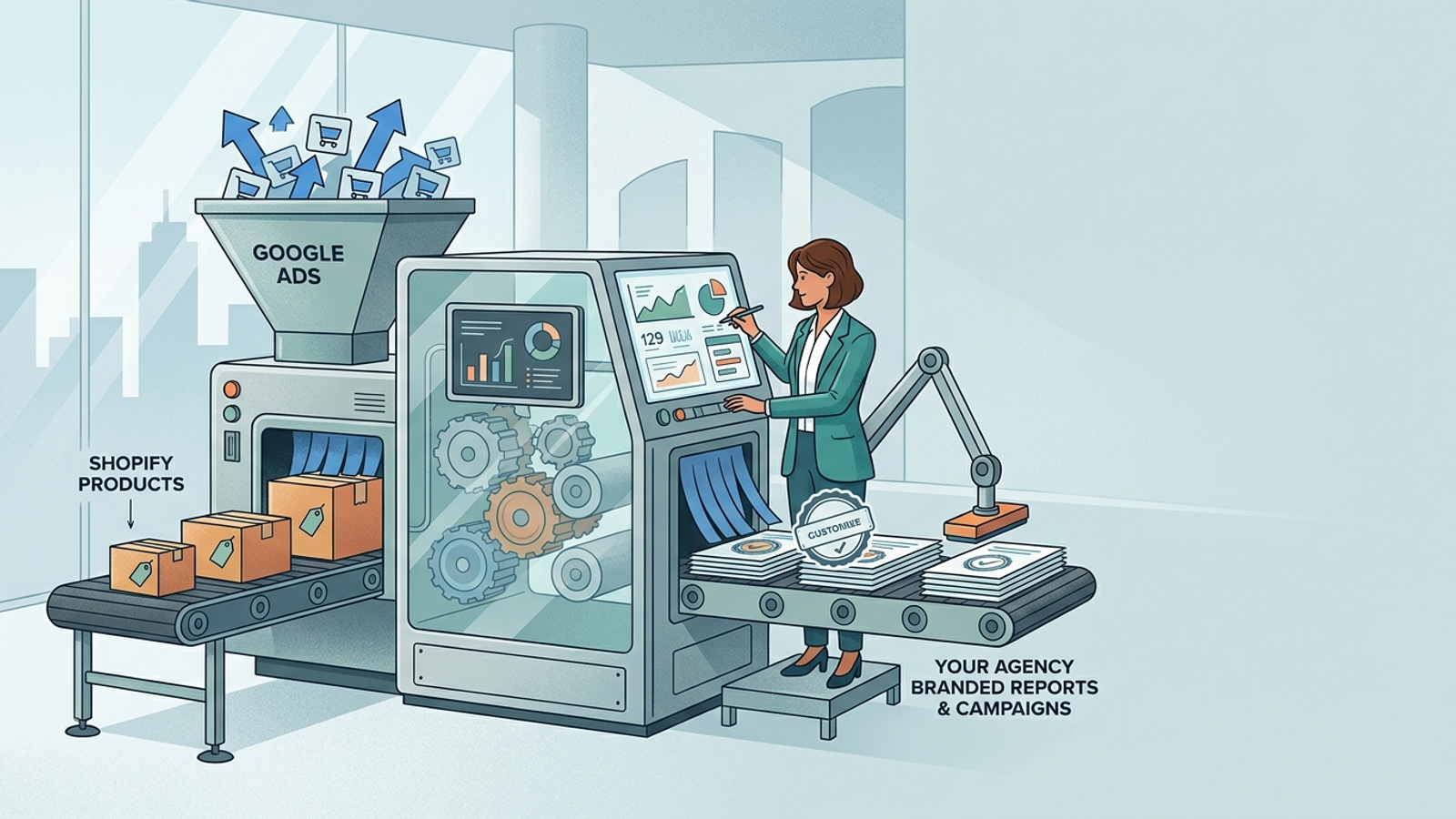
Most small agencies do not need another Google Ads dashboard. They need to stop spending Friday nights pausing out-of-stock products, fixing feeds, and pasting charts into decks that hide the vendor doing the work.
When an agency owner asks me about a white-label Google Ads tool for Shopify, they are usually trying to solve two problems at once: clients want attributable sales without funding an in-house $90,000-a-year media buyer, and the agency wants a dependable retainer without donating 15 hours a week to mechanical work.
I hit this wall years ago. An apparel merchant on Shopify hired me for Google Ads management. I quoted a flat $2,500 monthly retainer, connected the store through a standard app, then spent three months excluding out-of-stock SKUs, writing copy for 400 catalog variants, and pasting numbers into slide decks so the client never saw the tools underneath. After the mechanical chores, my effective hourly rate fell below $20.
A catalog connection is not a campaign-management engine. If you run a small agency, that distinction determines whether white-label PPC protects your margin or quietly eats it.
White-label gets abused in sales decks. For an agency reselling management, it should pass three tests:
If any of those leak, you did not buy white-label. You rented a referral program with a logo-upload field.
That is why I tell agencies to inspect the delivery model on groas for agencies closely. The connection happens once, execution runs underneath, reporting goes out under your brand, and your team remains client-facing.
Takeaway: white-label means you own the client relationship, not just the report cover.
Shopify integration gets abused the same way. Most tools mean they can pull a product catalog into Google Merchant Center. That sync matters, but it is plumbing, not management.
Shopify’s Google & YouTube channel automatically syncs your products to Merchant Center, so listings can update from Shopify admin without a Monday CSV ritual. That is the baseline.
What protects your margin is what happens after the connection:
I learned to watch three things the sync alone will not solve: variants that go out of stock on Friday night and keep spending through the weekend, price mismatches that trigger disapprovals, and titles written for a Shopify collection page that die in a Shopping auction.
Feed health is daily account defense. If you spend $20,000 a month across 800 SKUs, 5% waste on dead variants is $1,000 gone before the report.
When Google sees which products sold and for how much, it can move budget toward SKUs that repay spend. When it sees only clicks, it keeps buying clicks.
Takeaway: ask what changes automatically after the connect, not how quickly the connect happens.
The second half of the integration is the money signal. Purchase events need correct value. Refunds and cancellations need accounting. That revenue data needs to reach the bidding system cleanly.
When Google sees a search produced a $240 order rather than a $24 order, Target ROAS and value-based bidding can shift budget toward searches that repay spend. When value is missing, or duplicate tags double it, the same automation confidently buys the wrong traffic.
I used to tell clients enhanced conversions were optional polish. I was wrong. For Shopify catalogs, they are the difference between bidding on orders and bidding on button clicks.
Takeaway: demand stock-aware pausing and accurate purchase values, not a green “connected” checkmark.
The connection gets you into the auction. These three jobs decide whether you keep the client.
A $180 hoodie and a $22 accessory look identical as one conversion. Target ROAS can only favor the hoodie when each sale carries its value.
Look for bidding on revenue, not orders, with margin differences reflected where they matter.
Shopify stores spike on weekends and stall on Tuesdays. A tool that reallocates once a week can overspend the dip and starve the peak.
Look for daily budget movement between campaigns and product groups based on what repaid spend yesterday, not what the monthly plan predicted.
The tool should handle the repetitive work that otherwise leaks into your retainer:
Takeaway: if the demo cannot show SKU-level value in the bid and a daily money move, it is a feed sync with a logo, not management.
Building this in-house looks cheap until you price the labor. Say you hire one junior buyer at $65,000, add a feed app and a reporting seat, and still check accounts twice a week.
Humans review in batches. A stockout on Friday night can keep spending until Monday’s check.
I priced this for a nine-client shop last year. The loaded cost landed near $7,800 a month to support $14,000 in resale retainers. One churn and the margin was gone.
Buying white-label flips that math only if you buy execution, not suggestions. A tool that flags problems still bills your hours to fix them. An engine that pauses the dead SKU, shifts budget, and writes the client-ready note under your name protects the retainer without adding headcount.
This will not work for everyone. If you sell hands-on strategy and want manual control over every bid, keep doing it by hand and charge for it. If you sell dependable Shopify sales at a flat retainer, buy the execution layer and keep the relationship.
Takeaway: divide resale revenue by the hours you touch the account. If it sits under $200, you built the wrong model.
Do not overhaul your pitch first. Test the model against one store.
If that number stays under three hours a month and return on ad spend holds steady or climbs, you have turned Google Ads into a clean, productized revenue stream without hiring another media buyer.
If you still manually exclude search queries or paste charts into slide decks on Sunday night, walk away.
The point of white-label PPC was never to look like an agency that burns hours on mechanical chores. It was to deliver attributable revenue without paying for the waste.