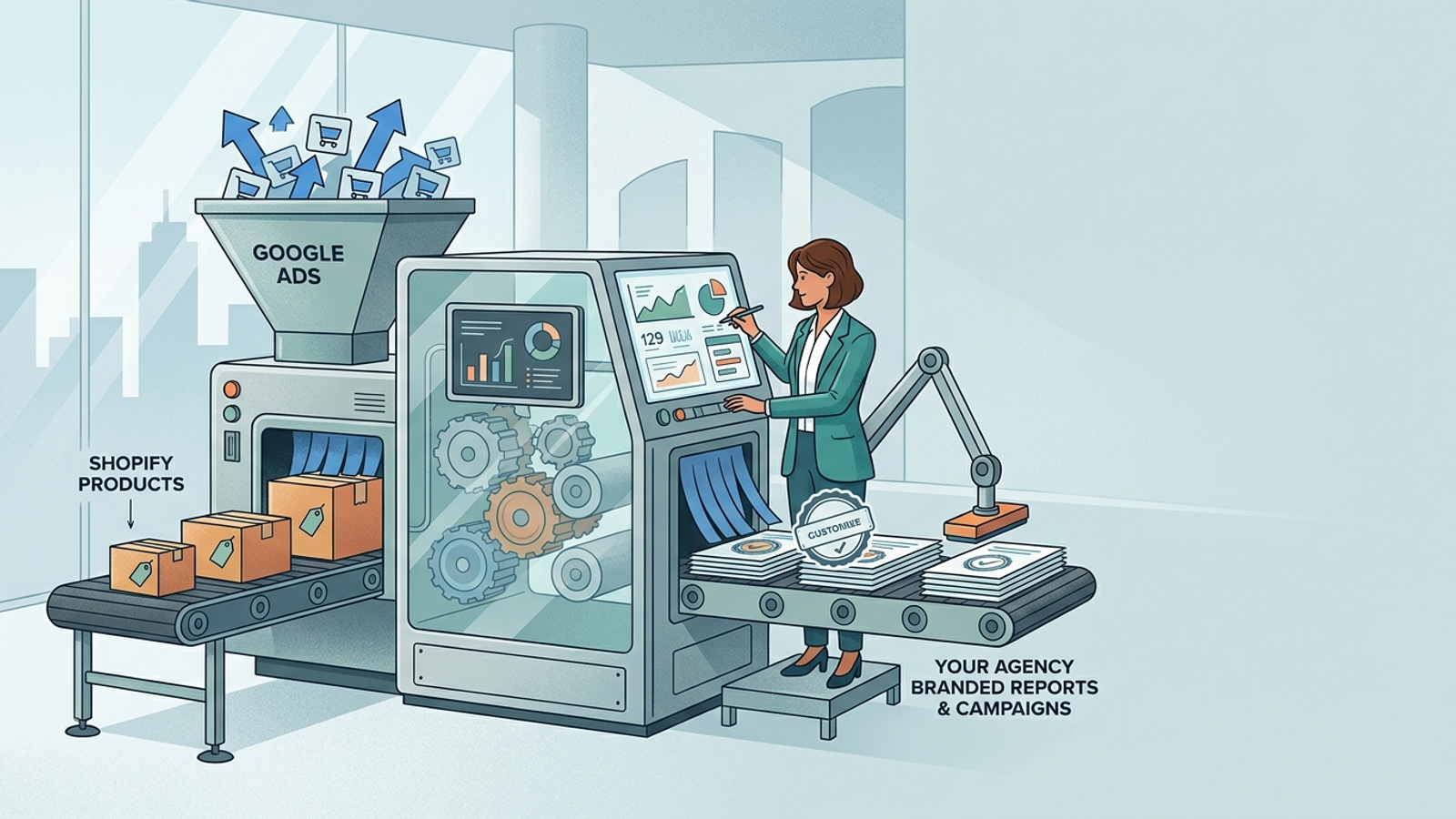
Done-with-you Google Ads management is a collaborative model where an in-house team retains strategic control of their Google Ads account while a proprietary engine handles execution and a senior strategist provides advisory support. It sits between fully self-managed campaigns and fully outsourced management, giving performance marketers the leverage of automation and expert guidance without surrendering ownership of their account.
This guide walks you through how to set up done-with-you Google Ads management for your in-house team, from auditing your current account to building a feedback loop that compounds results over time. By the end, you will have a clear, step-by-step framework for pairing your team with an engine and a strategist so you scale profitably without adding headcount.
Prerequisites: You need an active Google Ads account with live campaigns, someone on your team who understands Google Ads fundamentals, functioning conversion tracking, and a willingness to act on strategist recommendations.
Before You Start: What You Need In Place
Before you bring any engine or strategist into your workflow, confirm three things. First, you have at least one person on your team who can interpret Google Ads data and make decisions based on strategist recommendations. Second, your account is in good standing: no policy violations, no disapproved ads sitting unresolved, no billing issues. Third, your conversion tracking is live and accurate. If any of these are missing, fix them first. An engine amplifies what exists. If what exists is broken, it amplifies the problem.
Step 1. Audit Your Current Account Before Bringing In Any Engine Or Strategist
The first concrete action is to document what you have. You cannot define what to delegate until you know the full picture of your account's current state.
What To Document: Campaign Structure, Conversion Tracking, Attribution
Open your Google Ads account and record every active campaign, its type (Search, Performance Max, Display, Shopping), its daily budget, its bidding strategy, and its primary conversion action. Then open your conversion settings and verify that each conversion action fires correctly, that values are accurate, and that your attribution model matches your business reality. If you are still on last-click attribution for a multi-touchpoint sales cycle, flag that immediately. A good engine will need clean conversion signals to optimize against.
How To Score Your Account Against Best Practices
Walk through a structured checklist. Are your campaigns segmented by intent or product line, or is everything lumped together? Are you running at least three responsive search ad variations per ad group? Do your negative keyword lists exist and get updated? Are your audiences layered correctly? Score each area as green, yellow, or red. This scorecard becomes the first thing you hand to your strategist so they know where the biggest gains live. If you want to understand why audits sometimes fail to improve performance, the short answer is usually that they stop at diagnosis without changing execution. The DWY model solves this by pairing the audit with an engine that acts on findings immediately.
Red Flags That Signal You Need More Than A Tool
If your account has structural issues like campaigns competing against each other, conversion tracking that double-counts, or smart bidding strategies that are clearly optimizing for Google's revenue rather than yours, those are red flags. A standalone tool cannot fix strategic misalignment. You need a strategist who can diagnose the root cause and an engine that can execute the fix at scale.
Step 2. Define What You Want To Own Versus What You Want To Delegate
The in-house team that tries to delegate everything ends up in a DFY arrangement. The team that delegates nothing gains nothing. You need to draw a clear line before onboarding starts.
The In-House Team's Core Competency: Business Context, Offers, And Approvals
Your team knows things no engine or external strategist can infer from data alone: upcoming promotions, product margin differences, seasonal demand shifts, competitive moves in your industry, and what your leadership team considers a successful outcome. Own those inputs. They are your leverage.
What A Strategist Or Engine Should Own: Execution, Bidding, And Structure Changes
Bid adjustments, budget pacing, keyword expansion and pruning, ad copy testing at scale, audience layering, and structural changes to campaign architecture. These are high-frequency, high-volume tasks that consume the majority of an in-house team's time while delivering marginal returns per hour of effort. An engine trained on hundreds of billions in ad spend processes these decisions faster and more consistently than any single person can. A senior strategist reviews the engine's output and catches the edge cases that pure automation misses.
Building A Responsibility Matrix Before You Start
Create a simple two-column document. Column one: "In-house owns." Column two: "Engine plus strategist owns." For each major function (bidding, budget allocation, ad creation, landing pages, conversion tracking, reporting, strategic direction), assign a clear owner. Share this matrix with your strategist on day one. Revisit it at the 90-day mark.
Step 3. Select The Right Engine Plus Strategist Setup
Not all done-with-you Google Ads management setups are equal. What to look for in a Google Ads engine is autonomy depth, reporting transparency, and speed of execution.
What To Look For In A Google Ads Engine: Autonomy Depth, Reporting, Speed
The engine should do more than suggest changes for you to approve. It should execute at a level that compounds. Look for one that handles bidding, pacing, and structural optimization around the clock, not just during business hours. Reporting should show what the engine did, why it did it, and what changed as a result. Speed matters because Google Ads auctions shift by the hour. An engine that reacts daily is already behind.
What To Look For In A Dedicated Strategist: Accountability, Communication, Proactivity
A strategist in a DWY arrangement should not be a passive advisor who sends a monthly PDF. They should proactively flag risks, recommend structural changes, challenge your assumptions when the data warrants it, and be reachable when something breaks. The cadence that works for most in-house teams is a weekly written report on what the engine did plus a strategy call every other week.
With groas, the DWY product pairs a proprietary engine trained on over $500 billion in profitable ad spend with a senior human strategist. The engine runs underneath doing the heavy lifting while the strategist stays in full control. You get a weekly report on exactly what was done plus a strategy call every other week, along with exclusive insights, policy support, and competitor analysis directly from the groas internal team inside Google HQ. Your team stays in the driver's seat. The engine and strategist handle the execution and advisory.
Questions To Ask Before You Commit
Before signing with any provider: What does the engine actually change without human approval? How often does the strategist review the account? What is the minimum commitment? (With groas, it is month-to-month with $0 onboarding. Cancel anytime.) Can you see everything the engine does inside your own Google Ads account? What happens if results decline for two consecutive weeks?
Step 4. Set Up The Feedback Loop Between Your Team And The Strategist
Done-with-you Google Ads management fails when the "with you" part goes silent. The feedback loop is the mechanism that prevents this.
How To Share Business Context The Engine Cannot See
Create a shared channel (Slack, email thread, or whatever your team already uses) and commit to sharing three categories of information in real time: upcoming promotions or pricing changes, new product launches or discontinuations, and any shifts in business goals or margin targets. The engine optimizes against data. Your business context shapes what that data means. When a strategist knows you are about to launch a promotion next Tuesday, they can pre-position budgets and adjust bids before the spike, not react to it after the fact.
Cadence: Weekly Reviews Versus Monthly Reporting Versus Real-Time Alerts
The cadence that works for most teams using a DWY model: real-time alerts for anything that breaks (disapprovals, tracking failures, budget overspend), weekly written reports covering what the engine executed and what shifted, and a strategy call every other week to discuss what is working, what is not, and what to test next. Monthly reporting alone is too slow. By the time you see a problem in a monthly deck, you have already lost four weeks of spend to it.
What Good Collaboration Looks Like At Month 1, Month 3, And Month 6
At month one, expect heavy communication. The strategist is learning your business, calibrating the engine to your account's specific patterns, and your team is learning the rhythm. By month three, the feedback loop should be efficient: less back-and-forth, more proactive recommendations from the strategist, and clear momentum in your core metrics. By month six, the relationship should feel like an extension of your team, where the strategist flags opportunities before you ask and the engine handles execution you no longer think about.
Step 5. Measure Outcomes, Not Activity
The metrics that matter for an in-house plus engine setup are not impressions, clicks, or even click-through rate in isolation. They are cost per acquisition, return on ad spend, and contribution margin after ad spend.
How To Know If The Engine Is Actually Working Versus Just Running
An engine that is "just running" maintains the status quo. An engine that is working shows measurable improvement in efficiency or scale (ideally both) within the first few weeks. Look at week-over-week trends in CPA and ROAS, not just absolute numbers. Flat performance with more spend is scaling. Flat performance with the same spend means the engine is coasting. Your strategist should be able to explain exactly what the engine changed and why those changes matter. If you are getting smart bidding behavior that does not align with your goals, the strategist should catch it and override it.
When To Expand Budget And When To Pull Back
Expand budget when CPA is stable or declining and ROAS is at or above target, not when the engine "suggests" it. Pull back when CPA rises for more than five consecutive days without a clear external cause (seasonality, a competitor entering the auction, a tracking issue). Your strategist should make these calls with you, not for you. That is the DWY difference.
Step 6. Scale Without Adding Headcount
This is where the DWY model earns its keep. A traditional in-house setup hits a ceiling at whatever one person can physically manage in a week. Adding more campaigns, more markets, or more products means hiring another person or burning out the one you have.
With groas, the engine runs 24/7. It does not need a second headcount to manage a second market. It does not slow down when your media buyer takes PTO. The strategist scales their advisory across your expanding account because the engine handles the execution volume. If you want to see what this looks like in practice, this case study shows how a multi-location service business scaled across eight markets without hiring a second manager.
When To Upgrade From DWY To DFY
Many teams start on DWY and upgrade to DFY as they scale. The signal is usually that the founder or in-house lead gets pulled into other priorities, or the account complexity outgrows what your team can oversee even with the engine and strategist doing the heavy lifting. The groas strategist will flag when the timing makes sense. If you are unsure whether DWY or DFY is the right fit, the guidance is straightforward: apply for DFY and groas figures out the right plan on the call.
Common Mistakes In-House Teams Make In The First 90 Days
1. Not sharing business context. The engine optimizes on data. If you do not tell the strategist about your margin structure, your seasonal patterns, or your upcoming product launch, the engine optimizes blind.
2. Overriding the engine without data. If the engine shifts budget away from a campaign you "feel" should be performing, check the numbers before reversing. The engine sees auction dynamics your gut does not.
3. Treating the strategist like a vendor. DWY works when the strategist is treated as a team member, not a contractor you check in with once a month. Share context. Ask questions. Push back when something does not make sense.
4. Measuring activity instead of outcomes. Counting how many changes the engine made last week is irrelevant. What happened to CPA, ROAS, and contribution margin is the only question that matters.
5. Waiting too long to scale. When the data says performance is strong and stable, allocate more budget. In-house teams often leave money on the table by being overly cautious after the first good month.
6. Not revisiting the responsibility matrix. What made sense in month one may not make sense in month four. Revisit who owns what on a quarterly cadence. If you find yourself spending more time approving changes than the strategist spends making them, that is a signal to shift more ownership to the engine and strategist.
How groas Handles This For You
Everything in this guide describes the manual version of setting up done-with-you Google Ads management. With groas DWY, the setup is built into the product. The proprietary engine trained on over $500 billion in profitable ad spend runs underneath your account, executing around the clock. A senior strategist works alongside your team, delivering a weekly report on exactly what was done plus a strategy call every other week. You get exclusive insights, policy support, and competitor analysis directly from the groas internal team inside Google HQ. Onboarding is $0, the commitment is month-to-month, and you can cancel anytime. There are no lock-ins.
Your team stays in the driver's seat. The engine and strategist handle the execution and advisory that would otherwise require hiring multiple people or burning out the ones you already have.
The DWY Checklist For In-House Google Ads Teams
This is the model for in-house teams who want to scale without surrendering control. Audit your account honestly. Draw the line between what you own and what you delegate. Select an engine-plus-strategist combination where the engine runs 24/7 and the strategist is accountable, not advisory. Build a feedback loop that keeps business context flowing. Measure outcomes, not activity. Scale budget when the data says go. Revisit the responsibility matrix every quarter.
If you have someone in-house who knows Google Ads and you want the power of an engine trained on hundreds of billions in profitable ad spend plus a senior strategist, without giving up control, groas DWY is built exactly for this. Get started and see the difference in the numbers within the first few weeks.
Frequently Asked Questions About Done-With-You Google Ads Management
What Is Done-With-You Google Ads Management?
Done-with-you Google Ads management is a collaborative model where your in-house team retains strategic control of your Google Ads account while a proprietary engine handles execution tasks like bidding, pacing, and structural optimization, and a senior strategist provides advisory support. Your team owns business context, approvals, and strategic direction. The engine and strategist own the high-frequency execution that consumes most of a media buyer's week. It sits between fully self-managed campaigns and fully outsourced management, giving you leverage without surrendering ownership.
How Does An In-House Google Ads Team Work With A Strategist?
The in-house team shares business context the engine cannot infer from data: upcoming promotions, margin targets, seasonal shifts, and new product launches. The strategist reviews engine output, flags risks, recommends structural changes, and challenges assumptions when data warrants it. The typical cadence is a weekly written report on what was executed plus a strategy call every other week. Real-time alerts cover anything that breaks. The relationship should feel like an embedded team member, not a vendor you check in with monthly.
What Does Google Ads Management Include In A DWY Setup?
A well-structured DWY setup includes automated bid management, budget pacing, keyword expansion and pruning, ad copy testing at scale, audience layering, campaign structure optimization, weekly performance reports, biweekly strategy calls, real-time alerts for issues like disapprovals or tracking failures, and ongoing competitor analysis. The in-house team retains ownership of business context, offer strategy, and final approvals on major directional shifts.
How Is DWY Different From Hiring A Freelancer Or Agency?
A freelancer works part-time hours and can disappear. An agency often locks you into a 6-12 month contract, charges $5,000 or more in onboarding fees, and rotates staff. With groas DWY, you get a proprietary engine running 24/7 plus a senior strategist, with $0 onboarding and a month-to-month commitment you can cancel anytime. The engine is trained on over $500 billion in profitable ad spend, so execution quality and speed far exceed what a single freelancer or rotating agency media buyer can deliver.
How Do I Know If I Should Choose DWY Or DFY?
DWY fits if you have someone in-house who knows Google Ads and you want to keep your team running the day-to-day with better tooling and senior advisory. DFY fits if you would rather not be involved in execution and want Google Ads fully handled, including landing pages, offers, and creative. If you are unsure, apply for groas DFY. The team figures out the right plan on the call. Many customers start on DWY and upgrade to DFY as they scale or as the founder gets pulled into other priorities.
How Long Before I See Results From A DWY Google Ads Setup?
Most in-house teams working with an engine-plus-strategist model see measurable shifts in CPA and ROAS within the first few weeks. Month one involves heavy calibration and communication. By month three, the feedback loop should be efficient with clear momentum in core metrics. By month six, the relationship should feel like an extension of your team. The timeline depends on your account's starting condition, your budget, and how actively your team participates in the feedback loop.
What Metrics Should I Track In A DWY Arrangement?
Focus on cost per acquisition, return on ad spend, and contribution margin after ad spend. These are outcome metrics. Avoid measuring activity like how many changes the engine made or how many keywords were added. Week-over-week trends in CPA and ROAS tell you whether the engine is genuinely improving performance or just maintaining the status quo. Your strategist should be able to explain every material shift.
Can I Scale To Multiple Markets Without Hiring More People?
Yes. This is one of the primary advantages of the DWY model. The engine runs 24/7 and does not slow down when you add campaigns, markets, or product lines. With groas, a senior strategist scales their advisory across your expanding account because the engine absorbs the execution volume. Scaling traditionally means hiring another media buyer or burning out the one you have. The engine-plus-strategist model removes that bottleneck entirely.
What Happens If Performance Declines In A DWY Setup?
Your strategist should flag declining performance proactively, ideally before you notice it in a dashboard. If CPA rises for more than five consecutive days without a clear external cause like seasonality or a new competitor, the strategist investigates and recommends a course correction with your approval. Real-time alerts should catch tracking failures, disapprovals, or budget overspend immediately. The feedback loop is your safety net.