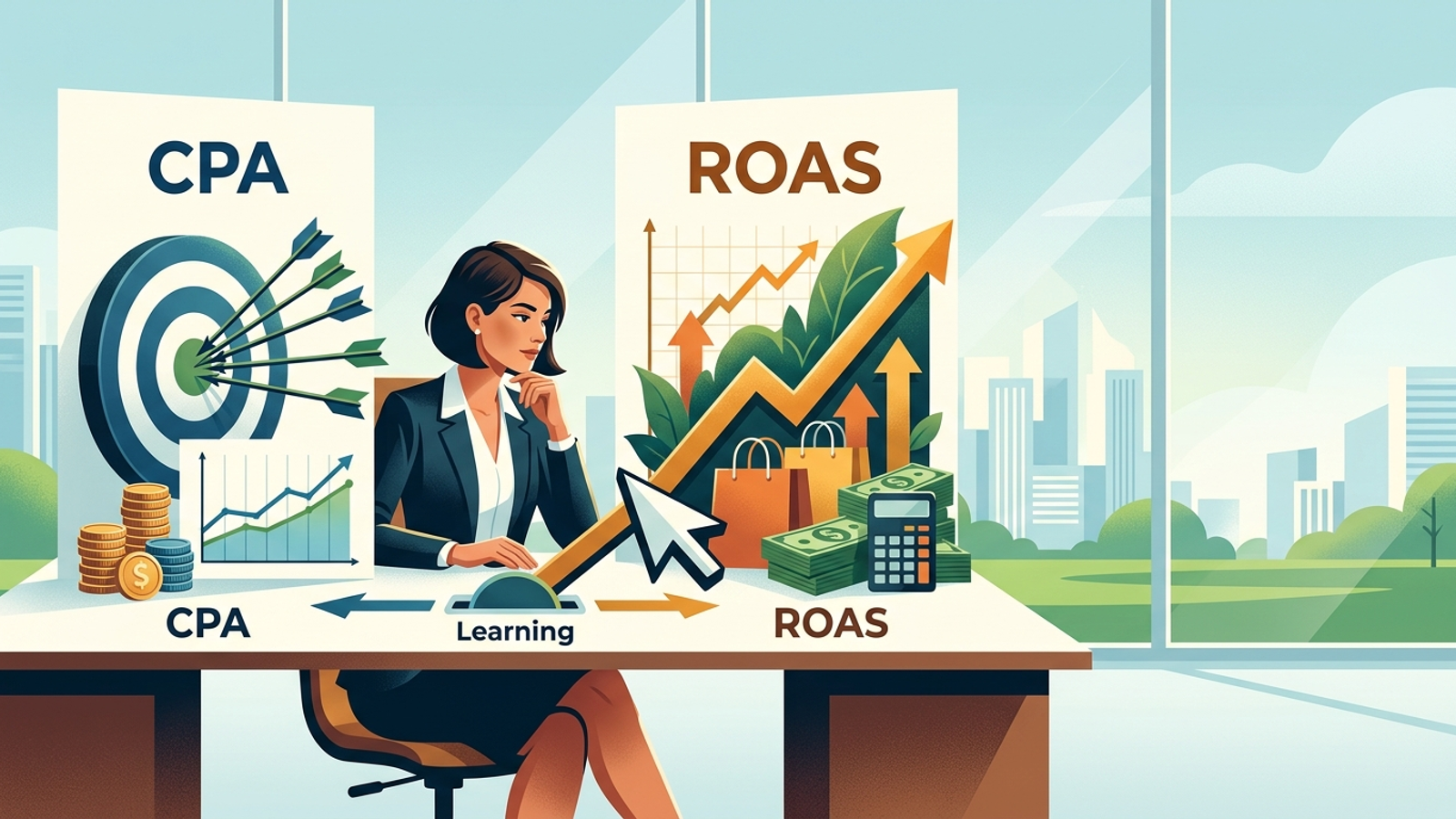
A high Google Ads ROAS is not a sign of strong performance. It is frequently a sign that your account is systematically avoiding growth. When your reported ROAS climbs to 8x, 10x, or higher, the most likely explanation is not that your campaigns are exceptional. It is that your account is only capturing the cheapest, easiest conversions available, the ones that would have happened without any ad spend at all, while actively suppressing the volume that would drive real business growth. A high ROAS in Google Ads often signals a ceiling, not a win. This piece explains why chasing high ROAS kills your Google Ads volume, how Smart Bidding throttles scale when targets are too aggressive, and what serious operators measure instead.
The conventional wisdom says otherwise. Advertisers, agencies, and reporting dashboards all treat rising ROAS as proof of optimization skill. But the math tells a different story, and understanding it is the difference between running an account that looks good in a screenshot and running one that actually grows a business.
What Most People Believe: High ROAS Means Strong Performance
The default mental model is simple. You spend a dollar on Google Ads, you get revenue back, and the higher that multiple, the better you are doing. ROAS is the number your agency puts at the top of the monthly report. It is the first metric most advertisers check in their dashboards. It is the number your CEO will remember from the last board meeting.
This model is not irrational. At a basic level, efficiency matters. Nobody wants to spend $10 to make $5. And Google itself reinforces the primacy of ROAS. Target ROAS is a headline bidding strategy. Google Ads dashboards default to showing conversion value divided by cost. Optimization Score often nudges you to tighten ROAS targets. The entire infrastructure of the platform treats ROAS as the north star.
Agencies reinforce this further. When an agency reports that ROAS went from 4x to 7x, clients hear "we're making you more money." That interpretation feels correct because higher efficiency should mean better outcomes. The agency gets a happy client, the client gets a number to show stakeholders, and everybody nods.
The problem is that this model confuses efficiency with effectiveness. It conflates margin on captured demand with actual business growth. And it creates a perverse dynamic where the easiest way to "improve performance" is to shrink the account down to only the conversions that were going to happen regardless.
The Math: Why 10x ROAS Frequently Means You Are Only Reaching The Easiest Conversions
Here is what actually happens inside most accounts running at a very high reported ROAS.
Brand Traffic Is Doing The Heavy Lifting
Pull your campaign-level data and separate branded search from everything else. In a large number of accounts where reported ROAS is north of 8x, branded campaigns are contributing a disproportionate share of the conversion value. Brand searches convert at extremely high rates because those users already know you. They were going to buy anyway. The ad just intercepted the click, often at a very low CPC.
When branded conversion value is blended into your overall ROAS, it inflates the number dramatically. You might have a 12x ROAS on brand and a 2.5x ROAS on non-brand. Your blended report says 7x, and everyone celebrates. But the real question is: how much of that 12x branded revenue was incremental? The honest answer, in most cases, is a small fraction. We cover this dynamic in depth in our piece on whether you should bid on brand keywords, and the answer is more nuanced than most agencies want to admit.
Smart Bidding Throttles Volume At Aggressive Targets
Google's tROAS bidding strategy does exactly what you tell it to do. When you set a target ROAS of 800%, the algorithm will only enter auctions where it predicts it can hit that target. That means it skips auctions where the expected return is 500% or 400%, even if those conversions would be perfectly profitable for your business.
The result is predictable. Impression share drops. Click volume drops. Conversion volume drops. But the conversions you do get are extremely efficient, so your reported ROAS looks great. You have not optimized performance. You have optimized a metric while constraining the actual output your business cares about: revenue and profit.
This is the ROAS target trap, and it catches advertisers constantly. We have written about the mechanics separately because understanding how target ROAS kills volume is essential before you can fix it.
The Diminishing Returns Curve Is Real
Every Google Ads account operates on a diminishing returns curve. The first dollars you spend capture the highest-intent users at the cheapest cost. Each additional dollar reaches slightly less intent-rich traffic at slightly higher cost. Your marginal ROAS declines as you scale. This is not a bug. It is how paid media works.
A very high blended ROAS means you are sitting at the top of that curve, only capturing the easiest demand. You are leaving the entire middle of the curve untouched, which is exactly where profitable growth lives.
What Strong Performance Actually Looks Like At Scale
Strong Google Ads performance is not defined by the highest possible ROAS. It is defined by the maximum volume of profitable conversions your business can capture.
Marginal ROAS Versus Reported ROAS
The metric that matters is not your blended, reported ROAS. It is the return on the next dollar spent. If your blended ROAS is 6x but your marginal ROAS (what happens when you increase spend by 10%) is 3x, the question is whether 3x is profitable for your business. If your margins support a 3x return, you are leaving money on the table by not scaling.
Serious operators calculate their break-even ROAS based on gross margin and customer lifetime value. Everything above break-even is profit. Everything above break-even that you are not spending on is opportunity cost.
Incremental Revenue Per Additional Dollar Spent
The right way to think about Google Ads performance is incrementality: how much revenue did this ad spend generate that would not have happened without it? This requires isolating branded search, accounting for organic cannibalization, and looking at new customer acquisition rates alongside topline ROAS.
When you start measuring this way, accounts that look incredible at 10x blended ROAS often reveal that only a fraction of their spend is generating truly incremental revenue. Meanwhile, accounts running at a more moderate 3x to 4x ROAS are frequently driving significantly more incremental growth. For a deeper look at why ROAS is the wrong success metric for most accounts, we have broken down the profit-first alternative.
What Realistic ROAS Looks Like When You Are Capturing Real Demand
Google Ads ROAS benchmarks vary by industry, but a few principles are consistent. Ecommerce accounts running aggressively on non-brand Shopping and Search typically see healthy, scaling ROAS in the 3x to 5x range. Lead generation accounts that are actually pushing into new demand often land at 2x to 4x on a blended basis when brand is excluded. If your non-brand ROAS is consistently above 6x to 8x and your volume is flat or declining, that is not good performance. That is a constrained account.
Setting ROAS Targets That Drive Growth Instead Of Restriction
The fix is not to abandon ROAS as a metric entirely. It is to set ROAS targets that balance profitability with scale, and to stop treating higher as universally better.
How To Calculate A ROAS Target That Works
Start with your unit economics. What is your gross margin? What is the lifetime value of a customer versus the first-purchase value? Your minimum acceptable ROAS is the point below which you lose money on a transaction. Your target should sit above that floor but not so far above it that you choke off volume.
For example, if your gross margin is 60% and you need to cover fulfillment and overhead, your break-even might be around 2x. A target of 3x gives you a profit cushion while still allowing the algorithm to compete in a wide range of auctions. Setting a target of 7x when your break-even is 2x is not conservative. It is destructive.
The tROAS Input Most Advertisers Set Wrong
Most advertisers set their tROAS based on what they want rather than what is achievable at scale. They look at their best-performing period, note that ROAS was 8x, and set 800% as the target. This immediately tells Google to only bid on auctions that match the conditions of that peak period, which were usually driven by a spike in brand demand or a seasonal surge. The algorithm cannot replicate those conditions across all auctions, so it stops bidding on most of them.
The correct approach is to start with a target at or slightly below your recent 30-day average ROAS, then adjust downward gradually while monitoring volume and total conversion value. You are looking for the point where lowering the target increases total profit, not just total revenue.
When To Lower Your Target To Unlock Scale
Lower your ROAS target when: total conversion value is flat month over month while spend capacity remains, impression share on high-value campaigns is below 50%, or your marginal cost per acquisition is still well within profitable territory. The goal is to find the efficient frontier, the point where the next dollar spent still generates positive contribution margin, and push spend to that line.
Why Your Agency Reports High ROAS While Your Business Stays Flat
This is the uncomfortable part. Agencies have a structural incentive to report the highest ROAS possible, because it makes their work look effective. But the easiest way to inflate ROAS is not to get better at advertising. It is to reduce spend on anything that is not a guaranteed conversion.
The Agency Playbook For Inflated ROAS
An agency can increase reported ROAS by focusing spend on branded search, tightening tROAS targets to suppress non-brand volume, layering in remarketing that recaptures users who were already converting organically, and cutting campaigns that are generating new demand at a lower but still profitable ROAS. None of these make your business more money. All of them make the report look better.
How To Audit Your Own Account
Pull a conversion report segmented by campaign type and search term category. Separate brand from non-brand. Look at non-brand ROAS and non-brand conversion volume trends over the last six months. If non-brand volume is declining while blended ROAS is climbing, your account is being optimized for a metric, not for your business. This is also worth checking against how an ecommerce brand rebuilt around margin instead of revenue to see what a healthier approach looks like in practice.
What To Measure Instead Of (Or Alongside) ROAS
ROAS should not be your primary performance metric in isolation. Here is what belongs next to it or above it in your hierarchy:
Incremental CPA. What does it cost to acquire a customer who would not have bought without the ad? This requires holdout testing or geo-experiments, but even a rough estimate is more useful than blended ROAS.
Contribution margin per conversion. Not all conversions are equal. A $200 sale at 20% margin is worth less than a $100 sale at 60% margin. Bidding strategies that optimize for revenue treat them as equal. Margin-aware optimization does not.
New customer acquisition rate. What percentage of your Google Ads conversions are net-new customers versus repeat buyers? If 70% of your "conversions" are returning customers clicking branded ads, your ROAS is mostly measuring retention, not acquisition.
Total profit from Google Ads. Revenue minus ad spend minus COGS minus fulfillment. This is the number your CFO cares about, and it often moves in the opposite direction of ROAS when an account is scaling correctly.
How groas Operationalizes Growth-First ROAS Management
This is where the rubber meets the road. Understanding that high ROAS can be a trap is one thing. Operationalizing the fix is another, because it requires constant recalibration of bidding targets, real-time monitoring of marginal returns, and the willingness to sacrifice a vanity metric in service of actual profit growth.
groas approaches this differently depending on who you are. If you are a business that wants Google Ads fully handled, groas runs everything end-to-end under the DFY model: a dedicated senior strategist owns every decision while a proprietary engine trained on over $500 billion in profitable ad spend executes around the clock. That strategist is not optimizing for a pretty ROAS number on a monthly report. They are optimizing for total profitable revenue, including rebuilding landing pages and offers when the bottleneck is post-click, not pre-click.
If you have an in-house team that knows Google Ads and you want to keep driving, groas's DWY model pairs that same engine with a strategist who works alongside your team. You stay in control while the engine handles the execution that a human cannot physically keep up with, like continuously recalibrating tROAS targets across hundreds of ad groups based on real-time marginal return data.
And if you are an agency managing client accounts, groas's DIY product gives your media buyers direct access to the engine so they can scale their client book without the bottleneck of manual execution. You keep your brand, your clients, and your margin. The engine runs underneath.
The core difference versus your current setup is straightforward. A traditional agency or a solo media buyer is capped at whatever one person can physically manage in a week. They will default to safe, high-ROAS strategies because it keeps the client happy and reduces their workload. groas puts a senior strategist on top of an engine that does not stop when a human runs out of hours, so the account is continuously pushed toward the efficient frontier of profitability and volume. No onboarding fees. Month-to-month. Cancel anytime. groas earns the next month by performing, not by locking you in.
The Thesis, Restated
A very high Google Ads ROAS is not something to celebrate uncritically. It is something to interrogate. In most accounts, a climbing ROAS alongside flat or declining conversion volume is direct evidence that the account is being managed for a metric rather than for business outcomes. The fix is not complicated in theory: calculate your true break-even, set targets that allow the algorithm to compete for profitable volume you are currently missing, and measure what actually matters, which is incremental profit, not blended efficiency.
In practice, executing this requires an engine that can continuously optimize at a level of granularity and speed that no human team can match, paired with a strategist who understands the difference between looking good and growing. That is exactly what groas builds. Whether you want it fully managed, collaborative, or powering your agency's execution, the starting point is the same: stop letting a high ROAS number trick you into standing still.
Running DFY? Apply here and groas figures out the right plan on the call.
Running DWY with your in-house team? Get started and pair your team with the engine.
Running an agency? Start your 7-day free trial and see what the engine does for your clients.
Is A High ROAS Always Bad In Google Ads?
No. A high ROAS is not inherently bad. It becomes a problem when it is paired with flat or declining conversion volume, because that combination typically means the account is only capturing easy, low-incremental conversions like branded search traffic. A high ROAS on non-brand campaigns at meaningful volume is genuinely strong performance. The key is distinguishing between an efficient, scaling account and a constrained one that looks good on paper while leaving profitable demand untouched.
What Is A Good ROAS For Google Ads In 2026?
A "good" ROAS depends entirely on your unit economics. For ecommerce, non-brand ROAS in the 3x to 5x range is typically strong when paired with growing volume. For lead generation, 2x to 4x on non-brand is often healthy. The right target is one calculated from your gross margin and customer lifetime value, set above break-even but low enough to allow Smart Bidding to compete in auctions that drive incremental growth. Anything dramatically above that floor likely signals the account is throttling volume.
Why Does My Google Ads Volume Drop When I Raise My ROAS Target?
When you increase your tROAS target, Google's Smart Bidding algorithm narrows the pool of auctions it enters. It will only bid on impressions where its predicted conversion value meets the higher threshold. This means fewer impressions, fewer clicks, and fewer conversions. The conversions you do get are more efficient, but total revenue and profit often decline. This is the core mechanism behind why high ROAS kills Google Ads volume.
How Do I Know If My ROAS Is Inflated By Brand Traffic?
Segment your conversion data by campaign type and search term. Separate branded search campaigns from non-brand campaigns and compare the ROAS and conversion volume for each. If your branded ROAS is 10x or higher and your non-brand ROAS is significantly lower, your blended number is being pulled up by traffic that likely would have converted organically. Running incrementality tests on branded keywords can reveal how much of that revenue is truly driven by ads.
Should I Lower My ROAS Target To Scale Google Ads?
Yes, in many cases lowering your tROAS target is the most direct lever for increasing profitable volume. The key is to lower it gradually while monitoring total conversion value and contribution margin, not just ROAS. If your break-even ROAS is 2x and you are targeting 7x, there is likely a large pool of profitable conversions between 3x and 6x that the algorithm is currently ignoring. groas handles this calibration continuously through its proprietary engine, adjusting targets in real time across ad groups to find the efficient frontier where profit is maximized at scale.
What Should I Measure Instead Of ROAS In Google Ads?
Measure ROAS alongside incremental CPA (cost to acquire customers who would not have converted otherwise), contribution margin per conversion (accounting for product-level margins, not just revenue), new customer acquisition rate, and total profit from the channel. These metrics together give a far more accurate picture of whether Google Ads is actually growing your business or just efficiently capturing demand that already exists.
How Do Agencies Inflate Google Ads ROAS Numbers?
Agencies can inflate ROAS by concentrating spend on branded search, tightening tROAS targets to suppress lower-efficiency but still profitable non-brand campaigns, relying on remarketing to re-engage users who would have converted organically, and cutting prospecting campaigns that generate new demand. These tactics improve the reported metric while reducing the total value Google Ads delivers to the business.
What Is Marginal ROAS And Why Does It Matter?
Marginal ROAS is the return on the next dollar of ad spend, as opposed to the blended average across all spend. It matters because every account operates on a diminishing returns curve. Your first dollars capture the highest-intent users; each additional dollar reaches less ready buyers at higher cost. Understanding marginal ROAS tells you whether increasing spend will generate profitable returns, even if it lowers your blended ROAS. groas's engine monitors marginal returns continuously and adjusts bidding to push spend to the point where the last dollar still generates positive contribution margin.
Can I Scale Google Ads Profitably With A Lower ROAS?
Absolutely. A lower blended ROAS at higher volume often generates more total profit than a high ROAS at low volume. If your break-even is 2x and you move from 7x ROAS on $10,000 spend to 4x ROAS on $30,000 spend, your total profit increases significantly even though the efficiency metric looks worse. The business outcome, which is profit, improved. The vanity metric, which is ROAS, declined. Serious operators optimize for the former.
How Does groas Prevent ROAS Targets From Killing Volume?
groas's proprietary engine, trained on over $500 billion in profitable ad spend, continuously recalibrates bidding targets at a granularity and speed that manual management cannot replicate. Rather than setting a single static tROAS across an account, the engine evaluates marginal returns at the ad group and product level in real time. In the DFY model, a dedicated senior strategist owns the strategy and ensures the account is being pushed toward maximum profitable volume, not maximum ROAS. In the DWY model, your team stays in control while the engine and a strategist handle the execution and calibration. The result is an account that scales to the efficient frontier instead of shrinking to a flattering number.